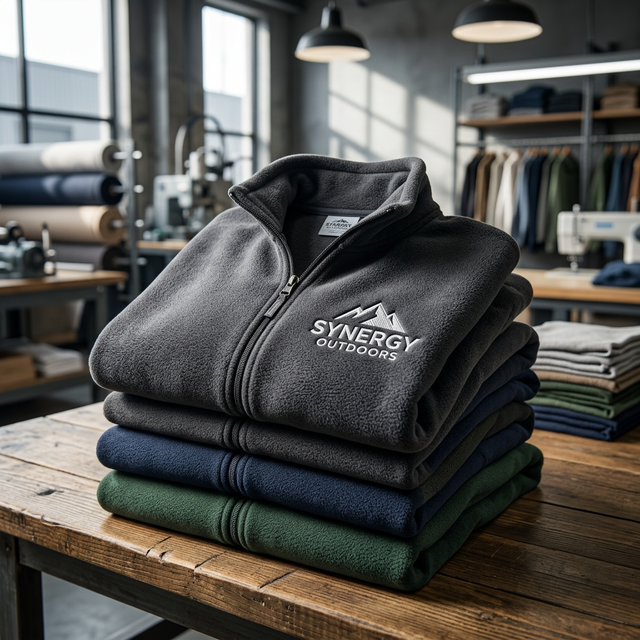
Sourcing bulk fleece jackets with custom embroidery seems straightforward—until you face distorted logos, puckered fabric, or inconsistent sizing across a 5,000-piece order. The difference between a successful run and a costly mistake lies entirely in the relationship between the fleece weight and the embroidery digitizing process. Here is what every B2B buyer needs to evaluate.
What It Really Means
**The Core Issue: Fleece Embroidery Stabilization**
Fleece embroidery stabilization is the critical manufacturing process of using specialized backing materials (cut-away or tear-away stabilizers) and specific digitizing techniques (like a "knock-down" stitch underlay) to provide a firm foundation for the embroidery thread.
Because fleece is a stretchy, textured knit fabric, sewing directly onto it without stabilization causes the stitches to pull the fabric inward. This results in permanent puckering and a distorted logo. A properly stabilized embroidered fleece will maintain its shape and crisp design even after repeated industrial washing.
I review inquiries every week from buyers asking: "What's the absolute lowest price for 1,000 embroidered fleece jackets?"
But the buyers who actually scale their brands—the ones who don't spend their holidays apologizing for late shipments—ask a different question.
They ask: "How does your technical team stabilize the fleece backing to prevent logo distortion after washing?"
Sourcing bulk embroidered fleece isn't just about buying a garment and slapping a logo on it. You are engineering a product. The needle tension of the embroidery machine has to perfectly match the density of the knit fabric.
The front of the jacket is your sales pitch. The back of the embroidery is the truth.
Fleece presents a unique challenge because of its pile (the textured surface). If a manufacturer uses a standard flat-woven digitizing file on a high-pile fleece without proper underlay stitching, your logo will sink right into the fabric. It looks patchy and amateur. And if they cut corners on the stabilizer backing? The fabric will permanently pucker around the design after the first wash.
When we process orders for 50,000+ pieces at Fominte, our first step isn't touching the fabric. It's testing the interaction between the specific fleece weight (e.g., 280gsm vs 320gsm) and the density of the client's logo.
We don't do pressure sales. If you need time to evaluate suppliers, take your time. Good partnerships aren't built on urgency. But whether you work with us or another manufacturer, you need to make sure you are asking the right technical questions before you sign the PO.
Step-by-Step Guide
Step 1: Obtain a Physical Strike-off
📦 Materials: Physical Sample
Never approve a bulk order of 5,000+ pieces based on a digital mockup alone. Always demand a physical "strike-off" (a sample of the embroidery on the exact fleece fabric).
⚠️ Important Notes: Evaluate the tension on the back. If it feels excessively stiff or you can see the fabric pulling, reject it.
Step 2: Verify the Fleece Weight (GSM)
📦 Materials: Specification Sheet
Confirm the grams per square meter (GSM). A 280gsm microfleece requires a completely different digitizing approach than a 380gsm heavy polar fleece.
⚠️ Important Notes: Lighter fleece is more prone to needle-cutting if the stitch density is too high. Ensure the supplier adjusts the file accordingly.
Step 3: Check the Backing Material Type
📦 Materials: Strike-off Sample
Inspect the inside of the jacket behind the logo. For fleece, a high-quality cut-away stabilizer is almost always mandatory.
⚠️ Important Notes: If the supplier uses a cheap tear-away stabilizer on stretchy fleece to save pennies, the logo will eventually warp.
Step 4: Request Wash Test Results
📦 Materials: Supplier Report / DIY
Wash the sample 3-5 times in industrial conditions to test for shrinkage differential between the thread and the fleece.
⚠️ Important Notes: This is where most cheap embroidery fails. The puckering often only appears after the fabric relaxes in the wash.
When to Use & Avoid
Microfleece (Under 250gsm)
✅ Use When
- Corporate uniforms
- Mild climates
- Indoor staff apparel
⚠️ Avoid When
- Heavy duty outdoor workwear
- Complex, high-density logos
Polar Fleece (280gsm - 320gsm)
✅ Use When
- Classic outdoor retail
- School spirit wear
- Versatile layering
⚠️ Avoid When
- Extreme cold weather environments
Heavyweight Fleece (350+ gsm)
✅ Use When
- Construction crew uniforms
- Winter outerwear
- Heavy-duty applications
⚠️ Avoid When
- Budget promotional giveaways
- Fitted athletic wear
Comparison
| Feature |
Direct Embroidery on Fleece |
Woven Patch Sewn on Fleece |
Heat Transfer on Fleece |
| Setup Cost |
Moderate (Digitizing fee) |
High (Patch mold/setup) |
Low (Print setup) |
| Durability |
Excellent (Lasts life of garment) |
Excellent |
Poor on high-pile fleece (May peel) |
| Look & Feel |
Premium, integrated, professional |
Classic, rugged, distinct edge |
Flat, often looks cheap on textured fabric |
| Best For |
Corporate logos, simple text, 1-3 colors |
Complex crests, detailed artwork, high-pile fleece |
Quick promotional items (Not recommended for retail) |
| Volume Efficiency |
Highly scalable for 10K+ runs |
Scalable, requires two-step assembly |
Fastest for small runs, problematic at scale |
⚡ Common Mistakes to Avoid
Using the wrong stabilizer
❌ Consequence: The fabric puckers around the logo permanently after the first wash, ruining the jacket's appearance.
✅ Solution: Insist that the manufacturer uses a medium-to-heavyweight cut-away stabilizer for all fleece embroidery orders.
Skipping the knock-down stitch
❌ Consequence: The embroidery thread sinks into the plush surface of the fleece, making the logo look patchy and illegible.
✅ Solution: Require your digitizer to program a specialized underlay stitch pattern that flattens the fleece pile before the main design is sewn.
Reusing a file digitized for cotton shirts
❌ Consequence: The stitch density is too high for the knit structure of fleece, causing "needle cutting" (holes along the edge of the logo).
✅ Solution: Always pay to have the logo specifically re-digitized for the exact fleece fabric you are purchasing. Do not use generic files.
Everything You Need to Know
Can you embroider very fine text on high-pile fleece?
Generally, no. The texture of heavy fleece makes letters under 1/4 inch tall difficult to read as they get lost in the pile. If you have fine text, we recommend simplifying the logo or using a woven patch instead.
Why do you charge a digitizing fee when another supplier offers it for free?
As our Head of Sales, Eric, says: "You usually get what you pay for in the digitizing file." Free digitizing often means an automated software conversion that doesn't account for fabric stretch or pile. We use human digitizers who engineer the file specifically for fleece, preventing thousands of dollars in ruined garments.
What is the standard production lead time for bulk embroidered fleece jackets?
For a standard order of 5,000 pieces using our core fleece inventory, expect 25-35 days for production after the strike-off sample is approved. During peak seasons (September-October), add an additional 10-15 days. "The first to commit gets the first pick" regarding production slots.
Conclusion
Sourcing bulk fleece jackets with custom embroidery is an investment in your brand's physical presence. It is easy to be seduced by a supplier quoting a dollar less per unit, but that savings evaporates the moment a client returns a distorted, puckered jacket.
By evaluating the digitizing process, understanding stabilization, and demanding physical strike-offs, you protect your supply chain and your reputation.
At Fominte, our capacity supports 50,000+ yards of consistent quality, and we test the embroidery architecture before we ever touch the production line. If you're looking for a manufacturing partner who cares as much about the back of the stitch as the front of the jacket, let's talk.
Stephen
Stephen is the Head of Brand & Strategy at Fominte. He bridges the gap between client expectations and factory-floor realities, ensuring B2B buyers ask the right questions to build resilient supply chains.
Head of Brand & Strategy at Fominte
.png?w=970&h=250)