.png?w=970&h=250)
Last week, a designer from Los Angeles sent me an email. She'd just received lace samples from three different suppliers, and the price difference was dramatic. The cheapest one was a third of the most expensive. Her question: "Which one should I choose?"
I forwarded the samples to Shawn. He glanced at the photos and smiled. "Tell her to do the light test."
Two days later, she replied: "The cheapest sample? I could see daylight through it when I pulled it apart. I get it now."
Price is the starting point, not the finish line. Today I want to share the framework Fominte uses to evaluate suppliers. We've refined it over 35 years.
Why Price Alone Will Mislead You
Here's the truth: most buyers start (and end) with price comparison. It makes sense. It's tangible, comparable, fits on a spreadsheet. But here's what I've learned working alongside Shawn and Eric: price tells you what something costs, not what it's worth.
Every time a buyer asks Eric for a "cheaper option," his answer is the same: "We can adjust specifications, but we won't compromise on craftsmanship. That's not negotiable."
That's not sales talk. That's 35 years of watching "cheap" turn expensive when you factor in returns, reputational damage, and lost customers.
So if price isn't the deciding factor, what should you look for? Let me walk you through five dimensions we use at Fominte.
The Five-Dimension Framework
1. Structural Integrity: The Foundation Test
The Pain Point:
You've probably experienced this. The sample looks perfect, but when the bulk order arrives, things start falling apart after a few washes. Edges fray, embroidery loosens, the whole piece loses its shape.
How to Test It:
Here are three tests you can do yourself, right now, with any sample:
① The Light Test
Hold the fabric up to a light source and gently stretch it. If you see significant light coming through the weave, that's a red flag. Quality lace should maintain its structure under tension.
② The Stretch-Recovery Test
Gently pull the fabric in different directions. Does it snap back to its original shape immediately? Or does it stay distorted? Good lace has memory. It returns to form.
③ The Edge Inspection
Look closely at how the edges are finished. If you see a simple overlock stitch (what we call "单独锁边"), be cautious. The strongest edges use French seams, bound edges, or wrapped finishes.
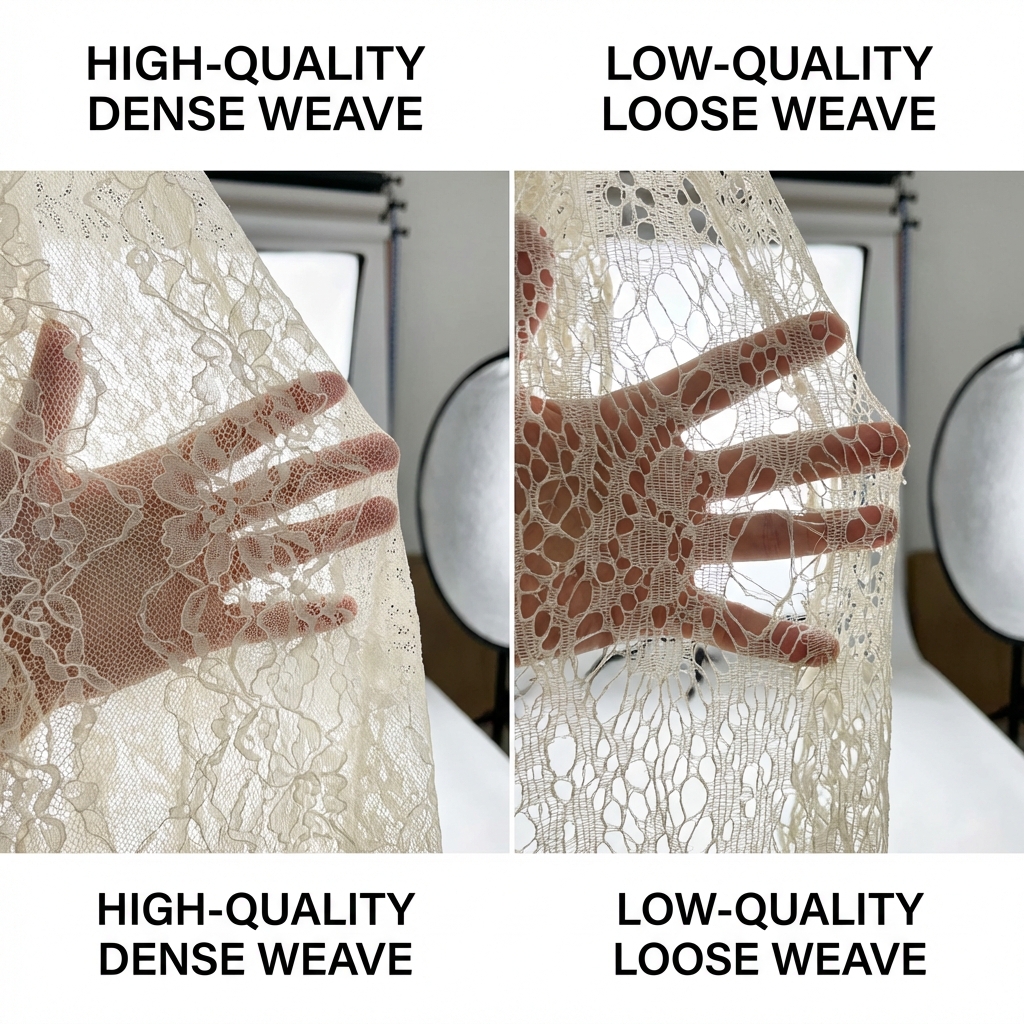
What We Do at Fominte:
All of our lace fabrics must pass a tension test where the recovery rate meets our internal benchmark. We don't use the weakest edge finish methods. Every edge is either bound or French-seamed, especially on pieces that will undergo repeated stress.
💡 Shawn's Pro Tip:
"Here's a quick test I taught our QC team: run your fingernail lightly across the surface. If fibers immediately pill or shed, the yarn twist is insufficient. That fabric won't survive three wash cycles."
2. Process Consistency: Can They Repeat Success?
The Pain Point:
The sample is flawless. The bulk order? Color variance, pattern misalignment, inconsistent density. Every batch feels like a gamble.
How to Test It:
① Request Multi-Batch Samples
Don't settle for one sample. Ask for samples from different production batches of the same design. Are they identical? Or do you notice variations?
② Ask About Their QC Process
Where are the quality checkpoints? Raw material inspection? In-process monitoring? Final inspection? What's their rejection rate? How do they handle defects?
A supplier who can't articulate their QC process probably doesn't have one.
③ Request Photos of Past Orders
Ask to see actual photos of completed orders they've shipped, not just portfolio shots. This gives you a real sense of output consistency.

What We Do at Fominte:
Our QC process has multiple checkpoints, from yarn inspection to finished goods. Shawn built this system when he was still a QC inspector himself. He knows every point where things can go wrong, so he designed the system to catch problems early.
Our customer re-order rate speaks to this: buyers come back because they know batch two will look like batch one.
💡 Eric's Pro Tip:
"Here's something I tell new buyers: if a supplier won't show you real factory floor footage, not just the sample room, be careful. Real factories are proud to show their production lines. That's where the proof lives."
3. Material Traceability: Know What You're Actually Buying
The Pain Point:
The label says "100% cotton," but the hand feel tells a different story. You suspect blended synthetics, but you have no way to verify.
How to Test It:
① Request Third-Party Testing Reports
Ask for OEKO-TEX, SGS, or other certified lab reports on fiber content. If they hesitate or can't provide them, that's a signal.
② Ask About Raw Material Sources
Where does their yarn come from? Which dyehouse do they use? Suppliers with traceable supply chains will answer these questions readily. Those who can't often rely on inconsistent or low-grade inputs.
③ Burn Test (If Possible)
Different fibers burn differently. Natural fibers like cotton and wool produce ash and smell like burning hair. Synthetics melt and smell chemical. It's crude, but it works.
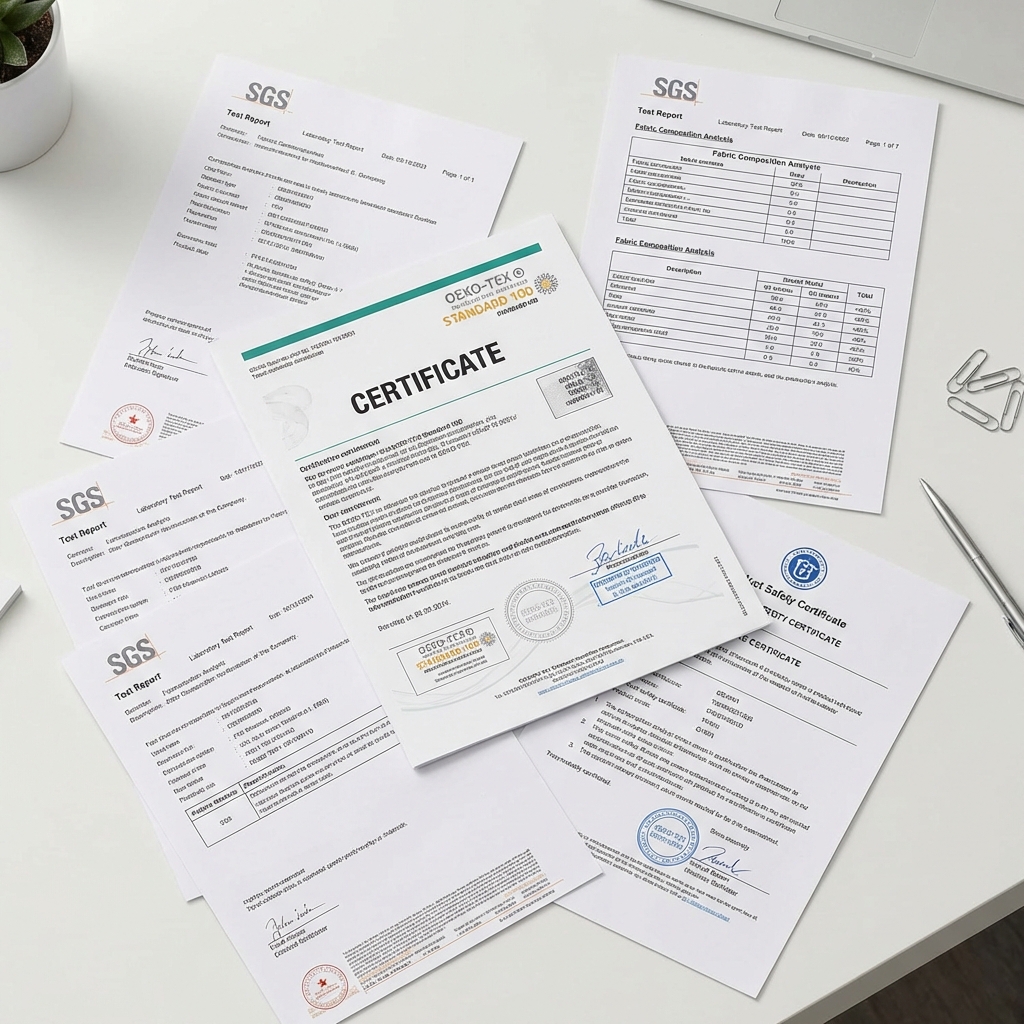
What We Do at Fominte:
Every fabric we produce can be traced back to its yarn supplier and dyehouse. We provide certifications not because clients demand them, but because transparency is part of our standard.
💡 Shawn's Pro Tip:
"Shawn once caught a raw material supplier passing off regular viscose as Tencel. His test? Wet strength. Tencel retains almost all its strength when wet; regular viscose weakens significantly. That kind of detail? Only someone who truly understands fabric would know to check."
4. Communication Quality: The Bridge Test
The Pain Point:
Emails disappear into the void. Replies are vague or robotic. When you ask technical questions, the salesperson can't answer and promises to "check with the factory" but never follows up.
How to Test It:
① Ask Specific Technical Questions
Don't just ask "What's your MOQ?" Ask things like: "What's the embroidery stitch density per square inch?" or "Do you use water-soluble or heat-away stabilizer?" If they can answer these immediately (or connect you to someone who can), that's a good sign.
② Measure Response Speed
Do you get a substantive reply within 24 hours? Or does it take multiple follow-ups?
③ Observe Proactivity
Do they just answer your questions, or do they suggest better solutions based on your project goals?
What We Do at Fominte:
We respond to technical inquiries within 24 hours, not with template replies, but with real guidance from Eric's team or our engineers. If our sales team can't answer immediately, they loop in the person who can. We don't gatekeep information.
💡 Stephen's Observation:
"One of my main jobs as Head of Brand is making sure communication doesn't get garbled. When you ask a question, it reaches the person who can answer it. No layers of forwarding, no canned responses. Eric says it best: 'The client's time is more valuable than our ego.'"
5. Partnership Mindset: Are They In It for the Long Haul?
The Pain Point:
The supplier only cares about large orders. Small test orders get ignored or deprioritized. There's no design collaboration. They're just order-takers.
How to Test It:
① Ask About MOQ Flexibility
Are they willing to work with smaller quantities for new clients? Or is it "1,000 yards minimum, no exceptions"? A supplier confident in their quality will be willing to prove it with a smaller initial run.
② Observe Their Advisory Role
Do they ask about your brand positioning? Your target customer? Do they suggest fabrics or techniques that might work better for your vision? Passive suppliers wait for specs. Partners engage in the design process.
③ Understand Their Client Base
Ask about their typical client profile and average relationship length. If they mostly work with one-time buyers, that tells you something.
What We Do at Fominte:
Our sweet spot is buyers who think three seasons ahead, not three weeks. We're selective about who we work with, not because we're elitist, but because we're built for long-term relationships, not transactional volume.
💡 Eric's story:
"Eric once received a $100,000 order, but the client wanted us to reduce a key quality standard by 20% to cut costs. Shawn refused. 'We can adjust specs, but we won't compromise on process.' That client went elsewhere. Three months later, they came back. Their chosen supplier had failed on quality. We ended up working together after all, but on our terms."
Bonus: Red Flags and Green Lights
🚩 Why Great Suppliers Often Aren't on Alibaba
Shawn made a deliberate choice years ago: we don't operate on platforms like Alibaba. It's not arrogance. It's about rhythm. Those platforms run on price competition and transactional speed. We run on partnership and quality consistency.
The best factories don't need to compete in a race to the bottom. We'd rather build relationships with 50 serious buyers than field 500 price-shopping inquiries a day.
✅ Certifications That Actually Matter
Not all certifications are equal. OEKO-TEX, GOTS, and ISO audits from recognized bodies mean something. Vague "quality certifications" with no third-party verification don't.
✅ Willingness to Show Equipment
Factories that are proud of their equipment will show it. Embroidery machines, cutting tables, QC stations. If they're invested in their tools, they're invested in their output.
Your Evaluation Checklist
Here's a summary you can save:
✅ Structure Test: Do light test and stretch-recovery test on samples
✅ Consistency Test: Request multi-batch samples; ask about QC checkpoints
✅ Traceability Test: Ask for third-party material certifications
✅ Communication Test: Measure response speed and technical depth
✅ Partnership Test: Observe flexibility, proactivity, advisory engagement
✅ Price Sense: Don't just compare numbers. Ask "Why this price?"
Final Thoughts
Evaluating a supplier isn't about finding the cheapest option. It's about finding the right partner. Price reflects cost structure; quality reflects values.
If you choose based on price alone, you'll pay for it later in returns, reputation, and lost customers. If you choose based on the framework above, you're not just buying fabric. You're buying reliability, consistency, and peace of mind.
Let's Talk
If you're looking for a lace fabric or embroidered garment supplier, you don't need a 15-page tech pack. Send a sketch or a sample photo to info@fominte.com and mention you read this article.
I'll make sure Eric's team gets back to you within 24 hours. Not with a template, but with specific guidance for your project.
We're not for everyone. But if you care about quality, transparency, and long-term partnership, let's have a conversation.
— Stephen
Head of Brand & Strategy, Fominte
