.png?w=970&h=250)
Anti-Pill Fleece: Test Methods, Grade Standards, and What Buyers Should Verify
What It Really Means
Anti-pill fleece is fleece engineered to resist surface fiber balling during wear and washing. The industry measures resistance using standardized tests, primarily ISO 12945, and rates results on a 1-to-5 scale. But knowing the test exists isn't enough. As a buyer, you need to know what grade your product demands, how to read the report, and what separates a reliable supplier's data from a PDF that looks official but proves nothing.
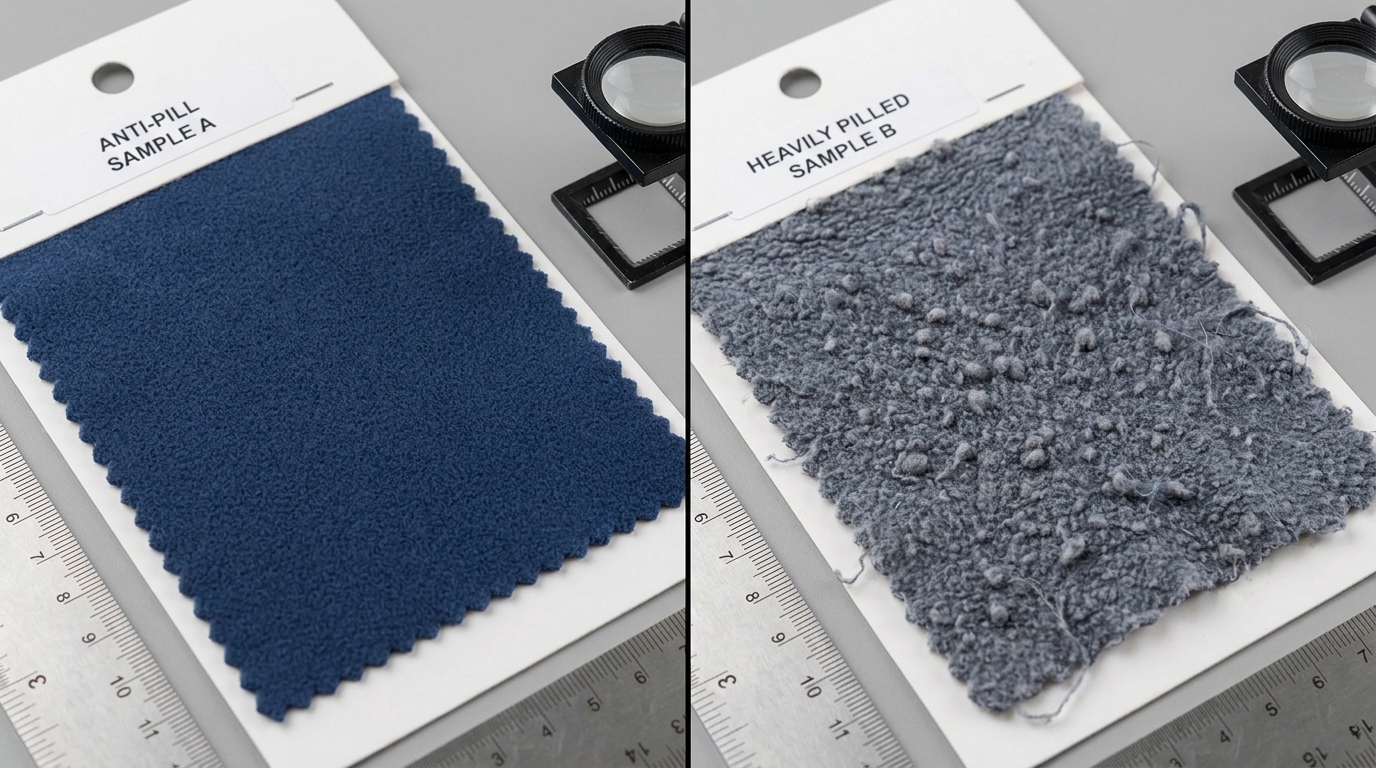
What Anti-Pill Fleece Actually Means (And Why It Matters for Your Brand)
Pilling starts with fiber migration. When fleece rubs against itself, other garments, or a seatback, friction pulls loose fiber ends to the surface. These fibers tangle into small balls — pills. On cotton, weak fibers break off and the pills disappear. On polyester, the fibers are strong enough that pills stay attached, grow larger, and make a garment look worn out after three washes.
This is why fleece, which is almost always polyester-based, requires deliberate anti-pill engineering. The fibers aren't going to self-cleaning like cotton does.
For brands, the damage goes beyond appearance. Retail buyers track return rates by defect category, and pilling consistently ranks in the top five reasons for garment returns in knitwear and fleece categories. A European mid-market brand we work with told us they once lost a major retail listing because a fleece jacket line pilled within the first month of sale. The retailer's quality team flagged it, and the brand spent six months rebuilding trust.
The physics are straightforward. Fleece has a raised pile surface, thousands of cut fiber loops standing upright. That pile gives fleece its soft hand-feel and insulation. But those upright loops are also vulnerable to abrasion. Some pilling will always occur. The real question is whether the fabric is engineered to minimize it, and whether the pills that do form are weak enough to shed naturally.
Anti-pill treatments work at different stages of this process. Some stabilize the fiber structure before pills form. Others weaken the fiber bond so pills detach quickly. The best approach combines both, and the test standards tell you exactly how well each method performs.
The Three Main Pilling Test Methods for Fleece
Not all pilling tests are equal, and the method your supplier uses matters more than most buyers realize. Each test simulates a different type of wear, and the results aren't interchangeable.
ISO 12945-1: The Pilling Box Method
This test places fabric samples in a cork-lined rotating box. The samples tumble randomly, simulating the kind of abrasion you'd see in casual wear — fabric rubbing against itself in a washing machine or during normal movement. It's the preferred method for knitted fabrics and loose-structure fleece because it doesn't apply excessive pressure. Most garment brands use this method for fleece apparel testing.
ISO 12945-2: The Modified Martindale Method
The Martindale tester rubs fabric against an abradant in a controlled circular pattern under a specific load (typically 415g for fleece). This method applies more pressure than the pilling box, making it better for dense or tightly woven fabrics. For heavyweight fleece used in upholstery or structured outerwear, this test provides more realistic simulation of sustained pressure contact.
ASTM D3512: The Random Tumble Pilling Test
This is the method most commonly specified for fleece in the North American market. Samples tumble in a chamber with cork or rubber balls, creating fiber entanglement that mimics real-world wear. The test runs for 30 to 60 minutes, and results are visually rated against standard photographs. ASTM D3512 is particularly relevant for fleece because the tumble action closely matches how fleece garments behave in dryers and during active wear.
A fabric that scores Grade 4 on the pilling box test might score Grade 3 on the Martindale test. The mechanical forces are different. When a supplier gives you a test report, the first thing you should check is which standard was used and whether it matches what your retail market or brand standard requires.
We test our fleece using both ISO 12945-1 and ASTM D3512, depending on the destination market. For European clients, ISO standards are typically required. For North American brands, ASTM is the norm. If a supplier only provides one test method, ask why — and ask whether the results would hold up under the other standard.
How to Read the 1-to-5 Grading Scale (And What Each Grade Means for Your Product)
The ISO 12945 grading scale runs from Grade 1 (severe pilling) to Grade 5 (no visible change). Most buyers know this. Fewer buyers know what each grade actually looks like on a garment, or what grade their product category demands.
Grade 5 — No Change
No visible fuzzing, pilling, or matting. The fabric surface looks identical to an untested sample. This is the gold standard, but it's rarely achieved on fleece without sacrificing hand-feel. If your supplier claims Grade 5 on standard fleece, ask for the test report — and check the cycle count. A Grade 5 result at 500 cycles means nothing if your product will experience 5,000 cycles of abrasion in its lifetime.
Grade 4 — Slight Fuzzing
A few scattered, indistinct pills may appear. Slight surface fuzzing is visible under close inspection but not noticeable to the average consumer. This is the target grade for most fashion fleece products — hoodies, pullovers, and casual outerwear. It represents a realistic balance between pill resistance and fabric softness.
Grade 3 — Moderate Pilling
Distinct pills of varying size and density appear across the fabric surface. This is the minimum acceptable grade for most retail applications, though some fast-fashion brands tolerate it for price-sensitive product lines. If your fleece consistently tests at Grade 3, it will likely show visible pilling within 10-15 wears.
Grade 2 — Distinct Pilling
Dense pilling covers a large portion of the fabric surface. This is a failure for any commercial garment. If a supplier's test report shows Grade 2, that's a rejection — regardless of price.
Grade 1 — Severe Pilling
The entire fabric surface is covered in dense pills. This indicates either a complete absence of anti-pill treatment or a fundamental fiber/yarn quality issue. No commercial application should accept Grade 1.
What Grade Should You Accept?
This depends on your product category and end use:
| Product Category | Minimum Acceptable Grade | Target Grade |
|---|---|---|
| Fashion fleece (hoodies, joggers) | Grade 3 | Grade 3-4 |
| Outdoor/performance fleece | Grade 4 | Grade 4-5 |
| Workwear/uniforms | Grade 4 | Grade 4-5 |
| Children's fleece | Grade 4 | Grade 4-5 |
| Home textiles (throws, blankets) | Grade 3 | Grade 3-4 |
The table above reflects industry norms, but your brand standard should be stricter than the minimum. If you're building a premium positioning, Grade 4 should be your floor, not your ceiling.
The Grade 5 Trap
Some suppliers advertise Grade 5 anti-pill performance. In theory, this means zero visible change after testing. In practice, Grade 5 often means one of three things: the test was run at a low cycle count, the sample was specially prepared (not representative of bulk production), or the fabric uses such a tight weave that it sacrifices the soft hand-feel buyers expect from fleece.
A Grade 4 result from a representative bulk sample at standard cycle counts is more valuable than a Grade 5 result from a cherry-picked lab sample. This is why test reports need context — cycle count, sample source, and testing lab accreditation.
What Happens After the Lab Test — Wash Durability and Real-World Performance
A pilling test tells you how the fabric performs at the moment of testing. It doesn't tell you how that performance holds up after repeated washing. This is where most buyer assumptions break down.
Anti-Pill Finish Degradation
Chemical anti-pill treatments — acrylic copolymer resins, polyurethane finishes, bio-polishing — degrade with each wash cycle. The typical lifespan of a chemical anti-pill finish is 30 to 50 home washes before performance drops noticeably. After that, the protective coating thins, fiber ends become exposed, and pilling accelerates.
This means a fabric that tests Grade 4 out of the factory might drop to Grade 3 after 30 washes and Grade 2 after 50 washes. If your product's expected lifespan is 100 washes (typical for children's outerwear or workwear), you need to specify anti-pill performance at end-of-life, not just out-of-box.
At Fominte, we test anti-pill performance at three stages: pre-wash, after 20 washes, and after 50 washes. This gives buyers a degradation curve, not just a single data point. A fabric that starts at Grade 4.5 and holds Grade 4 after 50 washes is a completely different product from one that starts at Grade 4.5 and drops to Grade 2.5 after 50 washes, even though their initial test results look identical.
GSM Impact on Pilling Behavior
Fabric weight directly affects pilling performance. Heavier fleece (300+ GSM) has a denser pile structure, which means more fiber ends are anchored within the fabric rather than protruding on the surface. Lightweight fleece (180-220 GSM) has a looser structure with more exposed fiber ends, making it inherently more susceptible to pilling.
This creates a sourcing tension: buyers want lightweight fleece for comfort and cost reasons, but lightweight fleece demands more aggressive anti-pill treatment to achieve acceptable grades. The treatment itself can affect hand-feel — over-treated lightweight fleece can feel stiff or synthetic.
Our approach is to match the anti-pill method to the GSM. For 300+ GSM heavyweight fleece, we rely primarily on fiber structure and yarn twist to resist pilling, with a light chemical finish as backup. For 200 GSM lightweight fleece, we use a more intensive bio-polishing process combined with a soft polyurethane finish that maintains drape while anchoring fiber ends.
Anti-Pill Treated vs. Inherently Pill-Resistant
These are different things, and the distinction matters for product claims.
Anti-pill treated fleece starts as standard polyester fleece that receives a chemical or mechanical finish to reduce pilling. The finish is applied during the dyeing or final processing stage. It works, but it degrades over time.
Inherently pill-resistant fleece uses fiber engineering to reduce pilling at the structural level. This includes modified polyester fibers with lower tenacity (so pills break off naturally), vortex-spun yarns with minimal surface hairiness, or blended constructions that anchor fibers more securely.
The best fleece products combine both approaches — inherently resistant fiber construction plus a protective finish. But this costs more, and buyers need to specify which approach they're paying for. A supplier offering "anti-pill fleece" without clarifying whether it's treated or inherent is leaving you without the information you need to make a sourcing decision.
How to Read a Supplier's Pilling Test Report (Red Flags and Green Flags)
You've received a test report from your fleece supplier. It shows ISO 12945 results. The grade looks acceptable. But is the report reliable?
What a Legitimate Test Report Should Contain
A credible pilling test report includes, at minimum:
- Testing laboratory name and accreditation number — The lab should be accredited to ISO 17025 (general requirements for testing lab competence). If the report doesn't name the lab, or names a lab you can't verify, treat the results with skepticism.
- Test standard used — ISO 12945-1, ISO 12945-2, or ASTM D3512. If the report just says "anti-pill test" without specifying the standard, it's incomplete.
- Sample details — Fabric construction, GSM, color, and whether the sample was cut from a production roll or a specially prepared lab sample.
- Cycle count or test duration — The number of Martindale cycles, tumble minutes, or box rotations. A Grade 4 at 2,000 cycles is not the same as a Grade 4 at 5,000 cycles.
- Grading result with photographic reference — The grade should be accompanied by standard photographs showing the actual fabric surface after testing.
- Date of testing — Reports older than 12 months may not reflect current production quality, especially if the supplier has changed fiber sources or finishing chemicals.
Red Flags to Watch For
-
No lab name or accreditation number. An "in-house test" is not equivalent to a third-party lab test. In-house testing has value for process control, but it shouldn't be your acceptance criterion.
-
Sample source not specified. If the report doesn't state whether the sample came from bulk production or a specially prepared lab batch, assume it was a lab batch. Lab samples often perform better than bulk production because they're produced under controlled conditions without the variability of full-scale manufacturing.
-
Only one test method reported. A supplier that only provides pilling box results (ISO 12945-1) for fleece destined for the North American market — where ASTM D3512 is the standard — is either unfamiliar with your market requirements or hoping you won't notice.
-
Cycle count below industry norms. Standard pilling test cycle counts are typically 2,000 to 5,000 for Martindale and 30 to 60 minutes for Random Tumble. If the report shows a lower cycle count, the grade is inflated relative to real-world performance.
-
Report date older than 12 months. Anti-pill finishing chemicals, fiber suppliers, and production conditions change. A report from two years ago doesn't guarantee today's production.
Green Flags — What Good Suppliers Do
A reliable supplier provides test reports from accredited third-party labs, tests representative bulk samples, uses the test standard appropriate for your market, and includes multiple data points (pre-wash and post-wash results). They also proactively share QC process documentation showing how they monitor anti-pill performance throughout production, not just at the final inspection stage.
At Fominte, our anti-pill QC process includes incoming fiber inspection, in-process testing during finishing, and final product testing on every production batch. We don't test once and assume consistency. Each batch gets its own test report, and buyers receive copies with their shipment documentation. Our defect rate stays below 2% because we catch issues at the fiber and finishing stages, not just at the end of the line.
If you're evaluating a new fleece supplier, start with the basics: What test standard do you use? Can you provide post-wash test data? Do you test every batch or just initial samples? The answers tell you more about their quality culture than any brochure.
FAQ
What is the difference between anti-pill fleece and regular fleece?
Regular fleece has no specific treatment to prevent fiber balling. After a few washes or extended wear, loose fibers migrate to the surface and tangle into pills. Anti-pill fleece undergoes chemical or mechanical treatment — such as resin coating, bio-polishing, or fiber modification — that stabilizes surface fibers and reduces pill formation. The difference becomes visible within the first 5-10 washes. Regular fleece shows noticeable pilling; anti-pill fleece maintains a cleaner surface for 30-50 washes or more, depending on the treatment quality.
How long does anti-pill treatment last on fleece garments?
Most chemical anti-pill finishes maintain effectiveness for 30 to 50 home wash cycles. After that, the protective coating degrades and pilling resistance decreases. Inherently pill-resistant fleece — made with modified fibers or specialized yarn construction — retains its resistance longer because the protection is structural, not applied. For products requiring extended anti-pill performance, we recommend specifying inherent resistance plus a chemical finish, and requesting post-wash test data (50+ cycles) from your supplier before approving bulk production.
Can I request a specific anti-pill grade from my fleece supplier?
Yes, and you should. Specify the minimum acceptable grade, the test standard to be used, and the cycle count in your purchase agreement or tech pack. For example: "Fleece must achieve minimum Grade 4 under ISO 12945-1 at 5,000 cycles, tested on bulk production samples by an ISO 17025 accredited laboratory." This removes ambiguity and gives you contractual grounds if the delivered product doesn't meet specification. Vague requirements like "anti-pill fleece" without grade specification leave too much room for interpretation.
When to Use & Avoid
Fashion Fleece (hoodies, joggers)
✅ Use When
- Accept Grade 3-4 minimum
Outdoor and Performance Fleece
✅ Use When
- Require Grade 4 minimum
Workwear and Uniforms
✅ Use When
- Require Grade 4-5
Children's Fleece
✅ Use When
- Require Grade 4 minimum
Comparison
| Test Method | Best For | Standard | How It Works |
| Pilling Box (ISO 12945-1) | Knits and loose-structure fleece | ISO 12945-1 | |
| Cork-lined rotating box, random tumbling | |||
| Modified Martindale (ISO 12945-2) | Dense woven and upholstery fleece | ISO 12945-2 | |
| Circular rubbing under 415g load | |||
| Random Tumble (ASTM D3512) | Fleece and synthetic pile fabrics | ASTM D3512 | |
| Chamber with cork/rubber balls, 30-60 min tumble |
⚡ Common Mistakes to Avoid
Everything You Need to Know
Conclusion