.png?w=970&h=250)
From Design to Fleece Sample: Fominte's Sampling Process and Timeline
What It Really Means
Why Fleece Sampling Is Different from Other Garment Sampling
Most garment sampling guides treat every fabric the same. Cut, sew, ship, approve. We've written about how our sampling process works for embroidery fabrics, and the fundamentals are similar. But fleece isn't cotton jersey, and it isn't woven twill. Fleece has a directional pile, a specific grain behavior, and a set of construction requirements that, if ignored during sampling, will surface as expensive problems during bulk production.
I've seen it happen. A buyer approves a sample that looks perfect. The drape is right, the color matches, the fit is good. Then bulk starts, and the cutting room realizes the grain direction wasn't specified. Half the pieces drape differently than the sample. The buyer notices. We start over.
Here's what makes fleece sampling different, and why it matters to your order.
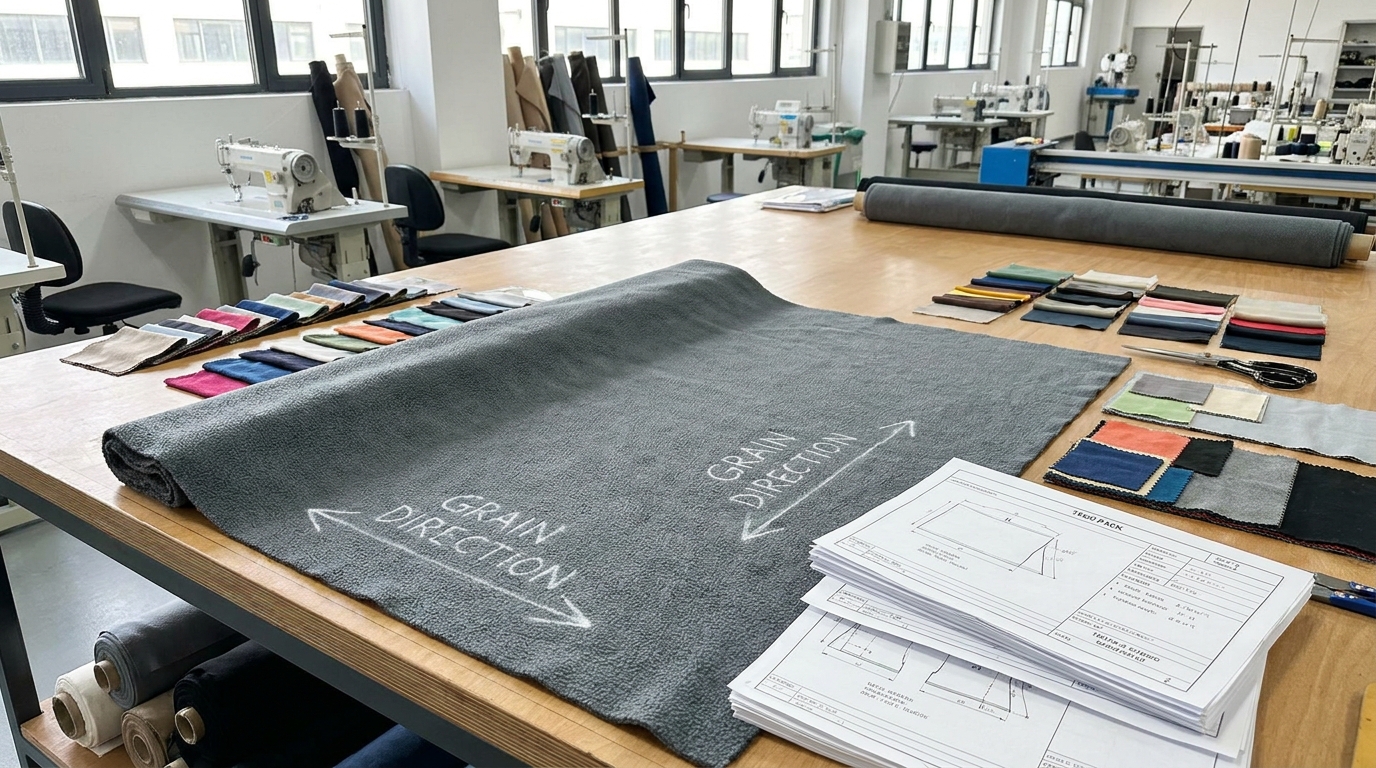
Grain direction. Fleece has a nap — a directional pile that catches light differently depending on which way it faces. Cut a panel with the grain running up, and it looks darker. Cut it with the grain running down, and it looks lighter. If your sample was cut one way and your bulk is cut the other way, the garments won't match. This isn't a quality defect. It's a cutting specification that needs to be locked in during sampling.
Pile matching. When you sew two fleece panels together — say, a front and a back — the pile height and direction need to match at the seam. If they don't, you get a visible line where the texture shifts. On a single sample, this is easy to control. Across 5,000 pieces, it requires cutting markers that account for pile direction on every panel. We set those markers during the sampling stage.
GSM selection. Fleece comes in a wide range — from 180 GSM microfleece to 400+ GSM heavyweight polar fleece. The GSM you choose during sampling determines your fabric cost, your garment weight, your warmth rating, and your shipping volume. We've had buyers request 300 GSM samples, then realize during bulk costing that 280 GSM would have met their performance requirements at 12% lower fabric cost. That conversation should happen before sampling, not after.
Pilling behavior. Fleece samples need to include anti-pill verification. If we send you a sample that looks great but hasn't been tested for pilling resistance, you're approving a visual standard that may not hold up after 10 washes. We test pilling on every sample fabric before cutting using methods aligned with ASTM D3512 and ISO 12945 standards.
These aren't theoretical concerns. They're the difference between a sample that protects your bulk order and one that gives you false confidence.
Fominte's Sampling Process: Step by Step
Our standard fleece sampling cycle is 7 to 15 days from tech pack receipt to sample shipment. The range depends on fabric availability, design complexity, and whether we're working with an existing pattern or creating something new.
Here's what happens inside that window.
Step 1 — Tech Pack Review & Design Optimization (1-2 days)
Before we touch fabric, our design team reviews your tech pack. This is a 10-person team — pattern makers, process engineers, and material specialists. They're not just reading measurements. They're looking for problems.
Common issues we flag during review:
- Seam placements that conflict with fleece grain direction. A curved seam across the grain will stretch differently than a straight seam. If your design calls for a curved side panel, we'll suggest adjusting the seam line or adding stabilizer tape.
- Stitch density that's too high for the GSM. Heavy fleece (300+ GSM) doesn't need the same stitch density as lightweight jersey. Over-stitching creates puckering and wastes thread. We optimize stitch counts to balance durability and cost.
- Construction methods that work on paper but not on fleece. French seams, for example, add bulk on heavyweight fleece. We'll suggest flat-felled seams or binding instead.
This review isn't optional. It's how we prevent the most common sampling failures — the ones that cost 2-3 weeks when you have to redo the sample.
Step 2 — Fabric Selection & Sourcing (1-2 days)
We maintain stock of the most common fleece types: polar fleece (200-380 GSM), microfleece (150-200 GSM), sherpa, and anti-pill fleece in standard colors. If your design uses a stock fabric, we can start cutting within a day.
For custom colors or specialty finishes — recycled fleece, DWR-treated fleece, brushed interior — we source from our regular mill partners. This typically adds 1-2 days for color matching and hand-feel verification.
We'll send you fabric swatches at this stage if you haven't already approved the material. Once we cut, changing the fabric means starting the entire sample over.
Step 3 — Pattern Making & Grading (1-2 days)
Our pattern makers create the sample pattern based on your approved tech pack. For fleece, this means accounting for:
- Shrinkage allowance. Fleece typically shrinks 2-3% on the first wash. We build this into the pattern so your finished garment matches the spec after washing, not before.
- Size grading. If you need multiple sizes, we grade the pattern during sampling. Getting grading right at this stage prevents cascading corrections during bulk.
Step 4 — Cutting with Grain Direction Control (1 day)
This is where fleece-specific expertise matters most. Every panel is cut with grain direction marked and consistent across all pieces. Our cutting room uses lay plans that account for pile direction — a step that generic garment factories often skip.
On a single sample, you might not notice if the grain is off by 10 degrees. On a bulk order of 5,000 pieces, that 10 degrees becomes a visible inconsistency across the entire production run. We lock it in during sampling.
Step 5 — Sewing & Construction (2-3 days)
Sample sewing is done by our most experienced operators, not the production line. The goal is to establish the construction standard that will be replicated during bulk.
During this stage, we test:
- Seam strength. Fleece seams need to handle the fabric's stretch without popping. We test seam strength to ensure it meets the requirements for the garment's intended use.
- Zipper and trim placement. If your design includes zippers, pockets, or elastic, we verify placement and function during sample construction.
- Overall construction quality. Every stitch, every seam, every trim is evaluated against the tech pack specifications.
Step 6 — Finishing, Pressing & Inspection (1-2 days)
After sewing, the sample goes through our standard finishing process: final pressing, thread trimming, and a complete inspection. We check measurements against the tech pack, verify construction details, and inspect for any defects.
The sample is photographed from multiple angles and the photos are sent to you for approval before shipping. This saves 3-5 days compared to shipping first and getting feedback later.
Step 7 — Photo Approval & Shipping (1-2 days)
You review the photos and either approve for shipping or request changes. If approved, we ship via DHL or FedEx. Typical delivery: 3-5 days to most destinations.
If changes are needed, we document your feedback and start the revision cycle (more on this below).
Total timeline: 7-15 days from tech pack to shipment.
What Our Design Team Does Before Cutting Begins
I want to expand on Step 1 because it's the part of our process that most buyers don't see — and it's the part that saves the most time and money.
Our design team doesn't just read your tech pack and execute. They evaluate it. Here's what that looks like in practice.
Feasibility review. This is where our design team's optimization process begins. We check whether your design is physically possible with the specified fabric. A 180 GSM microfleece can't hold the same structural elements as a 350 GSM polar fleece. If your tech pack calls for heavy-duty snaps on lightweight fleece, we'll tell you before we cut — not after the sample fails.
Stitch count optimization. Embroidery and decorative stitching on fleece can get expensive fast. Our team analyzes your design and identifies areas where stitch counts can be reduced without changing the visual result. On one recent order, we reduced stitch count by 18% by adjusting fill patterns in non-visible areas. The buyer saved $0.40 per piece on a 10,000-unit order. That's $4,000 from a change the end customer will never notice.
Construction method recommendations. What works on a cotton hoodie doesn't always work on a fleece jacket. We recommend construction methods based on the specific GSM, the garment's intended use, and the target market. A fleece vest for European outdoor retail needs different construction than a fleece pullover for Middle Eastern wholesale.
Material substitution suggestions. If your tech pack specifies a fabric that's over-specified for the application — say, a 380 GSM fleece for a lightweight layering piece — we'll suggest alternatives that meet performance requirements at lower cost. All our fleece fabrics carry OEKO-TEX Standard 100 certification, so compliance isn't affected by substitution. We'd rather save you money on fabric than charge you more for something you don't need.
This pre-production optimization is included in our sampling service. There's no extra charge for it. We do it because a well-optimized tech pack produces a better sample, and a better sample produces a smoother bulk order.
Sample Fees, Revisions, and the Path to Bulk
Let me address the questions buyers ask most often.
Sample Fees
We charge for samples. This is deliberate, and here's why.
A sample requires our design team's time, fabric from our stock, and dedicated operator hours. When we charge for a sample, we're ensuring that both sides are committed to the process. Free samples attract curiosity. Paid samples attract buyers who are ready to move forward.
Our sample fees cover the full process: tech pack review, design optimization, fabric sourcing, pattern making, cutting, sewing, finishing, inspection, and photo approval. The exact fee depends on the design complexity and fabric type, but we provide a clear quote before we start. No hidden charges.
The Bulk Offset Policy
Here's the part that matters for your budget: if your bulk order exceeds 1,000 yards, the sample fee is deducted from your production invoice.
This isn't a promotion. It's our standard policy. We structure it this way because we want sampling to be a stepping stone to production, not a standalone expense. For details on bulk order timelines and MOQ, see our fleece MOQ and lead time guide. If you're serious enough to order 1,000+ yards, the sample was a business development cost for both of us — and we share that cost.
Revision Policy
No sample is perfect on the first try. That's normal. What matters is how revisions are handled.
For repeat clients, we offer 3 revisions at no additional charge. You send back the sample with your notes — pinned adjustments, measurement corrections, construction feedback — and we rebuild. This policy exists because we've learned that the best bulk orders come from buyers who iterate during sampling, not from buyers who approve the first sample and hope for the best.
For first-time clients, revisions are quoted based on the scope of changes. Minor adjustments (measurements, trim placement) are typically included in the original sample fee. Major changes (new pattern, different construction method) require a new sample.
From Approved Sample to Bulk Production
Once you approve the sample, here's what changes — and what doesn't — when we move to bulk.
What stays the same:
- Pattern and grading specifications
- Construction methods
- Fabric type and GSM
- Trim specifications
- Quality standards
What changes:
- Cutting moves from single-ply to multi-ply lay cutting. This is faster but requires the grain direction markers we established during sampling.
- Sewing moves from individual operators to production lines. Each operator handles one operation, and the construction sequence is standardized.
- Inspection moves from single-garment evaluation to statistical quality control. We inspect a percentage of every production run, and the acceptance criteria are the same as what we applied to your sample. Our overall defect rate stays below 2% — you can read more about how our production line maintains that standard.
The sample is the contract. Every piece in your bulk order should match it. If it doesn't, that's our problem to fix — not yours.
FAQ
How long does it take to get a fleece sample from a Chinese manufacturer?
At Fominte, the standard timeline is 7 to 15 days from tech pack receipt to sample shipment. This includes tech pack review, design optimization, fabric sourcing, pattern making, cutting, sewing, finishing, inspection, and photo approval. Shipping adds 3-5 days depending on destination. If you're comparing suppliers, ask for a detailed breakdown of what's included in their timeline — some factories quote 7 days but don't include pattern making or inspection.
Can I use the sample fabric for my bulk order to ensure consistency?
Yes, and we recommend it. During sampling, we source fabric from the same mills we use for bulk production. When you approve the sample fabric, we lock in the supplier, the GSM, the color, and the finish. Your bulk order uses the same specification. If the mill makes a production run with a different dye lot, we test for color consistency before cutting. This is standard practice for us — not an add-on service.
What happens if the fleece sample doesn't match my expectations?
Send it back with your notes. We'll pin your adjustments, revise the pattern or construction as needed, and send a new sample. For repeat clients, the first 3 revisions are included at no additional charge. For first-time clients, we quote revisions based on scope. The goal is to get the sample right before bulk starts — not to rush approval and fix problems later.
CTA
Ready to see how your fleece design translates into a physical sample? Send us your tech pack at info@fominte.com and we'll return a feasibility assessment within 48 hours — including estimated sample timeline, cost, and design optimization suggestions from our production team.
If you're still evaluating fleece types for your collection, start with our Fleece Product Range Overview to see the full range of options we offer.
Step-by-Step Guide
Step 1: Tech Pack Review and Design Optimization
Step 2: Fabric Selection and Sourcing
Step 3: Pattern Making and Grading
Step 4: Cutting with Grain Direction Control
Step 5: Sewing and Construction
Step 6: Finishing, Pressing and Inspection
Step 7: Photo Approval and Shipping
When to Use & Avoid
New fleece product development
✅ Use When
- Full 7-15 day sampling cycle recommended
Repeat order with existing pattern
✅ Use When
- Faster cycle possible (5-10 days)
Custom color or specialty finish
✅ Use When
- Add 1-2 days for fabric sourcing
Multiple sizes needed
✅ Use When
- Grading done during sampling stage
⚡ Common Mistakes to Avoid
Everything You Need to Know
Conclusion