.png?w=970&h=250)
Fominte's Embroidery Product Range: What We Make and What It Does
What It Really Means
What Fominte Produces — The Full Product Matrix
We run 27 embroidery machines, each with 62 heads and 6-needle capability. Water-soluble, sequin, bead and tube, mesh, multi-craft combinations — we do all of it from one facility in Xuzhou. Monthly output: 300,000 meters.
Quick reference before we go deeper:
| Embroidery Type | Best For | Max Width | Key Limit |
|---|---|---|---|
| Water-soluble | Bridal, eveningwear, home decor | 1.4m | Max 400K stitches per piece |
| Sequin | Luxury fashion, costume, evening wear | N/A | Flat sequins ≤18mm, others ≤8mm, max 10 colors/fabric |
| Bead & Tube | Decorative panels, couture | N/A | Tubes <8mm |
| Mesh/Net | Bridal overlays, curtain inserts | Depends on base | Pattern density varies by mesh gauge |
| Combination | High-end custom, multi-texture | Varies | Complexity adds lead time |
If you already know what you need, skip ahead. If you're evaluating whether we can handle your specific requirements, read on — each section below has the specs that matter.
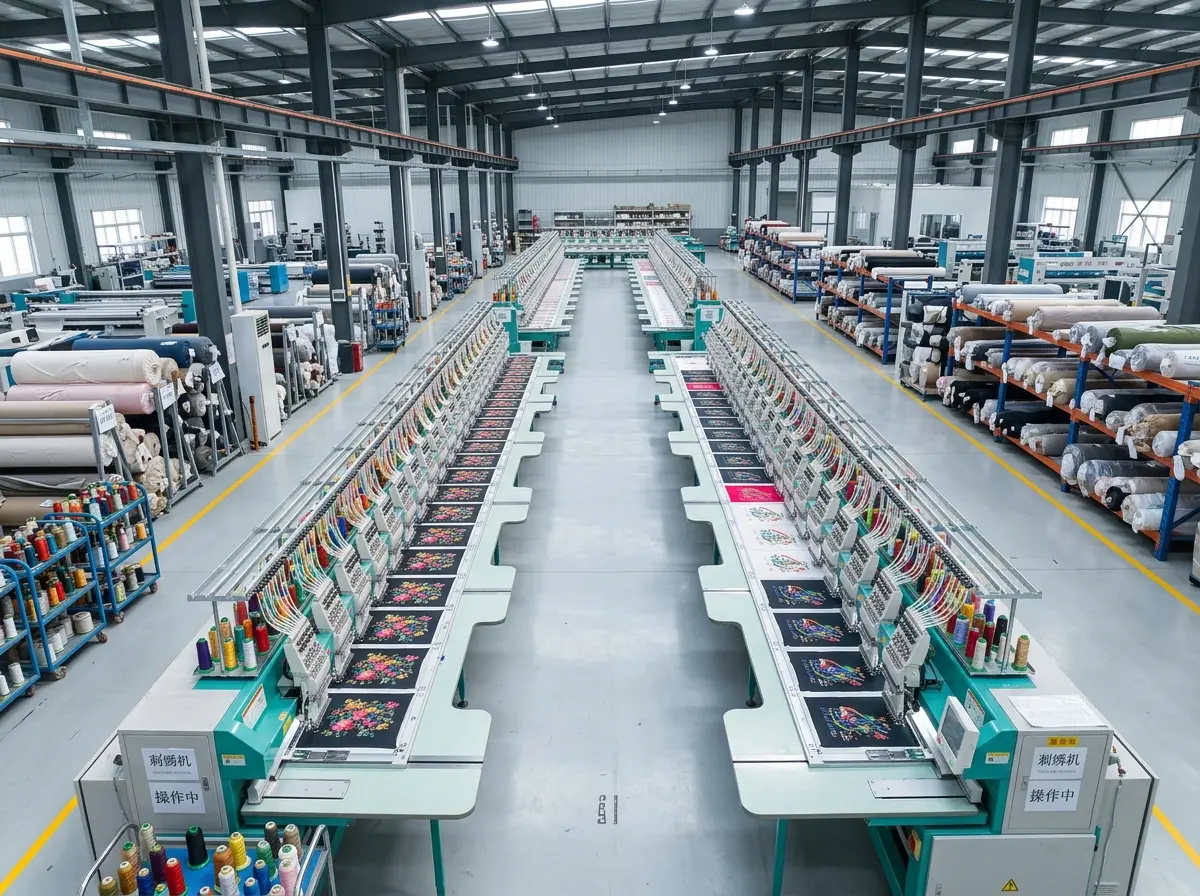
Water-Soluble Embroidery
Water-soluble embroidery is the go-to when you want intricate, lace-like patterns with clean edges. The process uses a dissolvable backing that's washed away after stitching, leaving only the embroidered thread structure. It's the technique behind most high-end bridal lace and decorative overlays you see in eveningwear.
What we can do:
- Max width: 1.4 meters — wide enough for full-gown panels without seaming
- Max stitch count: 400,000 stitches per piece — handles dense floral patterns and complex geometrics
- 6-needle color capability — up to 6 thread colors per design without manual color changes
- Thread types: Polyester, viscose, cotton — each with different sheen and durability profiles
Best applications:
- Bridal veils and gown overlays
- Evening dress panels
- Curtain and home decor overlays
- Any application where you need the fabric to "breathe" while maintaining pattern structure
When to choose water-soluble over other types:
If your design has fine detail, open-work patterns, or needs to look like handmade lace at production scale, water-soluble is the right call. If you need heavy embellishment or 3D texture, look at sequin or bead work instead.
One thing buyers often miss: water-soluble embroidery costs more per meter than mesh embroidery because of the dissolving and finishing step. Eric puts it simply: "You're not paying for more material. You're paying for less. The process of removing the backing is what costs money." Budget accordingly if you're comparing quotes.
Sequin, Bead & Tube Embroidery
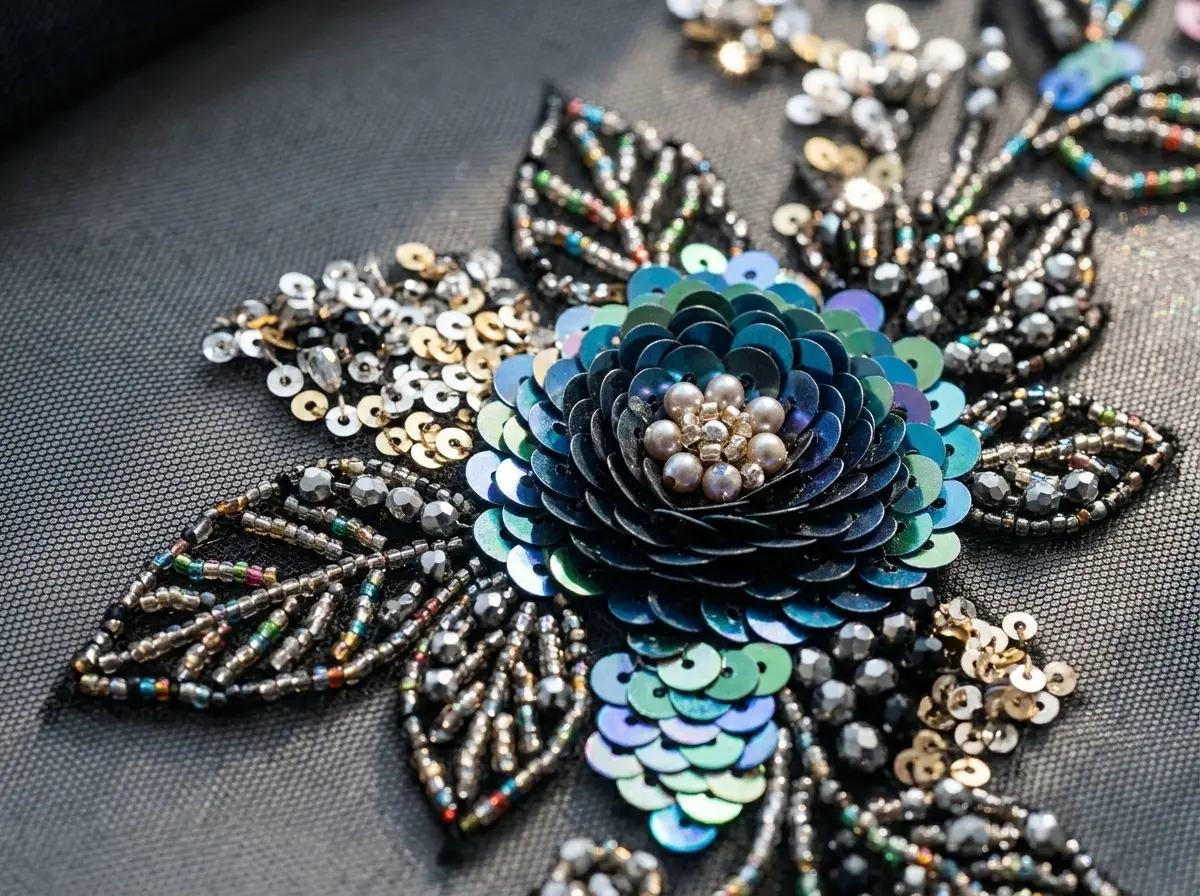
Sequin, bead, and tube embroidery add physical texture and light reflection that thread alone can't match. We handle all three, and we can combine them with thread embroidery on the same piece.
Sequin specifications:
- Flat sequins (edge-hole): Up to 18mm
- Other sequin shapes (round, cup, custom): Up to 8mm
- Color options: Unlimited — we source from a wide supplier base
- Same-fabric color limit: 10 different sequin colors per fabric piece
- Pattern types: All-over, scattered, border, motif placement
Bead and tube specifications:
- Tube size: Under 8mm
- Bead types: Glass, plastic, metal — depends on your application and wash requirements
- Attachment: Lock-stitch for durability, chain-stitch for decorative applications
Combination possibilities:
Our 6-needle setup makes this practical. We run sequin and thread in the same pass, or layer bead work on top of a sequin base. Common combinations:
- Sequin + thread (most popular — adds sparkle without overwhelming the design)
- Bead + sequin (high-end couture look)
- Tube + thread (geometric patterns with texture contrast)
Best applications:
- Evening wear and cocktail dresses
- Costume and stage wear
- Luxury fashion embellishment
- Home decor accent panels
What to watch for: Sequin embroidery adds weight to the fabric. A dense all-over sequin pattern can increase fabric weight by 30-50%, which affects drape and may require a sturdier base fabric. Our design team can advise on the right balance before you commit to production.
Mesh & Net Embroidery
Mesh and net bases are the workhorses of the embroidery world. They're versatile, cost-effective, and handle high-volume production well. If you're ordering for bridal, curtain panels, or garment inserts at scale, this is usually the most practical choice.
Base fabric options:
- Nylon mesh — soft hand, good for bridal and fashion
- Polyester net — more rigid, better for structured applications
- Tulle — lightweight, commonly used for veil and overlay work
Production characteristics:
- Handles high-density embroidery well because the open mesh structure doesn't pucker
- Consistent quality across large batches — this is where our 300,000-meter monthly capacity matters
- Compatible with all our thread types (polyester, viscose, cotton)
Best applications:
- Bridal veil panels and overlays
- Curtain and drapery inserts
- Garment yoke and sleeve inserts
- Any application where you need the base fabric to be semi-transparent
Compared to water-soluble: Mesh embroidery is faster to produce and costs less per meter because there's no dissolving step. The trade-off is that you see the mesh structure in the finished product, whereas water-soluble gives you a pure thread-only look. For a deeper comparison of mesh, crochet, and chemical lace, see our wholesale lace comparison guide. For most high-volume orders, mesh is the practical choice.
Quality at scale: When you're ordering thousands of yards, consistency is what separates a good supplier from a painful one. Our mesh embroidery runs across all 27 machines with standardized tension settings and thread path calibration. Batch-to-batch variation stays under control, and our defect rate on mesh orders sits below 2%. Our QC team tracks that number on every production run.
Combination & Specialty Embroidery
Some orders call for more than one technique on a single piece. We handle multi-craft embroidery regularly — it's one of the reasons buyers come to us instead of splitting orders across multiple suppliers.
What we offer:
- Applique: Fabric patches sewn onto a base, often combined with thread embroidery around the edges. Reduces stitch count and cost for large filled areas.
- Cutwork: Sections of the base fabric are cut away after embroidery, creating open-work effects similar to water-soluble but with more structural control.
- 3D embroidery: Raised foam stitching for logos and bold designs. Works best with simpler shapes and solid colors.
- Multi-technique layering: Sequin base + thread overlay + bead accents — whatever your design requires.
When combination work makes sense:
If your design has both detailed thread areas and embellished sections, doing it all in one production pass saves time and ensures color consistency across techniques. Splitting the same design across two suppliers means matching colors, tensions, and timing — which rarely goes smoothly.
Our 10-person design team handles the digitizing and process planning for combination work. They'll flag potential issues (like thread tension conflicts between sequin and fine thread areas) before production starts.
Real-world example: A Middle Eastern client needed 3,000 yards of bridal fabric combining water-soluble lace borders with scattered sequin accents. The challenge: the water-soluble process requires washing, which can loosen sequin attachment if the stitch sequence isn't planned correctly. Our team restructured the production order — embroidered the sequin sections first, then ran the water-soluble areas, then did the final wash. The result held up through the client's quality testing with no sequin loss. That kind of process planning doesn't happen by accident. It comes from having both the technical team and the production capacity to experiment before committing to a full run.
Production Capacity & Specifications at a Glance
For buyers who think in numbers, here's the full picture. If you want to see how these numbers translate into actual production steps, our factory walkthrough covers the process from raw material to finished roll.
| Specification | Data |
|---|---|
| Embroidery machines | 27 |
| Heads per machine | 62 |
| Needle configuration | 6-needle |
| Monthly capacity | 300,000 meters |
| Production team | 100-200 staff |
| Design team | 10 (digitizing, process planning, pattern optimization) |
| Water-soluble max width | 1.4m |
| Water-soluble max stitches | 400,000 per piece |
| Sequin flat max size | 18mm |
| Sequin other shapes max | 8mm |
| Tube max size | <8mm |
| Colors per fabric (sequin) | Up to 10 |
| MOQ | 100 yards |
| Standard lead time | 20-40 days |
| Sampling lead time | 7-15 days |
| Defect rate | Under 2% |
| Color fastness | Grade 4 |
| Shrinkage | Under 3% |
| Export port | Shanghai |
| Main markets | Middle East, Europe, North America, Southeast Asia |
| Certifications | OEKO-TEX, Higg Index, Amfori |
We don't hide behind vague promises. If you need specific test reports or certification documents for your compliance team, we provide them as part of the inquiry process. Our quality testing follows ASTM textile testing standards for color fastness, shrinkage, and tensile strength.
Which Embroidery Type Fits Your Order?
This is the question we get asked most often, and the honest answer is: it depends on what you're making, how much you need, and what your budget looks like. Here's a practical framework:
By application:
| Your Product | Recommended Embroidery | Why |
|---|---|---|
| Bridal gowns | Water-soluble or mesh | Clean lace look, wide panels, volume-friendly |
| Evening wear | Sequin + thread combo | Visual impact, dimensional texture |
| Curtain/home decor | Mesh embroidery | Cost-effective at scale, consistent quality |
| Fashion inserts | Mesh or cutwork | Semi-transparent, versatile |
| Luxury couture | Bead + tube + sequin | Maximum texture and light play |
| Logo/badge work | 3D embroidery | Raised, bold, durable |
By order volume:
- 100-500 yards: Standard lead time 20-30 days. Sequin work may add 5-7 days for material sourcing.
- 500-5,000 yards: Full production line dedicated. Lead time 25-35 days depending on complexity.
- 5,000+ yards: We'll assign a project manager and stagger production across multiple machines for consistent quality. Lead time 30-40 days.
By budget:
- Mesh embroidery is the most cost-effective per meter
- Water-soluble adds 30-40% over mesh for the same design complexity
- Sequin and bead work costs vary widely depending on material choices — our design team can suggest alternatives if budget is tight
If you're not sure which type fits your next collection, send us your design or reference image. Our team will recommend the right embroidery process, provide specs, and ship a sample within 7-15 days.
A note on lead time planning: The full production cycle includes digitizing (2-3 days for custom patterns), material sourcing (3-5 days), production setup (1-2 days), actual embroidery (5-15 days depending on volume), quality inspection (1-2 days), and finishing/packaging (2-3 days). That's where the 20-40 day range comes from. If you're working backward from a delivery date, factor in the full cycle, not just the stitching time.
FAQ
What is the minimum order quantity for embroidered fabric?
Our standard MOQ is 100 yards per design. For custom embroidery work, MOQ may vary depending on the complexity of the design and materials required. If you're evaluating multiple designs for a collection, we can discuss batch arrangements.
Can you combine multiple embroidery techniques on one fabric?
Yes. Multi-craft embroidery is one of our core capabilities. We regularly combine sequin with thread, bead with sequin, and other technique pairings on a single piece. Our design team plans the production sequence to manage thread tension and color consistency across techniques.
What certifications do your embroidered fabrics hold?
We hold OEKO-TEX Standard 100 (environmental textile certification), Higg Index (sustainability assessment), and Amfori (business social compliance initiative). Certification documents are available upon request during the inquiry process.
How long does it take to get a sample?
Standard sampling takes 7-15 days from design confirmation. The first sample has a fee, which is deducted from your order if production exceeds 1,000 yards. Returning clients get 3 rounds of sample modifications at no extra charge.
When to Use & Avoid
Water-Soluble
✅ Use When
- Bridal gowns and veils
- Evening dress panels
- Home decor overlays
- Lace-like open-work patterns
⚠️ Avoid When
- Heavy embellishment needs
- Budget-tight orders
- 3D textured effects
Sequin + Thread
✅ Use When
- Evening wear and cocktail dresses
- Costume and stage wear
- Luxury fashion embellishment
- Accent panels
⚠️ Avoid When
- Minimalist designs
- Weight-sensitive fabrics
- Very tight budgets
Mesh Embroidery
✅ Use When
- Bridal overlays and veils
- Curtain and drapery inserts
- Garment yoke and sleeve inserts
- High-volume production runs
⚠️ Avoid When
- Premium lace-only look
- Intricate free-form patterns
Combination Work
✅ Use When
- High-end custom collections
- Multi-texture designs
- Mixed technique panels
- Brand-differentiating pieces
⚠️ Avoid When
- Very tight lead times
- Simple single-technique designs
Comparison
| Type | Best For | Max Width / Size | Key Limit | Cost vs Mesh |
| Water-Soluble | Bridal, eveningwear, home decor | 1.4m width | 400K max stitches per piece | +30-40% |
| Sequin | Luxury fashion, costume | Flat ≤18mm, others ≤8mm | Max 10 colors per fabric | Varies by material |
| Bead & Tube | Decorative panels, couture | Tubes <8mm | Material sourcing adds lead time | Varies by material |
| Mesh/Net | High-volume production, bridal | Depends on base fabric | Pattern density varies by gauge | Baseline |
| Combination | High-end custom, multi-texture | Varies by techniques used | Complexity adds lead time and cost | Case by case |
⚡ Common Mistakes to Avoid
Everything You Need to Know
Conclusion