.png?w=970&h=250)
Water-Soluble Embroidery at Scale: What Fominte Produces and How We Guarantee Quality
What It Really Means
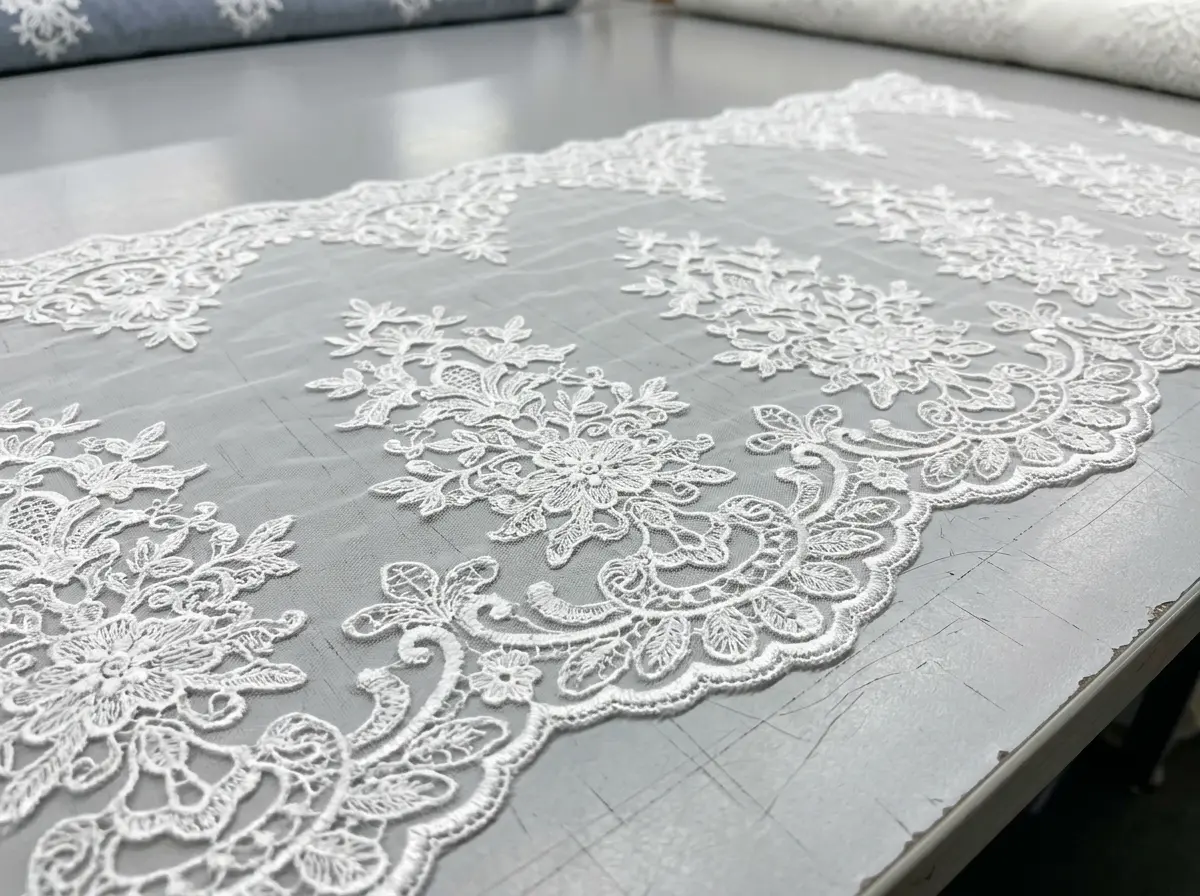
Water-soluble embroidery is the process of stitching dense thread patterns onto a dissolvable PVA stabilizer, then washing that stabilizer away to leave free-standing lace or open-work designs. At Fominte, we run this process across 27 machines with 62 heads each, producing up to 300,000 meters per month. This article explains what we make, how we control quality, and what specifications matter when you're ordering at scale.
What We Produce — Water-Soluble Embroidery Product Range
Water-soluble embroidery sits in a specific segment of our product matrix. Unlike mesh embroidery or crochet lace, which rely on a permanent base fabric, water-soluble embroidery dissolves its foundation entirely. What remains is pure thread structure: either floating lace panels that get appliquéd onto garments, or open-work effects integrated directly into a fabric run.
We produce two main categories:
Standalone lace panels. These are pre-embroidered pieces (trims, borders, appliqués, decorative patches) that get cut and sewn onto garments. Bridal wear, lingerie, and evening dress brands use these heavily. The thread density has to be high enough that the piece holds its shape after the stabilizer dissolves.
Integrated fabric runs. Here we embroider directly onto a continuous roll of PVA-stabilized fabric. After embroidery, the entire roll goes through a washing process that removes the stabilizer, leaving the embroidered pattern as part of the fabric itself. This is what buyers in the home textile and fashion fabric wholesale market typically order.
The difference matters for your order planning. Standalone panels require tighter stitch control and more post-production handling. Integrated runs are more efficient at volume but need careful coordination between the embroidery step and the dissolution step — get the timing or temperature wrong, and you lose batch consistency.
We also produce combination pieces where water-soluble embroidery works alongside other techniques. A common request is water-soluble lace combined with sequin embroidery on the same panel — the lace provides the base structure, and the sequins add surface decoration. These orders require two separate production passes and careful alignment between the water-soluble and sequin steps. If you're planning a multi-technique order, it's worth discussing the sequence with our team early to avoid rework.
Specifications That Matter — GSM, Width, Stitch Count, and Dissolution Type
When buyers ask about water-soluble embroidery, the first question is usually "what can you do?" Here are the numbers:
Stitch capacity: Up to 400,000 stitches per piece. This is our upper limit — most production runs between 50,000 and 200,000 stitches depending on design complexity. The higher the count, the denser the thread structure, and the more rigid the final product.
Maximum width: 1.4 meters. This is the widest we can produce water-soluble embroidery on a single pass. For wider applications, panels get joined in post-production, which adds seam handling to the order timeline.
PVA stabilizer options:
| GSM | Best For | Dissolution |
|---|---|---|
| 25 gsm | Lightweight lace, delicate trims | Hot water (70–95°C) |
| 30 gsm | Standard lace production | Hot water (70–95°C) |
| 35 gsm | Medium-weight fabric runs | Hot water (70–95°C) |
| 40 gsm | Dense patterns, structural lace | Hot water (70–95°C) |
| 45 gsm | Heavy-duty, high-stitch-count pieces | Hot water (70–95°C) |
Hot water vs. cold water soluble: Hot water soluble PVA (dissolving at 70–95°C) is the industry standard for wholesale production. It dissolves cleanly in 20–30 seconds and leaves minimal residue. Cold water soluble stabilizers (dissolving at 20–40°C) exist for situations where the fabric or thread cannot tolerate heat. They're more sensitive to humidity during storage and require more careful handling. At Fominte, we stock both types but recommend hot water soluble for any order above 1,000 yards.
Fabric width options: We stock PVA stabilizer in 63-inch (160 cm) and 72-inch (183 cm) widths. The 72-inch option costs more per yard but reduces waste on wider garment panels.
Here's something Eric tells buyers who are new to water-soluble embroidery: "The GSM number doesn't tell you how thick the final lace will be. It tells you how much support the thread gets during stitching. A 25 gsm stabilizer with 200,000 stitches will produce a stiffer result than a 45 gsm stabilizer with 50,000 stitches. The thread density is what creates the structure."
Thread selection: We primarily use polyester and rayon threads for water-soluble embroidery. Polyester is more durable and colorfast — it holds up better during the dissolution process and in subsequent washing. Rayon has a better sheen and drapes more naturally, but it's more sensitive to the hot water dissolution step. For orders where the lace will be machine-washed by the end consumer (lingerie, activewear), we recommend polyester. For decorative applications where appearance matters more than wash durability (bridal, evening wear), rayon gives a premium finish.
How We Make It — The Production Process
The production flow for water-soluble embroidery has more steps than standard embroidery. Each step is a potential failure point. We've gotten this wrong before, which is why the process looks the way it does now.
Step 1: Digitizing and file review. Every custom design starts with a digitizing file (DST or DSB format). Our 10-person design team reviews every incoming file before production begins. About 15% of files get sent back for revision — usually because the stitch density is wrong for the chosen stabilizer weight, or because the underlay structure won't support the final design after dissolution.
Step 2: Material preparation. We cut the PVA stabilizer to the required width and load it onto the machine frame. The stabilizer has to be handled with dry hands — moisture from sweat or humidity can cause premature softening. We store all PVA materials in sealed PE wrapping in a climate-controlled area. This is one of those details that separates experienced water-soluble embroidery producers from those who treat it like standard embroidery. A factory that doesn't control humidity in its PVA storage area will get inconsistent dissolution results — some pieces dissolve cleanly, others leave residue. We learned this the hard way years ago and now maintain strict environmental controls.
Step 3: Embroidery production. Our 27 machines, each with 62 heads and 6 needles, run in parallel. For water-soluble embroidery, we run at slightly lower speeds than standard embroidery because the PVA stabilizer creates more friction on the needle. Production speed depends on stitch count and design complexity — a 100,000-stitch design on a 35 gsm stabilizer typically runs at about 70% of our standard speed.
Step 4: Dissolution. After embroidery, the fabric goes into a warm water bath (90–95°C for hot water soluble PVA). The stabilizer dissolves within 20–30 seconds. For integrated fabric runs, this is done in a continuous washing machine. For standalone panels, we use batch washers with gentle agitation to avoid distorting the lace.
Step 5: Drying and finishing. The washed pieces go through a controlled drying process. Too much heat and the thread can shrink unevenly. Too little and residual moisture causes mildew during storage. We dry at moderate temperatures and inspect every batch for shape retention.
Step 6: Quality inspection. Every piece passes through our needle inspection machine, which detects broken needles, skipped stitches, and thread tension issues. We also do visual inspection under D65 and TL84 dual-light sources to check for color consistency. This is where Shawn's QC background shows — he trained our inspection team to catch problems that automated systems miss. (For a closer look at our full production flow, see Inside Fominte's Factory: How We Make Embroidery Fabric.)
Quality Control — How We Keep Defects Below 2%
Water-soluble embroidery has a narrower margin for error than standard embroidery. Stabilizer too thin for the stitch count? The design collapses. Dissolution temperature off by even a few degrees? You get residue. Drying uneven? Shrinkage. These defects don't show up until the final product, and by then you're starting over.
Our QC system has five checkpoints:
Incoming material inspection. Every roll of PVA stabilizer gets checked for width consistency (±1 cm), weight accuracy (±5% of rated GSM), and surface defects. We reject rolls that don't meet spec — Shawn's rule is "if the raw material is wrong, everything downstream is waste."
Digitizing file review. As mentioned, about 15% of files get returned. This isn't just about stitch count — we check whether the underlay pattern will survive dissolution, whether the edge finish is clean enough for the intended application, and whether the thread path minimizes jump stitches.
First piece approval. Before starting a production run, we produce 3–5 sample pieces. These go through the full dissolution and drying cycle, then get inspected. The customer approves these samples before we proceed. This step catches about 80% of potential issues.
In-process monitoring. During production, our floor team checks thread tension every 2 hours using a 2-inch satin stitch test. They monitor for broken needle fragments (a safety and quality issue), thread breakage rates (we target 1–3 breaks per 10,000 stitches), and stabilizer alignment.
Final inspection. Every finished piece gets needle-detected and visually inspected. We check for color consistency (D65 + TL84 dual-source), dimensional accuracy (±2% of spec), and surface defects. Our defect rate runs below 2% — and the majority of those are minor issues (loose threads, slight edge irregularity) that get hand-repaired rather than scrapped.
The color fastness of our water-soluble embroidery is rated at Grade 4, and shrinkage stays below 3%. These numbers matter for brands that sell into markets with strict quality standards — particularly the EU and Middle East.
One thing worth noting: water-soluble embroidery has a higher rework rate than standard embroidery — about 3–5% of orders need some level of rework, compared to 1–2% for standard embroidery. The extra rework comes from dissolution issues (residue, incomplete removal) and post-wash shape distortion. We build this into our production schedule, but it's one reason why the 20–40 day lead time range is wider than our standard embroidery lead time. If you're working with a tight launch date, tell us upfront so we can plan buffer time.
Ordering — MOQ, Lead Time, and Export
For water-soluble embroidery, our standard terms:
MOQ: 100 yards. This is our minimum for any embroidery order, including water-soluble. For custom designs, we require a digitizing file and sample approval before production begins.
Lead time: 20–40 days from sample approval to shipment. Here's the breakdown:
- Digitizing file review and revision: 2–3 days
- Material preparation (PVA stabilizer + thread): 3–5 days
- Production setup: 1–2 days
- Embroidery production: 5–15 days (depending on volume)
- Dissolution, drying, and finishing: 2–3 days
- Quality inspection and packing: 1–2 days
For orders above 10,000 yards, we recommend splitting into batches to maintain quality consistency across the full run.
Export: We ship from Shanghai Port. Our main markets are the Middle East, Europe, and Southeast Asia. All water-soluble embroidery products can be accompanied by OEKO-TEX Standard 100 certification, and we hold Higg Index and Amfori compliance credentials.
Packing: Water-soluble embroidery requires moisture-proof packaging. We use sealed PE bags with desiccant packs for all shipments. This is non-negotiable — PVA stabilizer residue on the fabric surface can re-activate in humid conditions during transit. We've seen cases where improperly packed water-soluble embroidery arrived at the destination with sticky surfaces because the shipping container went through tropical humidity. The fix costs more than doing it right the first place.
Certifications: Our facility holds OEKO-TEX Standard 100 certification, which certifies that the finished embroidery products are free from harmful substances. This is particularly important for water-soluble embroidery used in lingerie, baby clothing, and skin-contact applications. We also hold Higg Index and Amfori compliance credentials for buyers who need sustainability and social compliance documentation for their supply chain reporting.
What Comes Next
Spec sheets only tell you half the story. The other half is whether the factory behind those specs can actually deliver them consistently, at your volume, on your timeline.
We welcome facility audits — in person or virtual. Share your annual volume forecast, target specifications, and compliance requirements with info@fominte.com. Eric's team will respond within 24 hours with a production assessment and capacity allocation proposal.
When to Use & Avoid
Bridal and evening wear lace panels
✅ Use When
- applique trims
- decorative patches
- overlay lace
⚠️ Avoid When
- structural garment panels
- heavy-duty trim
Lingerie and skin-contact embroidery
✅ Use When
- soft lace panels
- skin-safe trims
- machine-washable designs
⚠️ Avoid When
- industrial-use textiles
- outdoor fabrics
Home textile fabric runs
✅ Use When
- curtain lace
- table linen embroidery
- upholstery accents
⚠️ Avoid When
- heavy canvas embroidery
- technical textiles
⚡ Common Mistakes to Avoid
Everything You Need to Know
Conclusion