.png?w=970&h=250)
Fleece MOQ, Lead Time, and Export: What to Expect When You Order from Fominte
What It Really Means
How MOQ Works for Fleece Orders
The short answer: our fleece garment MOQ starts at 100 pieces per style per color. But that number alone doesn't tell you much, because minimum order quantity for fleece products shifts depending on what you're ordering, how it's constructed, and what materials go into it.
A polar fleece jacket with a full zipper, lined hood, and DWR coating has different material minimums than a basic microfleece pullover. The jacket needs zipper tape by the yard, hood lining fabric, and specialty coating, and each supplier sets their own minimums. The pullover is one fabric, one thread color, one construction method. The MOQ difference between these two products can be 200 pieces or more.
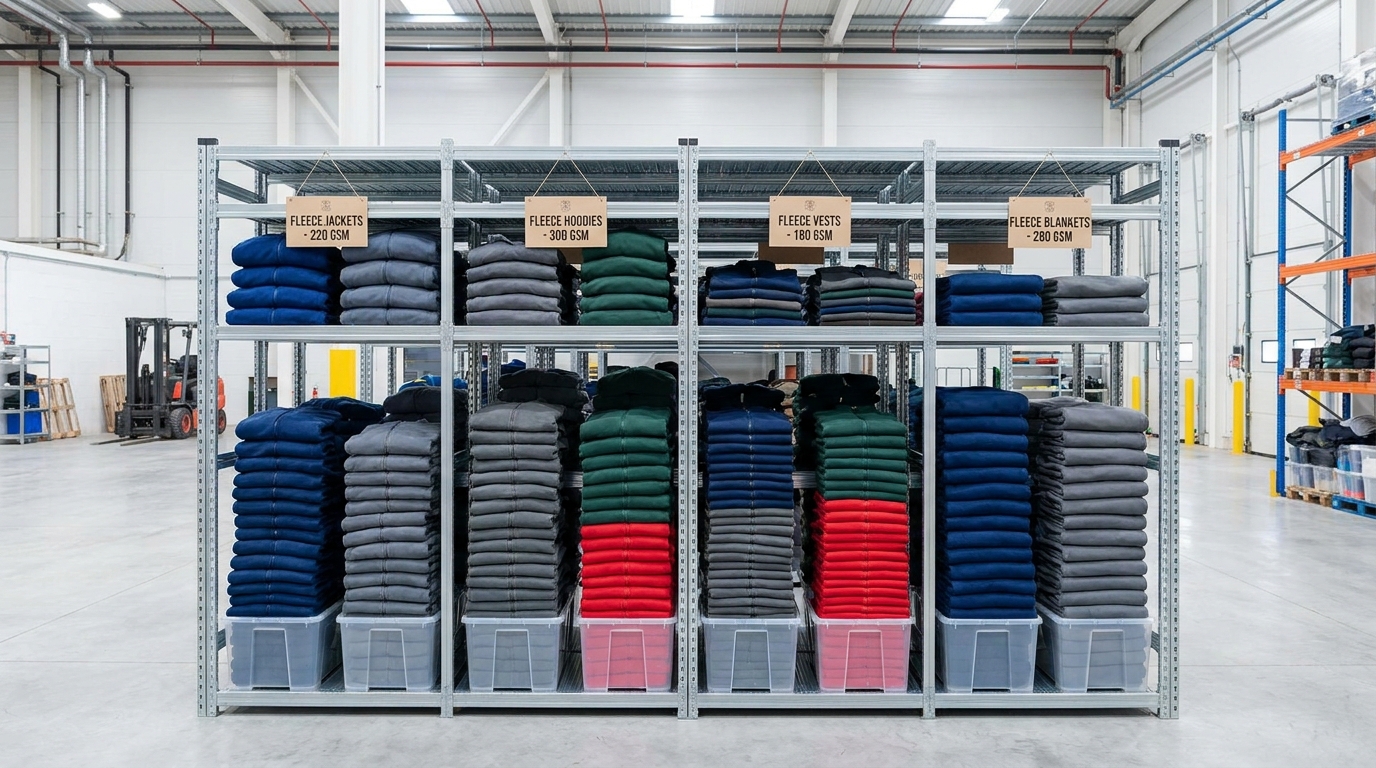
MOQ by Fleece Product Type
Here's how MOQ breaks down across the main fleece categories we produce:
- Polar fleece jackets (full-zip, half-zip): 100-200 pcs per style per color. Full-zip styles run higher because of zipper sourcing minimums and more complex construction.
- Fleece hoodies (pullover and zip-up): 100-150 pcs. Pullover styles are simpler; zip-up hoodies follow similar logic to jackets.
- Fleece vests: 100 pcs. Fewer components, simpler construction, lower MOQ.
- Sherpa and teddy fleece garments: 150-200 pcs. These fabrics are thicker, require more careful cutting (the pile is longer and more directional), and finishing takes longer.
- Fleece blankets: 100 pcs. Blanket construction is straightforward, but the fabric itself often comes in wider rolls with different sourcing minimums.
These numbers reflect per-style, per-color minimums. If you order 3 colors of the same jacket style, the MOQ applies to each color separately because each requires its own dye lot. Some buyers try to negotiate a lower MOQ by accepting mixed colors in one production run, but that only works if the fabric is the same base — you can't mix a navy dye lot with a black one and call it a single order.
Why MOQ Varies: Fabric, Trims, and Color Minimums
The garment MOQ is the floor. Underneath it are the material minimums that actually drive the number.
Fabric minimums: Our standard fleece fabric MOQ is 100 yards per color. For specialty constructions like bonded fleece, anti-pill treated fleece, or recycled fleece with GRS certification, the fabric mill may require 300-500 yards per color. That pushes the garment MOQ up accordingly.
Trim minimums: Zippers, drawstrings, elastic cord, branded labels: each has its own minimum from the trim supplier. A custom-molded zipper pull might have a 1,000-piece minimum. If your order is 200 jackets, you're paying for 1,000 zipper pulls whether you use them or not. This is why standardizing trims across styles reduces per-unit cost.
Color minimums: Each color requires a separate dye lot. Dye houses have minimums too, typically 500-1,000 yards per color for fleece. If you want 6 colors in a 200-piece order, you're asking the dye house to run 6 small lots, which is expensive and sometimes below their minimum. The practical solution: limit your first order to 2-3 core colors, then expand in repeat orders.
Eric, our sales director, puts it this way: "The buyer who asks for 8 colors in a 200-piece order is asking me to say no. The buyer who asks for 3 colors in a 500-piece order is asking me to give them a better price."
How We Handle First-Time Orders vs. Repeat Programs
First-time orders and repeat orders follow different paths, and the MOQ reflects that.
For a first-time buyer, we start with sampling. You send a tech pack (or even just a reference sample and a sketch), and we produce 3-5 samples for your approval. The sample fee covers materials and labor. It's a real cost. If your subsequent bulk order exceeds 1,000 pieces, we deduct the sample fee from your invoice. This isn't a gimmick; it's how we share the risk of a new relationship. If you want a detailed breakdown of how our sampling process works, see From Design to Sample: How Fominte's Sampling Process Protects Your Bulk Order.
Once you've approved the sample and placed your first bulk order, the relationship shifts. Repeat orders can often work with lower MOQs because we already have your patterns, your approved fabric specifications, and your trim sourcing on file. The setup cost is gone. A buyer who ordered 500 jackets in their first order and wants 200 in a different color for a seasonal run — that's a conversation we can have.
For established programs — buyers who order 3-4 times per year with consistent styles — we offer production scheduling priority and volume-based pricing. The MOQ becomes less of a hard line and more of a starting point for a planning conversation.
Fleece Lead Time: A Stage-by-Stage Breakdown
"30-45 days" is the number you'll see on most manufacturer websites. It's not wrong, but it's incomplete. A fleece order doesn't move through the factory in one continuous block. It passes through distinct stages, each with its own timeline and dependencies.
Understanding these stages helps you plan. If you know that sampling takes 7-15 days and bulk production takes 20-40 days, you can work backward from your delivery date and figure out when you need to place your order.
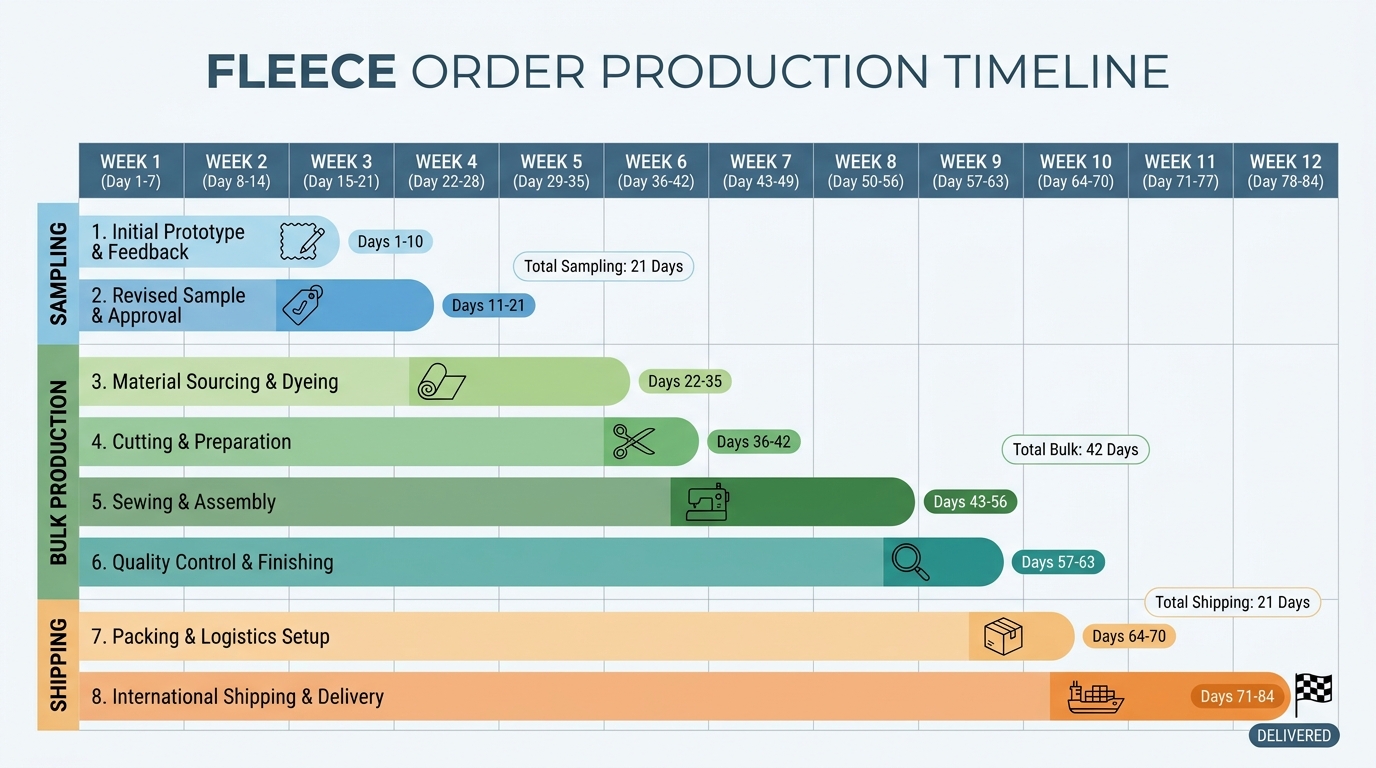
Sampling: 7-15 Days from Tech Pack to Your Door
The sampling stage breaks down like this:
-
Tech pack review and quotation: 1-2 days. We review your tech pack, confirm fabric availability, check trim sourcing, and provide a quotation. If you don't have a formal tech pack, send us a reference sample and your requirements — our design team can work from that, but the review takes an extra day or two.
-
Fabric and trim sourcing: 2-5 days. If we have your required fleece in stock (common for standard polar fleece and microfleece), this is fast. Custom colors or specialty constructions (bonded fleece, sherpa, recycled fleece) may need 5-7 days if the fabric needs to be sourced from our mill partners.
-
Pattern making and cutting: 1-2 days. Our pattern team creates or adjusts the pattern based on your size specs. For standard styles, we often have base patterns that only need grading adjustments.
-
Sample sewing and finishing: 2-4 days. One of our sample room tailors sews the garment, applies trims, and finishes it. This is a single-piece operation — slower than bulk, but precise.
-
Quality check and packing: 1 day. The sample gets a full inspection, is pressed, folded, and packed for express shipping.
Total: 7-15 days. The range depends on fabric availability and construction complexity. A basic microfleece pullover with in-stock fabric can ship in 7 days. A sherpa-lined jacket with custom zipper and DWR coating might take 15.
What can slow sampling down: Incomplete tech packs (missing measurements, unclear trim specs), fabric that needs custom dyeing, and design changes mid-process. The single biggest delay I see is buyers who change their mind about the design after sampling has started. Every change resets part of the process.
Bulk Production: The 20-40 Day Timeline
After you approve the sample and confirm the bulk order, here's how the production timeline breaks down:
-
Order confirmation and material booking: 2-3 days. We confirm all specifications, book fabric from the mill, and order trims. For repeat orders with existing specifications, this can happen same-day.
-
Fabric production or sourcing: 3-10 days. If the fabric is in stock, we move immediately. If it needs to be knitted and finished (common for custom GSM or colors), add 7-10 days. This is the variable that most buyers underestimate.
-
Cutting: 2-5 days depending on order size. A 500-piece order might be cut in 2 days. A 5,000-piece order with multiple styles and sizes takes 4-5 days.
-
Sewing and assembly: 5-15 days. This is the core production stage. Our floor runs multiple sewing lines, and each line handles a specific style. A standard fleece jacket takes about 25-35 minutes of sewing time per piece. With a 20-person line producing 8 hours a day, that's roughly 300-400 pieces per day per line.
-
Finishing and pressing: 1-2 days. Every garment gets pressed, threads are trimmed, and any final details (hangtags, care labels) are attached.
-
Quality control: 2-3 days. This includes in-line inspection during sewing, final inspection of finished garments, needle detection (100% of garments), and packing inspection.
-
Packing and shipping preparation: 1-2 days. Garments are folded, poly-bagged, boxed, and labeled according to your specifications. Carton markings, shipping labels, and packing lists are prepared.
Total: 20-40 days. The lower end is for repeat orders with in-stock fabric and simple construction. The upper end is for large orders with custom fabric, multiple styles, and complex construction.
For a detailed look at how orders move through our production floor, see Inside Fominte's Fleece Production Line.
What Can Extend Lead Time (and How to Avoid It)
The most common causes of extended lead times, based on our order history:
- Fabric delays: Custom dye lots or specialty constructions that need longer sourcing time. Solution: confirm fabric availability before placing the order, or choose from in-stock options.
- Trim sourcing issues: Custom zippers, branded labels, or specialty hardware with long supplier lead times. Solution: order trims early, or use standard options for the first run.
- Design changes during production: Changing a measurement, adding a pocket, or swapping a zipper mid-production requires re-cutting and re-sewing. Solution: lock all specifications at sample approval.
- Peak season congestion: From July to October, every fleece manufacturer is running at full capacity. Lead times stretch by 10-20 days. Solution: order before June or after November (more on this below).
- Quality issues requiring rework: If our QC finds a systematic problem (shade variation, construction defects), we stop production and fix it. This adds days but prevents receiving a container of unsellable goods. Solution: this is actually a feature, not a bug.
The Fleece Export Process: From Our Factory to Your Warehouse
Exporting fleece garments from China involves more than putting boxes on a ship. The process has specific checkpoints, documentation requirements, and logistics steps that affect your total timeline from order to delivery.
We ship from Shanghai Port, the world's busiest container port and the primary hub for China's textile exports. From our factory in Xuzhou to Shanghai is about a 6-hour truck drive. Container loading happens at the port, not at our factory.
Pre-Shipment Inspection: What We Check Before Loading
Before any container leaves, we conduct a pre-shipment inspection. This is separate from our internal QC. It's the final gate.
The inspection covers:
- Quantity verification: We count cartons and verify piece counts against the packing list. A 2% variance is acceptable; anything beyond that requires reconciliation.
- Packaging integrity: Cartons are checked for damage, proper sealing, and correct markings. Moisture barrier bags are verified for sealed shipments to humid destinations.
- Label accuracy: Care labels, content labels, country-of-origin labels, and any retailer-specific labels are checked against specifications.
- Random garment inspection: We pull a statistical sample (typically AQL 2.5) from the packed cartons and inspect for defects. This catches any issues that slipped through final inspection. Our inspection methods follow AATCC (American Association of Textile Chemists and Colorists) testing standards for colorfastness and fabric performance.
Third-party inspection is available and recommended for first orders. SGS, Bureau Veritas, and Intertek all operate in our region. We cooperate fully with third-party inspectors and provide access to all production records.
Documentation: What You Receive
Standard export documentation includes:
- Commercial invoice: Itemized list of goods with unit prices, total value, and payment terms.
- Packing list: Carton-by-carton breakdown of contents, weights, and dimensions.
- Bill of lading: The shipping document that serves as receipt of goods by the carrier.
- Certificate of origin: Required for customs clearance in your country. We issue this through the local chamber of commerce.
- Test reports: If your order includes OEKO-TEX certified fabric or specific test requirements, we include the relevant test reports.
For buyers in the EU, we can provide REACH compliance documentation. For US buyers, we can provide CPSIA compliance certificates for children's products. Our fleece fabrics are OEKO-TEX Standard 100 certified, which means they've been tested for harmful substances and are safe for direct skin contact.
Packaging Standards: How We Pack for International Transit
Fleece garments require specific packaging to arrive in sellable condition. The pile surface is compressible. If you pack fleece too tightly or use the wrong bagging method, the garments arrive flat and need reconditioning.
Our standard packing method:
- Each garment is individually poly-bagged with a tissue paper interfold to protect the pile surface.
- Garments are folded to a consistent size and stacked in cartons with cardboard dividers.
- Cartons are double-walled for international shipping, with moisture-absorbing packets for ocean freight.
- Carton dimensions are optimized for container loading. We calculate the most efficient arrangement to maximize container utilization.
Custom packaging (retail-ready poly bags with barcodes, hanger packing, branded tissue paper) is available. These requirements should be specified at the order confirmation stage, not after production starts.
Shipping from Shanghai: Transit Times by Destination
Ocean freight transit times from Shanghai:
| Destination | Transit Time | Notes |
|---|---|---|
| Southeast Asia | 7-14 days | Shortest route, multiple weekly sailings |
| Middle East (Jebel Ali) | 15-20 days | Major hub for regional distribution |
| Europe (Hamburg/Rotterdam) | 25-35 days | Most common for EU buyers |
| North America (Los Angeles/New York) | 25-40 days | West coast faster than east coast |
| Australia (Meldney/Sydney) | 14-20 days | Direct sailings available |
These are port-to-port estimates. Add 3-5 days for customs clearance and inland transportation at destination. Air freight is available for urgent orders but costs 5-8 times more than ocean freight.
Peak Season Planning for Fleece Orders
Fleece is a seasonal product. The buying cycle follows the weather: retailers stock fleece for fall and winter, which means orders need to ship in summer and early fall. This creates a predictable pattern of demand that every experienced buyer plans around.
The Fleece Ordering Calendar: When to Order for Fall Delivery
Based on our production schedule and what we see from buyers year after year:
- January-March: Ideal time for fall collection planning. Fabric mills have capacity, sampling happens fast, and you can lock in production slots before the rush.
- April-May: Best window to place bulk orders for fall delivery. Production slots are still available, lead times are at their shortest (20-30 days), and you have room for any unexpected delays.
- June: Last reliable window for fall orders. Lead times start stretching as factories fill up.
- July-October: Peak production season. Every fleece manufacturer is running at capacity. Lead times extend by 10-20 days, and getting a production slot requires advance booking. Prices may also increase due to demand.
- November-December: Production slows as factories complete fall orders and prepare for Chinese New Year. Good time to plan for next year.
What Happens to Lead Times During Peak Season
During peak season (July-October), the timeline changes:
- Sampling: Extends from 7-15 days to 10-20 days. Sample rooms get crowded with requests from buyers who are late to the party.
- Bulk production: Extends from 20-40 days to 35-55 days. Sewing lines are fully booked, and fabric mills are running overtime.
- Shipping: Container space gets tight. Booking a container 2-3 weeks in advance becomes necessary instead of the usual 1 week.
Eric's observation: "Buyers often misunderstand what 'peak season' means. They think it means 'when you should buy.' It actually means 'when everyone who didn't plan ahead is now scrambling.' The buyer who orders in April isn't just getting faster delivery. They're getting better product because they had real choices — fabric options, production slots, shipping schedules. The buyer who orders in August is getting whatever's left."
How to Beat the Peak
The simplest strategy: order your fall fleece collection in April or May. You get the shortest lead times, the widest fabric selection, and the most flexible production scheduling. You also get better pricing — factories are more competitive when they're filling their schedule, not when they're turning away orders.
If you're already in the peak season and need to order:
- Simplify your order: Fewer colors, fewer styles, standard fabrics. Complexity multiplies delays.
- Accept in-stock fabric: Don't request custom dye lots. Choose from what the mill has available.
- Book shipping early: Reserve your container slot as soon as production starts, not when it finishes.
- Communicate clearly: The faster you respond to our questions during production, the faster we resolve issues.
For more on how we handle large orders during peak season, see How We Deliver Large Orders. The methodology applies to fleece as well.
What You Need Before Placing a Fleece Order
The quality of your order starts with the quality of your preparation. Buyers who come to us with complete specifications get faster quotations, smoother sampling, and fewer production surprises.
The Minimum Requirements
At a minimum, we need:
- Tech pack or reference sample: A tech pack with measurements, construction details, and material specifications is ideal. If you don't have one, a physical reference sample with your modification notes works.
- Color specifications: Pantone (TPX/TCX) codes for fabric and any contrasting elements. "Navy blue" is not a specification. "Pantone 19-4028 TCX" is.
- Size chart: Measurements for each size you want produced. If you need grading (scaling from one size to others), let us know and our pattern team can help.
- Quantity per style per color per size: The breakdown drives everything: fabric requirements, trim sourcing, production planning, and pricing.
- Delivery date: When you need the goods at your warehouse. We work backward from this date to determine if the timeline is feasible.
Nice-to-Have: What Makes the Process Smoother
These aren't required, but they speed things up:
- Packaging specifications: How you want garments folded, bagged, and boxed. Retail-ready packaging requirements should be specified upfront.
- Label files: If you have branded labels, hangtags, or care labels, provide the artwork and specifications at order confirmation.
- Test requirements: If your market requires specific testing (OEKO-TEX, flammability, restricted substances), tell us before sampling so we select the right fabrics and components.
- Target price: Knowing your cost ceiling helps us recommend the right fabric weight, construction method, and trim options.
Common Mistakes That Delay Orders
The mistakes I see most often:
- Vague color specifications: "Something like this" with a photo of a screen. Screen colors are unreliable. Always use Pantone codes.
- Changing specifications after sample approval: You approved the sample with a certain zipper, then want to switch to a different one for bulk. That's a re-sampling situation, not a simple swap.
- Underestimating fabric lead time: "Can you start cutting tomorrow?" Only if we have your exact fabric in stock. Custom fabric needs 7-10 days minimum.
- No packaging specs until the last minute: "Oh, we need these on hangers with retail tags" — said two days before shipment. Hanger packing requires different folding, different cartons, and different shipping arrangements.
Stephen's advice: "Part of my job is reviewing the inquiries that come through our system, and I see a pattern. Many buyers ask the wrong questions. They ask about price and MOQ. What they should be asking is: 'How do I know you're real?' and 'What do you need from me to make this order go smoothly?' The second question is the one that separates successful orders from painful ones."
FAQ
What is the minimum order quantity for fleece jackets? For fleece garments, our standard MOQ starts at 100 pieces per style per color. For larger programs with multiple styles, we can discuss volume flexibility. The exact MOQ depends on fabric type, construction complexity, and trim requirements. Sherpa and specialty fleece garments typically require 150-200 pieces minimum.
How long does it take to produce a fleece order? Sampling takes 7-15 days from tech pack approval. Bulk production takes 20-40 days depending on order size and complexity. Total timeline from order confirmation to shipment is typically 30-55 days. During peak season (July-October), add 10-20 days to these estimates.
Which port do you ship from and what are transit times? We ship from Shanghai Port. Transit times: Southeast Asia 7-14 days, Middle East 15-20 days, Europe 25-35 days, North America 25-40 days, Australia 14-20 days. These are ocean freight port-to-port estimates; add 3-5 days for customs and inland transport at destination.
Can I order fleece products for the first time without a large commitment? Yes. We work with first-time buyers on trial orders. Start with sampling (7-15 days), approve the sample, then place your initial bulk order. Sample fees can be deducted from bulk orders over 1,000 pieces. Our MOQ of 100 pieces per style is designed to let you test the market before committing to larger volumes.
What documents do I receive with my shipment? Standard documentation includes commercial invoice, packing list, bill of lading, and certificate of origin. Additional documents available on request: OEKO-TEX certificates, test reports (SGS/Bureau Veritas), REACH compliance documentation (EU), and CPSIA certificates (US children's products). The export process is similar across our product lines — if you've ordered embroidery fabric from us before, the documentation workflow is the same. See our embroidery MOQ and export guide for comparison.
Do you offer third-party inspection before shipment? Yes. We cooperate fully with third-party inspection agencies (SGS, Bureau Veritas, Intertek). We recommend third-party pre-shipment inspection for first orders. We provide access to all production records, test reports, and sample retention for comparison.
Step-by-Step Guide
Tech Pack Review and Quotation
Fabric and Trim Sourcing
Bulk Production
Pre-Shipment Inspection
Documentation and Shipping
When to Use & Avoid
First-time fleece order (100-300 pcs)
✅ Use When
- Start with sampling (7-15d), approve sample, then bulk (20-40d). Sample fee deducted from orders over 1000 pcs
⚠️ Avoid When
- Placing bulk order without sampling first, skipping tech pack preparation
Repeat order (500-2000 pcs)
✅ Use When
- Faster turnaround (15-30d bulk) because patterns and fabric specs are on file. MOQ flexibility for established buyers
⚠️ Avoid When
- Assuming same specs as last order without confirming no changes
Peak season order (Jul-Oct)
✅ Use When
- Lead times extend 10-20d. Book production slot early. Simplify colors and styles. Accept in-stock fabric
⚠️ Avoid When
- Ordering in August for September delivery, requesting custom dye lots during peak
Large program (5000 plus pcs, multiple styles)
✅ Use When
- 30-55d lead time. Plan 4-6 months ahead. Standardize trims across styles to reduce MOQ and cost
⚠️ Avoid When
- Treating each style as independent order instead of a coordinated program
Comparison
| Product Type | MOQ (per style per color) | Sample Lead Time | Bulk Lead Time | Key Considerations |
| Polar Fleece Jackets (full-zip) | 100-200 pcs | 7-15 days | 20-40 days | Zipper sourcing minimums, more complex construction |
| Polar Fleece Jackets (half-zip) | 100-150 pcs | 7-12 days | 20-35 days | Simpler than full-zip, fewer trim requirements |
| Fleece Hoodies (pullover) | 100 pcs | 7-12 days | 20-30 days | Simplest construction, lowest MOQ |
| Fleece Hoodies (zip-up) | 100-150 pcs | 7-15 days | 20-35 days | Similar to jacket construction |
| Fleece Vests | 100 pcs | 7-10 days | 15-25 days | Fewer components, fastest production |
| Sherpa and Teddy Fleece | 150-200 pcs | 10-15 days | 25-40 days | Longer pile requires careful cutting, thicker fabric |
| Fleece Blankets | 100 pcs | 7-12 days | 20-30 days | Wider fabric rolls, different sourcing minimums |
⚡ Common Mistakes to Avoid
Everything You Need to Know
Conclusion