.png?w=970&h=250)
The Hidden Costs of Drop-Shoulder Designs: What an Oversized Fleece Hoodie Manufacturer Wants You to Know
What It Really Means
I review tech packs from B2B buyers every week who want to launch a drop-shoulder silhouette. They expect the fabric consumption to be just slightly higher than a standard-fit hoodie. When I send back the yield calculation, they are usually shocked.
They want to know why this oversized design requires 25% more fabric than their regular fit line. The answer is simple geometry. A drop-shoulder isn't just a blown-up pattern. The way it cuts into the fabric roll is fundamentally different.
If you are sourcing thousands of units, you need to understand this geometry. Here is the math behind bulk drop-shoulder production, from cutting waste to specialized grading.
Fabric Utilization: Why "Oversized" Kills Your Cutting Yield
A standard, set-in sleeve hoodie pattern usually achieves an 80-85% fabric yield. The armholes and sleeve caps interlock neatly on the cutting marker.
A drop-shoulder design ruins that interlocking puzzle. The sleeve cap is flattened, and the armhole on the body drops straight down. This creates large rectangular gaps on the marker that cannot be filled. Your fabric utilization drops to 70%. You are paying for 30% waste.
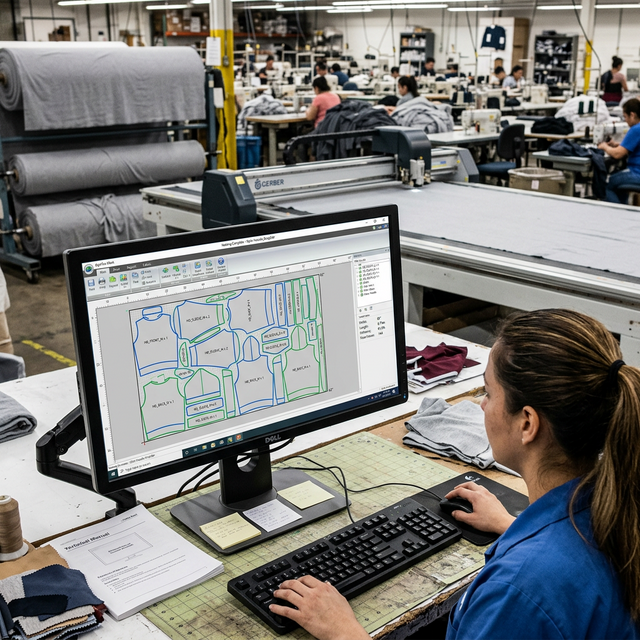
At Fominte, we use CAD digital nesting to fix this. We rotate pattern pieces based on grainline tolerance and interlock multiple sizes onto a single marker—nesting a Size S sleeve inside the negative space of a Size XL body, for example. This pushes yield back closer to 78-80%. But buyers still must factor this architectural inefficiency into their target cost.
Grading Rules for a Custom Oversized Hoodie
Grading is how a pattern scales from a Size Small to a Size XXL. For a standard fit, the math is proportional: add a quarter-inch here, a half-inch there.
An oversized hoodie breaks those rules. If you apply linear grading to a drop-shoulder design, the Size XXL sleeves will hang past the wearer's fingertips, and the Size XS will lose the "slouchy" aesthetic entirely.
The shoulder drop grades at a different mathematical ratio than the chest width. The sleeve length must also compensate inversely. As the shoulder drops further down the arm on larger sizes, the actual sleeve block decreases so the cuff stays at the wrist. Many factories get this wrong, and the larger sizes become unwearable. We build dedicated grading matrices specifically for drop-shoulder silhouettes.
Preventing the "Neck Drag" in Heavyweight Drop-Shoulder Designs
When producing in the 350 GSM to 450 GSM range, the weight of the fleece becomes a structural problem.
A common defect in heavy drop-shoulder hoodies is "neck drag." The double-layered hood acts as a counterweight pulling backward. Because the shoulder seam is dropped and doesn't rest on the wearer's natural shoulder apex, there is nothing locking the garment in place. The front neckline slowly rides up and chokes the wearer.
We fix this through pattern balance. We adjust the yoke geometry and shift the shoulder seam forward. We change the neckline curve to redistribute the center of gravity, using the front body panels to counter the heavy hood. We engineer the balance points so the hoodie actually sits comfortably.
Final Thoughts Before You Order Bulk
Producing profitable oversized hoodies requires precision pattern work. If your supplier doesn't know how to nest CAD markers to reclaim fabric yield, or how to grade a non-linear drop shoulder, your profit margin disappears into the cutting room scrap bin. Send us your oversized specs, and our pattern engineers will optimize your yield before you place a bulk order.
⚡ Common Mistakes to Avoid
Everything You Need to Know
Conclusion