.png?w=970&h=250)
Single vs Double Knit Fabric: Which is Better for Your Production?
What It Really Means
Here is what Shawn, our founder, always tells the production managers: "The architecture matters more than the thread." That architecture dictates how much risk you are taking on when you scale up your order.
The Hidden Cost of Single Jersey: Shrinkage and GSM Tolerance
Many buyers gravitate toward single jersey because the cost per yard is lower. It uses less yarn and knits faster. If you are managing a supply chain for a major retail brand, you know that the invoiced fabric cost is only half the story.
Single jersey's unbalanced structure makes it incredibly susceptible to shrinkage and skewing (twisting) after washing. When you are producing 100,000 t-shirts, a 5% shrinkage variance between dye lots means your sizing consistency is destroyed.
To stabilize single jersey for mass production, factories rely on the finishing process, such as heat setting and compacting. If a supplier quotes you a shockingly low price for single jersey fabric, there is a very high probability they are skipping the compaction process or running the fabric through the stenter frame too fast to save energy costs.
Eric, our Head of Sales, often has this conversation with new clients. "You usually get what you pay for in the finishing," he says. "If someone's price is significantly lower, there's a reason. Find out what it is. With single jersey, they might be stretching the fabric on the stenter frame to meet your yield requirements. The moment your customer washes that garment, it will shrink right back."
At Fominte, when we produce cotton knit fabric wholesale, our single jersey goes through a rigorous compaction process to ensure shrinkage remains strictly under 5%, sometimes hitting 3% for premium combed cotton lots. We test against standard AATCC dimensional change test methods. It takes more time and costs a fraction more per yard, but it prevents 10,000 garments from being rejected at final QC.
The Stability Premium of Double Knit Fabrics
If single jersey requires volatility management, double knit offers structural reliability.
Because double knit fabrics are interlocked from two sets of needles, they possess inherent stability. They lay completely flat on the cutting table, which drastically speeds up the cutting and sewing process in the factory. The yield loss from curled edges disappears entirely. This makes double knits the standard for structured garments like blazers and heavyweight hoodies.
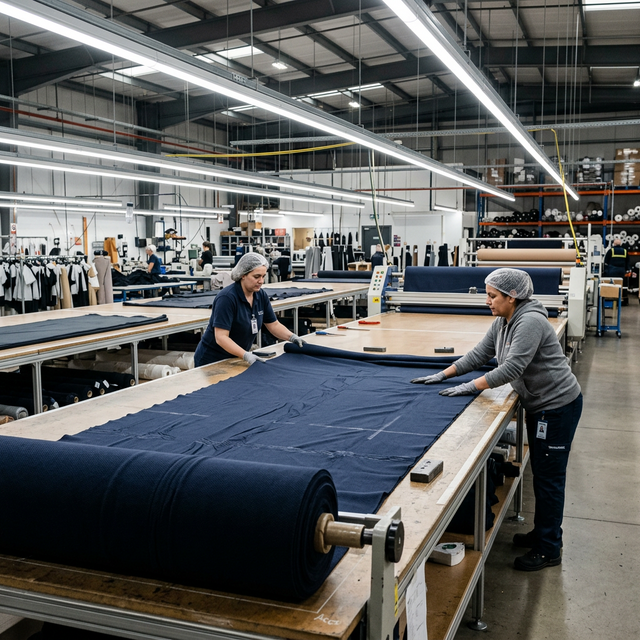
Consider the cutting room floor. When laying out single jersey, our technicians manage the tension carefully to avoid stretching the fabric before the blade hits it. Double knit fabric stays put. The cutting accuracy increases and the defect rate drops.
The initial fabric cost is higher because you are knitting two layers. However, the hidden savings in manufacturing efficiency (fewer rejected garments and zero curling issues) often offset that premium for structured designs.
The Dye Lot Dilemma: Mixing Single and Double Knits
Here is a scenario we see almost every season: A brand designs a premium heavyweight t-shirt. They specify a heavy single jersey for the main body (let's say 220 GSM) and a 1x1 double knit rib for the collar. They send the Pantone code and ask for a perfect match.
This is where the physics of dyeing comes into play. Single jersey and double knit ribbed structures reflect light differently. Even if both fabrics are dyed in the exact same vat using the exact same chemical formula, they will often look slightly different to the naked eye. This phenomenon is known as metamerism, and the structural density of the fabric exaggerates it.
When a factory says they will just dye both materials together, that is a red flag. Achieving a perfect match between a single bed body fabric and a double bed trim requires distinct, painstakingly calibrated dye formulations for each structure.
We don't take shortcuts here. For large-scale OEM orders, our dye house formulates separate recipes for the single jersey body and the double knit trim. We do lab dips for both structures independently until they match under standard D65 daylight and TL84 store lighting.
"The edge is where you see if someone cares," Shawn reminds our QC team. "It's the last thing the customer touches. If the collar doesn't match the body, the whole production was probably sloppy."
Capacity, Lead Times, and Strategic Sourcing
Choosing the right fabric also means understanding the production timeline. Double knits take longer to knit because the machine is doing double the work per rotation. If you are forecasting a massive Q4 rollout, you need a supplier with the actual machine capacity to handle the volume without bottlenecking your supply chain.
Fominte’s manufacturing base in Xuzhou is built for volume scalability. With our current equipment fleet, we can support orders of 50,000+ yards per month consistently, maintaining strict defect rates below 2%. For a standard 100K yard production run, our lead time typically sits at 45 days, which includes rigorous testing. Eric always points out to our strategic partners:
"In wholesale, you need to be early enough to preserve your choices."
If you wait until you see demand signals from your retail stores to order your double knit outerwear, you are competing for the same limited machine capacity as everyone else. The brands that win are the ones that commit to their fabric choices and secure production slots before the seasonal rush.
Comparison
| Feature | Single Jersey | Double Knit |
| Structure | Unbalanced (single needle bed) | Balanced (interlocked double needle beds) |
| Edge Curling | High tendency to curl at cut edges | Lays flat, zero curling |
| Shrinkage Risk | High (requires strict compaction) | Low (inherently stable) |
| Fabric Weight | Lightweight, highly breathable | Thicker, more structured |
| Manufacturing Yield | Lower (due to edge curling and shrinkage) | Higher (faster cutting and sewing) |
Everything You Need to Know
Conclusion