.png?w=970&h=250)
I was standing in the sample room last Tuesday when Eric walked in with a stack of inquiry emails. "Look at this," he said, showing me his screen. "Three buyers, all asking for 'lace fabric wholesale' — but none of them know which type they actually need."
It's a pattern we see constantly. A boutique owner in Manchester needs lace for spring dresses. A wedding brand in California is building their 2026 collection. A startup designer just got their first big order. They all know they want lace. But the conversation usually stops there.
Here's the thing: "lace fabric" is like saying "metal" when you're building a bridge. Which kind? For what purpose? What happens if you choose wrong?
After watching Shawn and our floor team handle hundreds of these inquiries, I've learned that the difference between a successful lace order and a costly mistake usually comes down to understanding what you're actually buying. Not the romance of it — the mechanics.
So let me walk you through what we tell our buyers. This is the guide I wish someone had given me when I first started learning this industry.
Understanding Lace Fabric Types: What You're Actually Choosing
When buyers come to us, they're usually thinking about what the lace looks like. Shawn taught me to flip that question: think about what the lace does.
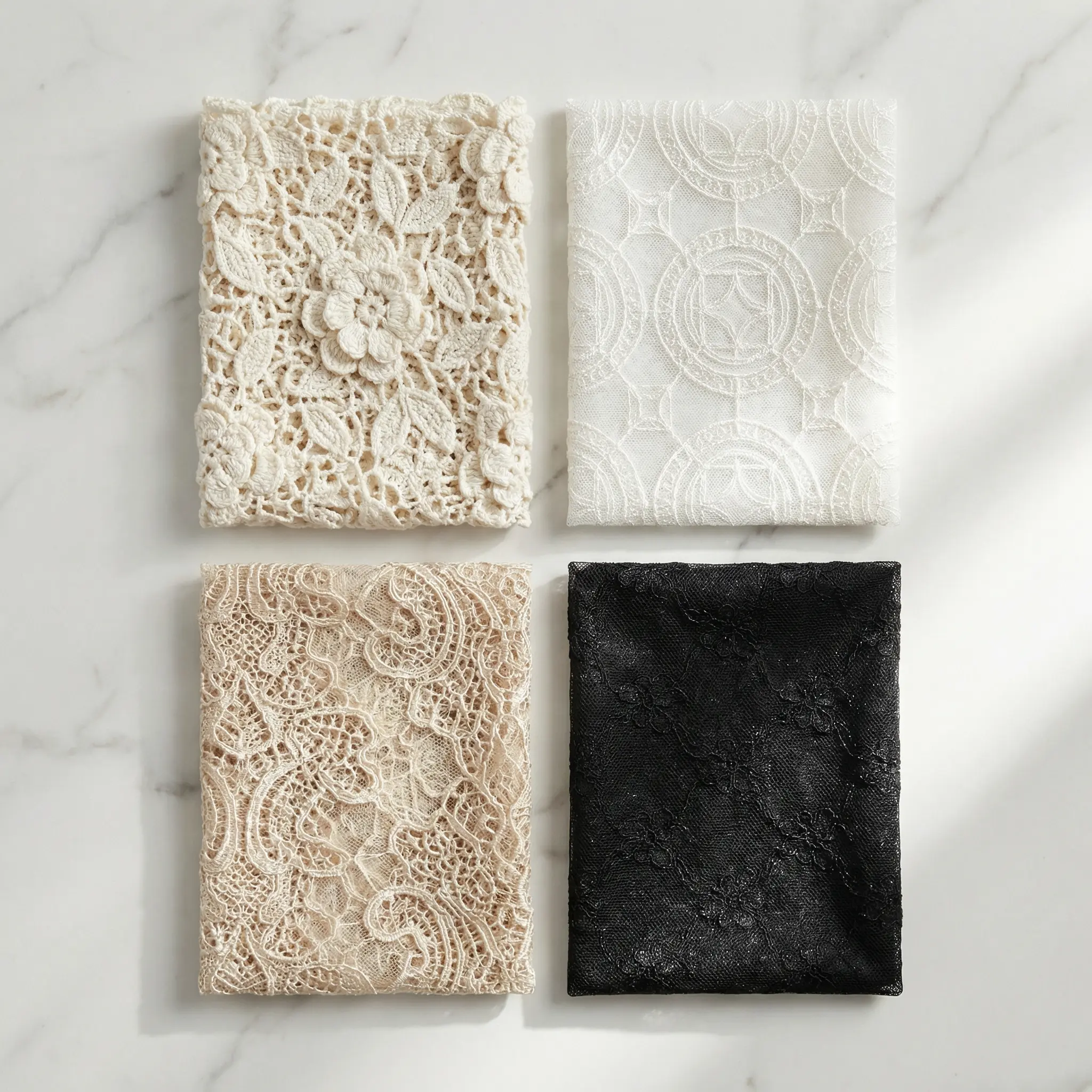
Here are the four main types we work with, and the questions you should be asking about each:
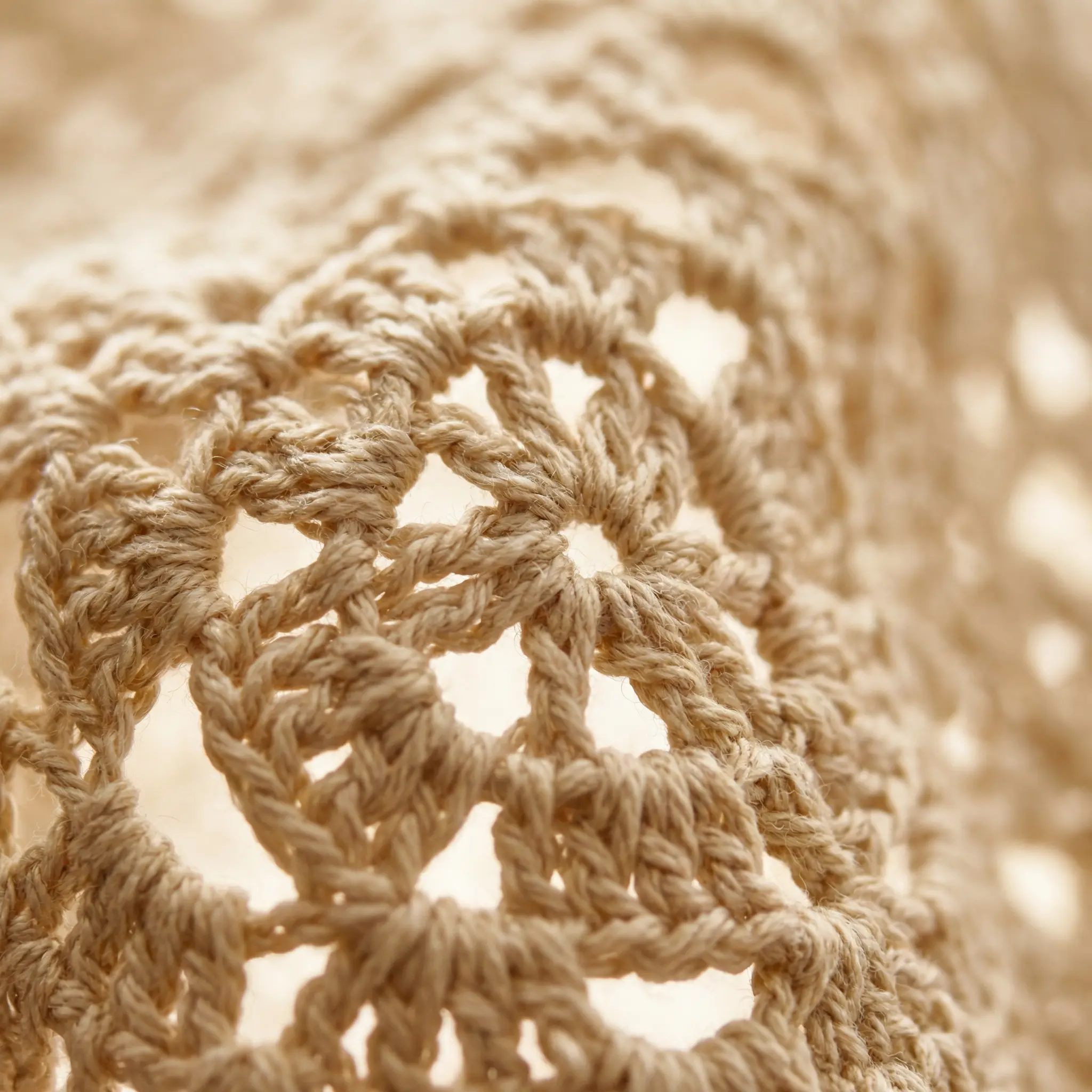
1. Crochet Lace
What it is: This is the type that looks handmade. Because historically, it was. Modern crochet lace is machine-produced but mimics the interlocking loop structure of hand-crochet work.
Best for:
- Bohemian or vintage-style clothing
- Blouses, cardigans, summer dresses
- Retailers targeting the festival/vacation market
Technical specs:
- MOQ: Typically 300-500 yards per color/design
- Lead time: 15-20 days for stock patterns, 25-30 days for custom
- Key advantage: The 3D texture gives it a premium, artisanal look
- Watch out for: Edges can unravel if not properly finished — ask your supplier about edge treatment
Eric's note: "We see a spike in crochet lace inquiries between January and April. Buyers are prepping for spring/summer collections. If you wait until March to order, you're competing with everyone else for production slots."
2. Mesh Lace / Embroidered Lace
What it is: A fine mesh base with embroidered patterns on top. This is our bread and butter at Fominte — it's what we've specialized in for over 30 years.
Best for:
- Formal wear, evening gowns, wedding dresses
- Overlays and statement pieces
- High-volume retailers who need consistent quality
Technical specs:
- MOQ: 500-800 yards (can negotiate lower for established clients)
- Lead time: 20-25 days standard, 30-35 days for custom patterns
- Key advantage: Incredibly versatile — works for everything from subtle detailing to full lace garments
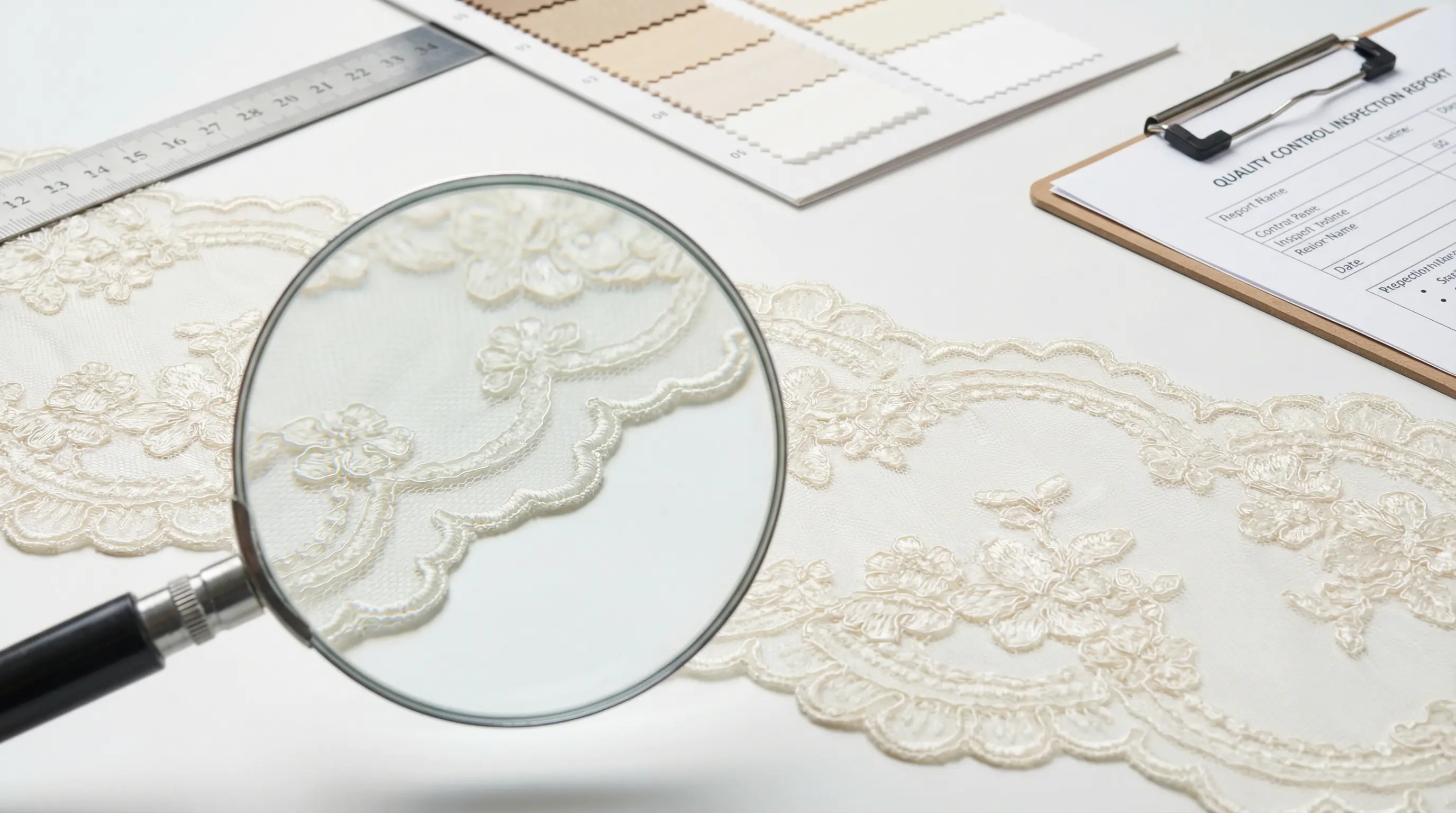
- Quality checkpoint: Hold it up to light. A well-made mesh lace should have even tension across the entire piece. If you see puckering or loose areas, that's a red flag.
Here's something Shawn showed me: he took two samples of mesh lace that looked identical. Same pattern, same color. Then he pulled them lengthwise. One stretched smoothly. The other showed weak points where the embroidery thread had stressed the mesh.
"The second one will fail at the seams," he said. "Maybe not in the factory, maybe not even in the first wash. But it will fail. That's the difference between choosing by price and choosing by production method."
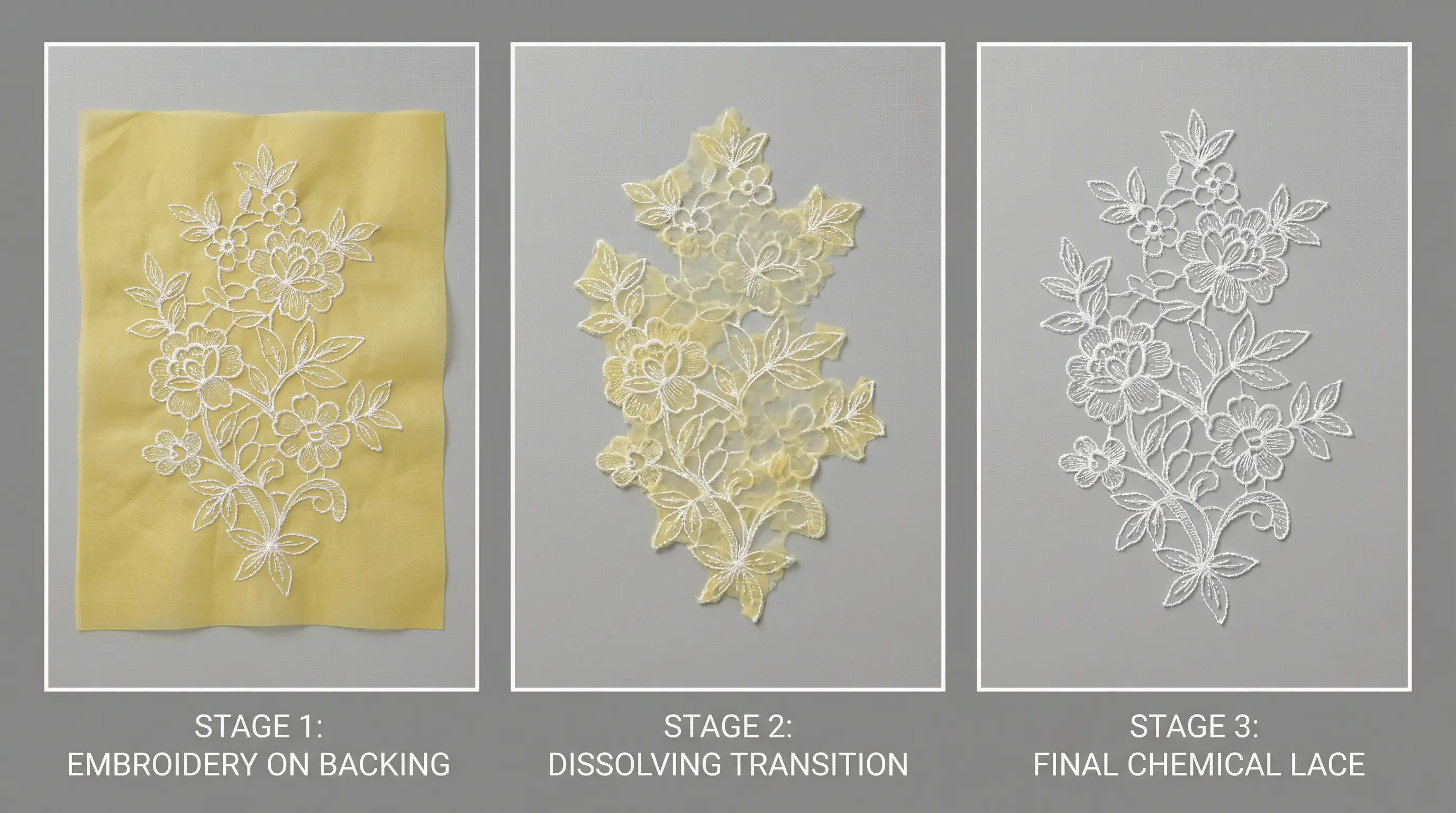
3. Water-Soluble Lace / Chemical Lace
What it is: Embroidery on a water-soluble backing that dissolves during production, leaving only the thread pattern. The result is lace with no base fabric — just the design floating in air.
Best for:
- High-end applications where you want pure lace with no mesh showing
- Appliqués, trims, and decorative elements
- Bridal wear and luxury fashion
Technical specs:
- MOQ: 300-500 yards (lower volumes possible but price per yard increases)
- Lead time: 25-35 days (the dissolution process adds time)
- Key advantage: The most delicate, premium-looking option
- Cost reality: Expect to pay 30-40% more than mesh lace for the same design
Eric tells me buyers often hesitate at this price point. His answer: "You're not paying for more material. You're paying for less. The process of removing the backing is what costs money — and what creates that floating effect your customer is willing to pay for."
4. Stretch Lace
What it is: Any of the above lace types, but woven or blended with elastane/spandex to add stretch.
Best for:
- Lingerie and intimate apparel
- Fitted garments that need to move with the body
- Activewear details
Technical specs:
- MOQ: 500-800 yards (elastane blends require specialized equipment)
- Lead time: 30-40 days (longer than non-stretch versions)
- Key advantage: Comfort and fit for body-conscious designs
- Important note: See below. This is NOT where first-time buyers should start.
Why we don't recommend stretch lace for your first order:
I learned this the hard way by watching a client's first order go sideways. They were a small US-based lingerie startup, excited about their designs, and they insisted on stretch lace for everything. The problem? Stretch lace is the most technically demanding type to work with.
The elastane fibers behave differently than the base fabric. Cutting requires different blade angles. Sewing requires different tension settings. Even washing samples becomes complicated — you need to test recovery rate, not just color fastness.
Shawn's rule: "Master the basics first. You can add complexity later."
If you're new to lace sourcing, start with mesh lace or crochet lace. Build that relationship. Understand how your supplier manages quality. Then move to stretch.
Quality Checkpoints: What to Look For (And What to Ask)
Here's the truth about lace quality: most problems aren't visible in a photo. You need to know what tests to run, or what questions to ask your supplier to run them for you.
The Light Test
This is Shawn's favorite. It takes five seconds. Hold the lace up to a light source. A window, a lamp, your phone screen. Look for:
- Even illumination: Light should pass through consistently. Dark spots indicate yarn tangles or production errors.
- Mesh integrity: In mesh-based lace, you should see a regular grid pattern. Irregular holes mean the backing is compromised.
- Thread tension: The embroidered pattern should sit flat. If it's puckering, that's a tension issue. It will get worse with handling.
When buyers visit our factory, Shawn always does this test with them. I've watched him reject entire batches because of inconsistencies that weren't obvious to the naked eye — but showed up immediately under light.
The Pull Test
Gently pull the lace widthwise and lengthwise. You're looking for:
- Recovery: When you release tension, does the lace return to its original shape? Or does it stay stretched?
- Thread integrity: Do any threads snap or separate?
- Edge behavior: Do the edges start to unravel?
This is especially important for mesh lace. The embroidery thread and the mesh base need to move together. If one is stronger than the other, you'll see stress points.
The Edge Examination
Look closely at how the lace edges are finished:
- Scalloped edges: Should be smooth and even. Ragged scallops indicate rushed production.
- Straight edges: Should have a clean selvedge or a proper finishing thread.
- Cut edges: If the lace is sold by the yard with raw edges, ask how it will behave when cut for your garments.
Shawn's philosophy: "The edge is where you see if someone cares. It's the last thing they touch before shipping. If the edge is sloppy, the whole production was probably sloppy."
Lead Times & MOQ: The Real Decision Factors
Let's talk about what actually determines whether you can work with a lace supplier.
Minimum Order Quantities
Our standard MOQs:
- Stock patterns/colors: 300-500 yards
- Custom colors on existing patterns: 500-800 yards
- Fully custom patterns: 1000+ yards
Can you negotiate these down? Sometimes. Here's Eric's framework:
"If you're a first-time buyer asking for 200 yards of custom lace, the honest answer is: probably not. The setup costs don't change whether we're running 200 yards or 1000 yards. But if you're willing to choose from our stock patterns, or if you can commit to regular orders over time, we can work with you."
The other option: start with samples. We offer 1-5 yard sample orders for buyers who want to test the market before committing to production volumes. Many of our best long-term clients started this way.
Lead Time Realities
Here's what goes into those 20-30 day lead times people see on websites:
- Pattern programming (if custom): 2-3 days
- Material sourcing: 3-5 days
- Production setup: 1-2 days
- Actual production run: 5-10 days depending on volume
- Quality inspection: 1-2 days
- Finishing and packing: 2-3 days
Notice what's NOT in that timeline? Waiting for other orders to finish. That's what happens when you order during peak season.
Eric's seasonal warning: "We see lace inquiries spike in January-February (spring collections), May-June (wedding season prep), and September-October (holiday party wear). If you're ordering during those windows, add 7-10 days to the standard lead time. Not because we're slower — because you're in line behind everyone else who waited too long."
Common Mistakes (And How to Avoid Them)
After reviewing years of inquiry emails and production issues, here are the patterns we see:
Mistake #1: Choosing lace based only on price per yard
Eric showed me an email thread from last year. A buyer found lace at $3.50/yard from one supplier, $5.20/yard from another (us), and chose the cheaper option. Three months later, they came back to us. The cheap lace had failed their quality testing — threads were breaking during cutting.
The math: They saved $1.70 per yard on 500 yards ($850 total). They lost the entire order ($1,750 in material costs) plus production time, plus customer trust.
Shawn's version: "Price is information. But it's not the only information. If someone's price is significantly lower, there's a reason. Find out what it is."
Mistake #2: Not testing with your actual production process
Order samples. Actually cut them. Actually sew them. Actually wash them.
We've had buyers approve samples based on visual inspection, then discover the lace behaves completely differently under an industrial sewing machine than it did with their home machine. By then, they've committed to 800 yards.
Mistake #3: Forgetting about seasonal lead times
This goes back to Eric's data about peak inquiry periods. The buyers who order lace for Valentine's collections in December get their pick of production slots. The buyers who order in January are choosing from what's left.
This is the same "time as leverage" principle Shawn has been teaching me about wholesale in general: being early isn't about being first — it's about having choices when you order.
Making the Choice: A Framework
When you're evaluating lace suppliers and lace types, here's the decision tree we recommend:
Start with your end product:
- What garment are you making?
- What's the wear environment? (Formal occasion? Daily wear? Performance garment?)
- What's your target price point?
Then ask about specifications:
- What's the required durability? (One-time wear vs. multi-season piece)
- Do you need stretch? (Hint: probably not for your first order)
- What's your volume? (This determines which suppliers can even work with you)
Finally, talk to your supplier about:
- Their quality control process (ours involves light testing and tension testing on every roll)
- Their sample policy (can you test before committing to large orders?)
- Their communication style (Are they responsive? Do they ask clarifying questions or just say "yes" to everything?)
That last point is critical. As Shawn puts it: "A good supplier doesn't just take your order. They ask questions that save you from mistakes you don't even know you're about to make."
What Happens Next
If you've read this far, you probably have specific questions about your specific project. That's exactly what this guide is designed to do — give you enough context to ask those questions intelligently.
Here's what I recommend:
-
Identify your lace type: Based on your garment design and budget, which of the four main types fits your needs?
-
Determine your volume: Do you need full production quantities (500+ yards), or are you in the sample/testing phase (1-5 yards)?
-
Check your timeline: When do you need finished garments in hand? Work backward to figure out when you need lace delivered.
-
Reach out with specifics: The more detail you can provide (even if it's rough), the more accurate the guidance you'll get.
If this sounds like what you're looking for, send a message to info@fominte.com with the basics:
- What you're making
- Rough quantity (even a range is helpful)
- Your timeline
- Any specific requirements (color, stretch, custom pattern, etc.)
I'll make sure Eric's team gets back to you within 24 hours. No 15-page tech pack required — a sketch or a reference photo works. Let's start a conversation.
Final Thought: Why This Matters
There's a reason I'm writing this instead of just listing product specifications on a website. Because lace buying isn't just about picking a product from a catalog. It's about understanding what you actually need, finding a supplier who can deliver that consistently, and building a relationship that works for multiple seasons.
Shawn's been doing this for 35 years. He's seen factories come and go, trends change, clients succeed and fail. The ones who succeed aren't necessarily the ones with the biggest budgets or the flashiest designs. They're the ones who understand their supply chain, who ask good questions, and who treat their suppliers like business partners instead of vending machines.
We don't do one-time orders. Our sweet spot is the buyer who thinks three seasons ahead, not three weeks.
If that's you, we should talk.
Want to explore our lace fabric collections? Visit embroidered-fabric or contact us at info@fominte.com for samples and quotes.
