.png?w=970&h=250)
The Quarter-Zip Fleece Manufacturer's Guide to Waving Zippers and Custom Hems
What It Really Means

The Quarter-Zip Waving Problem
Zipper "waving" or "buckling" is the most common defect in quarter-zip production. Fleece fabric and polyester zipper tapes shrink at completely different rates when exposed to heat. During the post-sewing press or the consumer's first wash, the fleece shrinks. The rigid zipper tape doesn't. That excess zipper length has nowhere to go, twisting into a wavy chest line.
Professional factories must implement strict shrinkage controls before sewing. Here is how Fominte handles it:
- Pre-Shrinking Zippers: We use heat-press machines to pre-expand and stabilize the zipper tape.
- Dimensional Stability Testing: We test bulk fleece batches according to AATCC Test Method 135. We hold the fabric to a strict ±3% tolerance to match the zipper.
We also reinforce the zipper placket with fusible interfacing, locking the vertical grainline in place to distribute tension evenly.
Custom Hardware & MOQs
Branded zipper pullers are usually the first request for custom quarter-zips. A custom Logo adds a premium touch, but it introduces MOQ hurdles.
If you request standard YKK or SBS zippers with generic pullers, we don't require additional MOQs beyond the garment bulk. Bespoke molded logo pullers, however, require custom tooling.
- Tooling Costs: Usually $50 to $150 per mold (zinc alloy or silicone).
- Hardware MOQs: Most premier suppliers require 3,000 to 5,000 pieces per custom puller.
If your order is only 1,000 pieces, you have two options. You can accept the hardware MOQ and stock the remaining 2,000 pullers for future runs. Or, you can opt for laser-engraved logos on standard blank pullers to bypass the high MOQ requirement entirely.
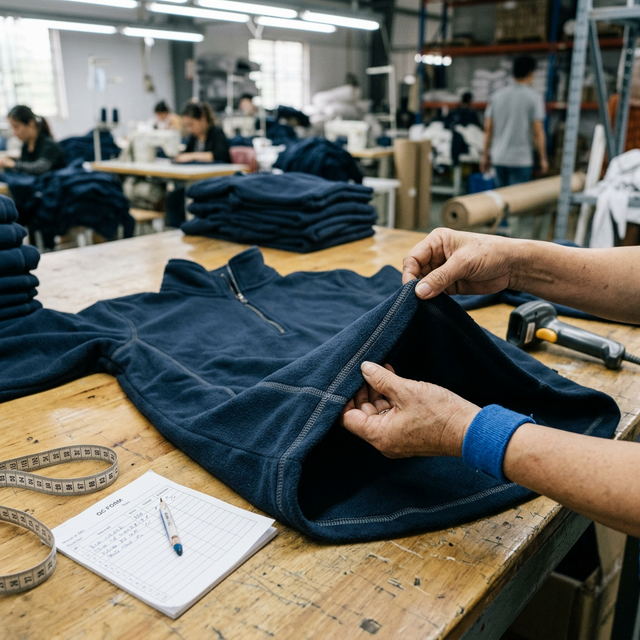
Drop-Tail Hems & Flatlock Seams
The hem and seam construction define the quarter-zip's overall fit. A "drop-tail hem" (longer in the back) is highly requested for activewear because it provides extra coverage during movement.
Sewing a drop-tail hem on thick fleece requires specialized handling. The curved side vents where the front and back hems meet are extreme stress points. If not cleanly bartacked, they will tear during wear.
Using reinforced flatlock seams—which lay completely flat against the skin to prevent chafing—significantly impacts production costs. Flatlock machines require 4 needles and 6 threads, consuming up to 30% more thread than standard overlock stitching. It also reduces the sewing speed (increasing the Standard Allowed Minutes, or SAM, per garment). Expect flatlock seaming to add a premium to your final FOB price. The upgrade in comfort is usually worth the investment for high-end brands.
Managing Production Costs at Scale
When scaling up to bulk production, millimeters matter. The length of the quarter-zip directly impacts fabric marker efficiency.
A standard quarter-zip length is usually 1/4 of the center front length (7 to 9 inches). If a designer extends the zipper to a "deep-zip" (12+ inches) for a relaxed neckline, it completely changes how the front panels are cut. This can drop marker efficiency by 2-5%, increasing fabric waste and cost.
A reliable OEM partner will work with your tech packs during sampling to optimize these lengths. By adjusting the zipper drop by just half an inch, we often significantly improve fabric utilization, passing wholesale cost savings back to your bottom line.

Comparison
| Hardware Type | Tooling Cost | MOQ Requirement |
| Generic (YKK/SBS) | None | No extra MOQ |
| Laser Engraved Blank | None | No extra MOQ |
| Bespoke Molded Logo | $50-$150 | 3k-5k pieces |
⚡ Common Mistakes to Avoid
Everything You Need to Know
Conclusion