.png?w=970&h=250)
The Truth About Stretch Cotton Jersey: A Factory's Perspective for B2B Sourcing
What It Really Means
Beyond the Basics: What Makes True Stretch Cotton Jersey?
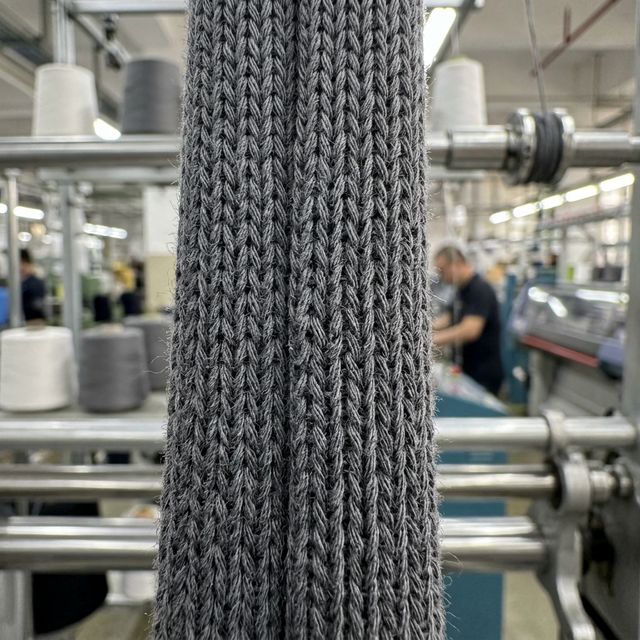
Let's establish the baseline. A standard 100% cotton jersey is a breathable, soft knit fabric made entirely of cotton yarns. But when you add elasticity into the mix—creating what the industry calls stretch cotton jersey or cotton spandex jersey knit—you are fundamentally changing how the fabric behaves on the machines.
The industry standard "golden ratio" is usually 94-95% cotton blended with 5-6% spandex (elastane). However, not all 95/5 blends are created equal. The difference lies in the spinning process.
In high-quality single jersey fabric production, the spandex core is fully wrapped by the cotton fibers. We call this core-spun yarn. In cheaper alternatives, the spandex is simply plated (laid alongside) the cotton during the knitting process. Plated spandex is cheaper and faster to produce, but it exposes the elastic fibers to direct heat during dyeing and washing, which brings us to the first major trap in wholesale sourcing.
The 3 Hidden Traps in Wholesale Stretch Cotton Jersey Sourcing
When a brand switches suppliers to save 50 cents a yard, they often walk directly into one of these three manufacturing traps.
Trap 1: The Dye Lot Consistency Nightmare
Achieving color consistency on 100% cotton is relatively straightforward. Achieving it on a cotton-spandex blend is a chemical puzzle. Cotton and spandex absorb dyes at completely different temperatures and rates.
When dyeing stretch cotton jersey, the fabric must undergo a high-temperature setting process to stabilize the spandex. If the factory uses inferior dyes or rushes the setting process to save on energy costs, the spandex fibers won't take the dye properly. Have you ever stretched a dark navy or black t-shirt and seen shiny, white elastane fibers grinning through the color? That is the result of cheap dyeing processes.
More importantly, rushed dyeing leads to severe dye lot variations. Roll A might be a perfect midnight blue, while Roll B from the next batch looks slightly purple under fluorescent lights. For a brand owner, inconsistent fabric means unmatched sleeves and bodies on the sewing floor. Your fabric savings are instantly vaporized by a 15% garment rejection rate.
Trap 2: Fake Pre-Shrunk Processes & Shrinkage Rates
Cotton shrinks; that is a fact of nature. When you add the inherent tension of stretch knitting, you have a fabric practically begging to contract the moment it hits hot water.
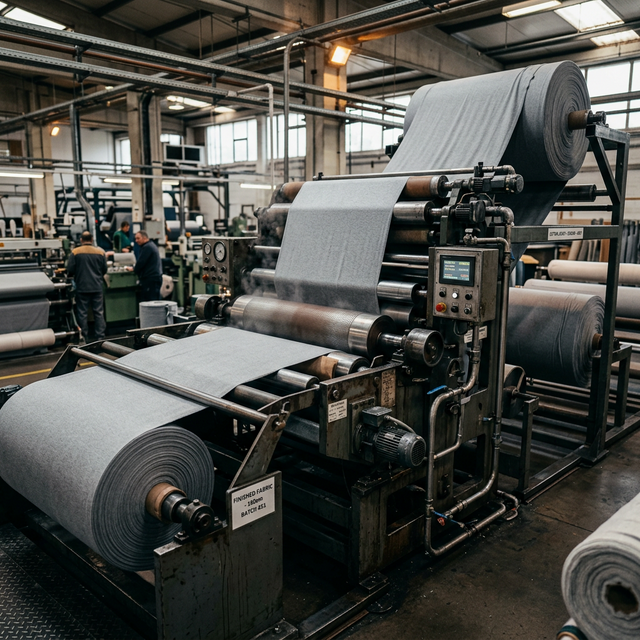
A reliable supplier will guarantee a shrinkage rate—usually under 5% for high-quality cotton spandex jersey knit. To achieve this, the fabric must go through rigorous pre-shrinking (compacting and steaming) at the factory level.
This process costs money. It requires heavy machinery and massive amounts of steam. Crucially, it slows down the entire production line. Many low-cost suppliers skip the deep compacting stage. They might run it through a light steam bath and call it "pre-shrunk" to secure the order. The result? You sew the garments to spec, the consumer washes them once, and a size Large t-shirt becomes a tight size Medium.
If a supplier's price is suspiciously low, ask for their official shrinkage tolerance data before you wire a 30% deposit.
Trap 3: Elastic Fatigue After 5 Washes
A brand’s reputation isn't built on how the garment looks on the hanger; it's built on how it fits after the fifth wash.
Elastic fatigue happens when the spandex fibers break down or lose their "memory" due to poor quality extrusion or improper heat setting during manufacturing. Cheaper stretch cotton jersey fabric feels perfectly stretchy on the swatch card, but the stretch recovery rate plummets after standard domestic laundering. The elbows bag out, and the necklines sag. Eventually, your customer leaves a one-star review.
Eric, our Head of Sales, often has this conversation with prospective clients. "You're not just paying for the material weight. You are paying for the durability of the tension structure. The front presentation is the sales pitch; the structural integrity is the truth."
How Fominte Controls Quality in Bulk Production
At Fominte, we don't treat wholesale strictly as a volume game; we treat it as an engineering challenge. When you order 5,000 yards of stretch cotton jersey from us, here is what happens behind the scenes:
1. Strict Yarn Sourcing: We mandate core-spun yarn for all premium stretch jersey orders to protect the elasticity and ensure uniform dye absorption.
2. Controlled Heat Setting: Our stenter frames are calibrated to stabilize both the cotton and the spandex without degrading the elastic memory. We don't rush the line speed to pump out more volume.
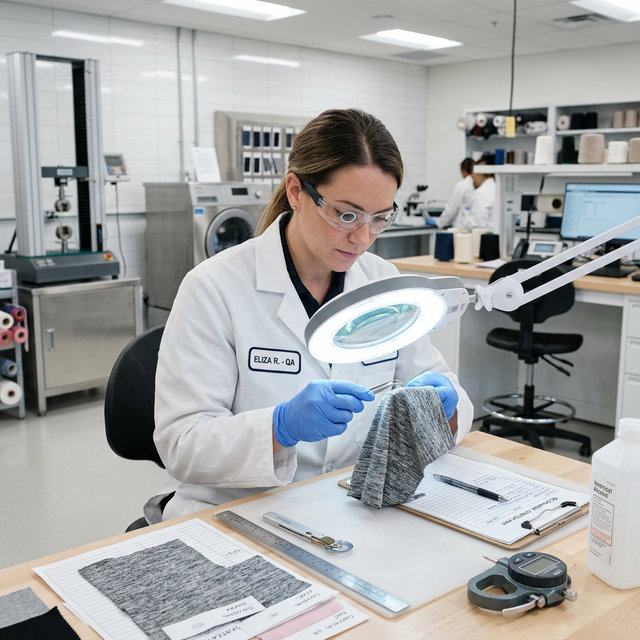
3. The 3-Point Shrinkage Test: Before a batch leaves the floor, the fabric must pass our internal wash tests to ensure the shrinkage rate stays firmly within the agreed AQL limits.
We also operate on transparent, factory-level MOQs. Unlike wholesalers who sell stock yardage from unknown origins, our make-to-order production means your batch is dyed in the same vat, processed on the same line, and tensioned on the same frame. Our MOQ isn't arbitrarily set to be difficult; it is determined by the capacity of the dye vats required to guarantee zero dye lot variation across your entire order.
Make-to-Order vs. Stock Fabrics for Your Brand
Many emerging buyers look for vendors offering "no MOQ" stock fabrics. If you are producing 50 pieces for a local boutique, stock fabric is fine. But if you are scaling a reliable brand, relying on wholesale stock fabric is a massive liability.
With stock fabric, you have no control over the dye formula, no assurance of the shrinkage rate, and when you need to reorder the exact same color in six months, it simply won't match.
Make-to-order manufacturing secures your supply chain. Yes, it requires better demand forecasting and a willingness to commit to vat-level MOQs. But as Shawn points out when discussing wholesale strategy: "Timing in wholesale isn't about being first. It's about being early enough that you still have choices. The client who orders early isn't just getting their product faster. They're getting better product because they had real choices."
Comparison
| Sourcing Method | Pros | Cons | Best For |
| Make-to-Order (MTO) | Precise dye lot control, custom physical specs (GSM, width, shrinkage) | Higher Minimum Order Quantity (MOQ), longer lead times | Mid-to-large brands requiring strict consistency across seasons |
| Stock Fabric | Immediate availability, lower MOQ for initial sampling | High risk of dye lot variation, questionable shrinkage rates | Small test runs or fast-fashion drops |
⚡ Common Mistakes to Avoid
Everything You Need to Know
Conclusion