.png?w=970&h=250)
What Determines Fleece Product Price? GSM, Construction, and 4 Other Cost Factors
What It Really Means
Fleece product price is determined by six factors: GSM weight, fabric construction, trim selection, order volume, lead time urgency, and post-treatment processes. Most buyers compare unit price on a quotation sheet. Smart buyers compare total cost — and that requires understanding what's behind each number.
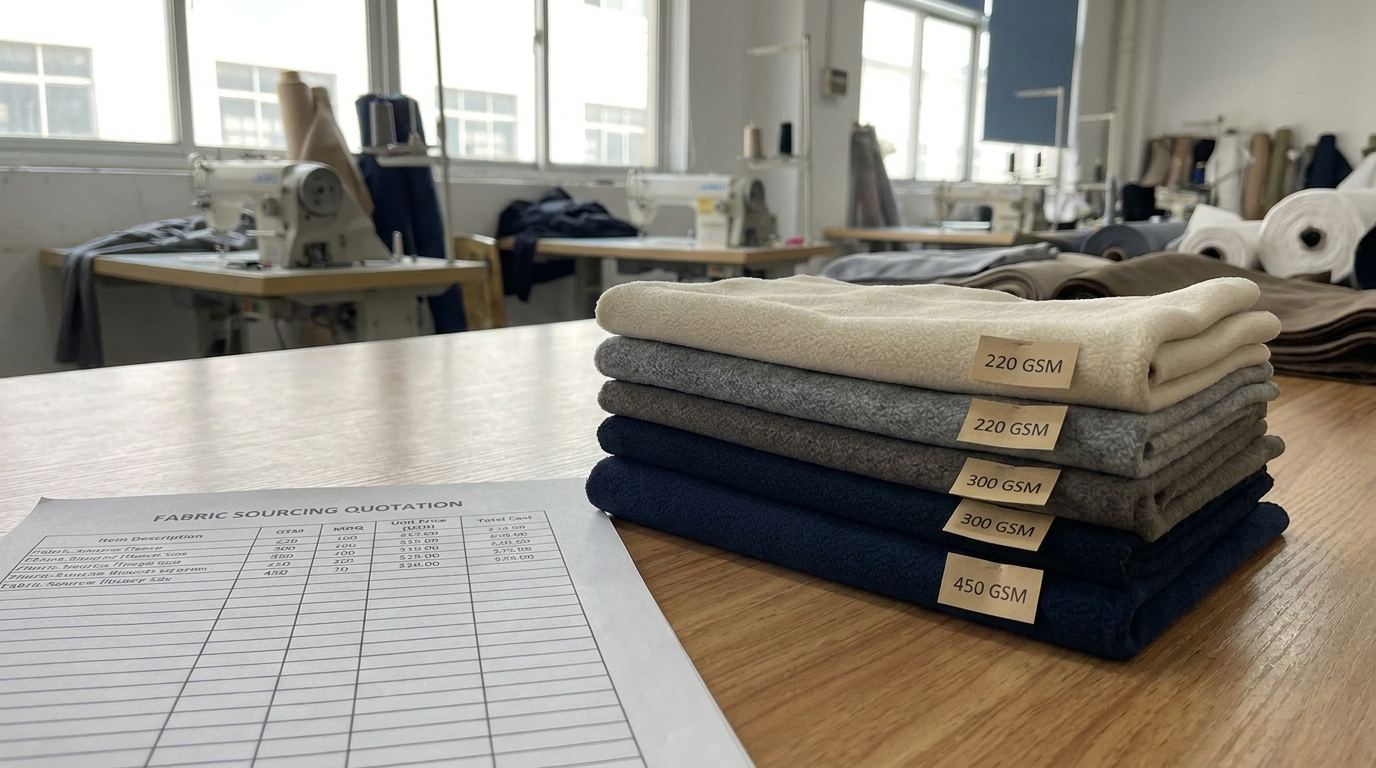
The 6 Factors That Determine Your Fleece Product Price
When I review inquiries through our system, I see the same pattern every week. A buyer sends a tech pack, gets a quotation, and immediately asks: "Why is this more expensive than what I paid last time?" Or they send me a competitor's price and ask us to match it.
The problem isn't the price. The problem is that they're comparing apples to oranges without knowing it. Two fleece products can look identical in a photo but cost 30% more to produce because of differences you can't see from a product listing.
Here are the six factors that actually determine what you pay.
GSM Weight: Why Heavier Fleece Costs More
GSM — grams per square meter — is the most obvious cost driver, but it's also the most misunderstood. Buyers know that higher GSM means heavier fabric. What they don't always realize is how that weight translates to raw material consumption.
A 200 GSM polar fleece uses roughly 40% less polyester than a 300 GSM version. That's not a marginal difference — it compounds across every meter of fabric in your order. When you're ordering 10,000 meters, the GSM choice alone can swing your material cost by thousands of dollars.
Here's the breakdown most suppliers won't give you:
- 100-200 GSM: Lightweight microfleece, typically used for layering pieces and linings. Material cost is lowest, but the fabric has less body and warmth retention. (For a complete breakdown of fleece types by GSM, see our fleece product range overview.)
- 200-300 GSM: The standard range for polar fleece jackets and hoodies. This is where most wholesale orders land — good balance of warmth, weight, and cost.
- 300+ GSM: Heavyweight fleece and sherpa. Material cost jumps significantly, but so does the perceived value at retail.
I see this mistake constantly. Buyers default to the heaviest GSM because they think "heavier equals better quality." Not true. A well-made 250 GSM anti-pill fleece will outperform a cheap 350 GSM fleece after 20 washes. GSM tells you how much material is in the fabric. It doesn't tell you how good that material is.
Fabric Construction: Single-Sided vs Double-Sided vs Sherpa
This is where most quotation comparisons fall apart. Buyers compare prices between a single-sided polar fleece and a double-sided sherpa without accounting for the production complexity difference.
Single-sided fleece — the standard polar fleece you see everywhere — has one brushed face and one smooth back. It requires one finishing pass. That's it.
Double-sided fleece has brushed surfaces on both faces. The production process requires two finishing passes, which means more machine time, more energy consumption, and more quality control checkpoints. Expect 15-25% higher production cost compared to single-sided at the same GSM.
Sherpa and teddy fleece add another layer of complexity. The pile construction is different — longer, denser fibers that require specialized finishing equipment. (If you want a deep dive on how these pile types differ, we covered that in our sherpa vs teddy vs fluffy fleece guide.) The cutting process is also more demanding because pile direction matters. Our floor team at Fominte will tell you: cutting sherpa without matching pile direction across panels is a fast way to get complaints about color variation in the finished garment.
The construction type also affects your defect rate. More complex constructions have more opportunities for production issues. At Fominte, we maintain a defect rate below 2% across all fleece types, but that's because we've invested in the right equipment and trained our team specifically for each construction type. (You can see exactly how our production line handles different fleece types in our fleece production line walkthrough.) Not every supplier has that setup.
Trim and Accessories: The Hidden Cost Driver
This is the factor that surprises buyers the most. They focus on fabric cost and forget that a fleece jacket isn't just fabric — it's zippers, drawcords, toggles, labels, and sometimes lining.
Trim and accessories typically account for 10-20% of the total garment cost. But that percentage can swing wildly depending on your specifications.
A basic #5 nylon zipper costs a fraction of a YKK Vislon zipper. Metal toggles cost more than plastic ones. Reflective drawcords cost more than standard polyester cords. Each choice seems small in isolation, but they add up fast across a large order.
Last year, a client compared our quotation to a competitor's. Ours was 12% higher. When we broke down the difference, 8% came from trim choices — we'd quoted YKK zippers and reinforced seam tape because that's what their tech pack specified. The competitor had quietly swapped in generic components.
I'm not saying expensive is always better. I'm saying you need to know what you're paying for. Ask for a trim breakdown. If the supplier can't give you one? Red flag.
Order Volume: The Quantity Breakpoint
Every buyer knows that larger orders mean lower unit prices. But the relationship isn't linear — it follows a curve with specific breakpoints where the price drops meaningfully.
At Fominte, we see the biggest price jumps at these thresholds:
- 500-1,000 pieces: Base pricing, highest unit cost
- 1,000-3,000 pieces: 8-12% reduction, material procurement becomes more efficient
- 3,000-5,000 pieces: 12-18% reduction, production line optimization kicks in
- 5,000+ pieces: 18-25% reduction, bulk material pricing and dedicated production runs
The reason for these breakpoints isn't just material volume — it's production efficiency. Setting up a production line for fleece takes time and resources regardless of whether you're making 500 pieces or 5,000. That setup cost gets amortized across more units at higher volumes.
But here's what most buyers miss: the cheapest unit price isn't always the best deal. If you order 5,000 pieces but can only sell 3,000, you've just paid for 2,000 pieces of deadstock. The "savings" from the volume discount are eaten by inventory carrying costs.
Eric, our head of sales, puts it this way: "The buyer who orders 3,000 pieces and sells all of them makes more money than the buyer who orders 5,000 and sits on the rest. Volume discounts are real, but only if the volume moves."
Lead Time Urgency: When Speed Costs Money
Standard lead time for fleece production at Fominte is 20-40 days depending on complexity and order size. That's our normal pace — quality checks at every stage, proper finishing, careful packaging. (For a full breakdown of MOQ policies and lead time expectations, see our fleece MOQ and export guide.)
When a buyer needs it faster, the cost goes up. Not because we're charging a "rush fee" as a penalty, but because faster production genuinely costs more to execute.
Here's why:
Overtime labor: Our team works regular shifts. Asking them to work overtime means overtime pay — typically 1.5x the normal rate for evenings and weekends.
Air freight vs sea freight: If your order is urgent enough that sea freight won't meet your deadline, you're looking at air freight costs that can be 5-8x higher. For a 3,000-piece fleece order, that difference alone can be thousands of dollars.
Production line disruption: When we prioritize a rush order, it means other orders get pushed back. That has a cost — either in overtime for the displaced orders or in client relationships when their lead times extend.
Peak season surcharge: September through January is peak season for fleece. Everyone wants winter inventory. Production slots fill up fast, and the ones that remain available command premium pricing because demand outstrips supply.
Shawn, our founder, has a saying: "The client who orders early isn't just getting their product faster. They're getting better product because they had real choices." Planning your order timeline isn't just about avoiding rush fees — it's about having access to the best production resources when you need them.
Post-Treatment Processes: Anti-Pill, Flame-Retardant, and Beyond
The base fleece product is just the starting point. The finishing treatments you specify can add 10-30% to the production cost, depending on the process.
Anti-pill treatment: This is the most common add-on. It involves a chemical or mechanical process that reduces fiber tangling on the fabric surface. It adds roughly 10-15% to the fabric cost, but it dramatically extends the product's appearance life after multiple washes. For wholesale orders intended for retail, the investment almost always pays off through lower return rates.
Flame-retardant treatment: Required for certain markets (especially the US and EU) depending on the product category. This is a more expensive process — expect 15-25% cost increase — and it requires specific testing and certification to meet standards like CPSC 16 CFR 1610 (US) or EN 14878 (EU).
Water-repellent coating (DWR): Adds another 8-12% to the cost. Durable Water Repellent coatings are popular for outdoor fleece products, but the cost adds up when combined with other treatments.
Brushing and napping variations: Different brush depths and nap heights create different textures — from smooth polar fleece to lofty sherpa. Each variation requires different machine settings and finishing passes, which affects production time and cost.
The key question to ask yourself: which treatments does your market actually require? I've seen buyers specify flame-retardant treatment for products that don't legally need it, adding cost without adding market value. And I've seen buyers skip anti-pill treatment to save 10%, only to deal with customer complaints after the first wash.
At Fominte, we hold OEKO-TEX Standard 100 certification, which means our finishing processes meet strict chemical safety standards. That's not just a certificate — it's a cost factor built into our pricing because we use compliant chemicals and processes. When you compare our price to a supplier without that certification, part of the difference is the cost of compliance.
The Total Cost of Ownership: Why Unit Price Isn't Everything
Here's the conversation I have with almost every new buyer: they come in focused on unit price, and I try to shift their focus to total cost of ownership.
Total cost of ownership includes:
Defect rate and replacement cost: If a supplier's defect rate is 5% instead of 2%, that's 3% of your order that needs replacement. On a 5,000-piece order, that's 150 pieces — plus the shipping cost, the time delay, and the customer goodwill you lose while waiting for replacements. At Fominte, we maintain a defect rate below 2% through rigorous quality control at every production stage. That's not a marketing number — it's a factory floor reality backed by decades of process refinement.
Return rate: Products that pill after three washes, shrink after the first wash, or lose color in sunlight come back as returns. Each return costs you the original sale plus return shipping plus processing. Anti-pill treatment and proper shrinkage control aren't luxuries — they're insurance against return costs.
Inventory carrying cost: If you over-order to get a volume discount but can't move the stock, you're paying for storage, insurance, and opportunity cost on that capital. Sometimes the "more expensive" supplier who lets you order the right quantity is actually cheaper in the long run.
Communication and rework cost: When a supplier misunderstands your tech pack or substitutes materials without asking, the rework cycle costs time and money. Clear communication and proper documentation aren't soft benefits — they're cost avoidance.
Shawn built this factory on one principle: "Quality is not a cost. It's an investment." The buyers who get that? They stay. The ones chasing the lowest unit price? They're gone by next season, looking for another supplier, wondering why their returns keep climbing.
How to Read a Fleece Quotation Like a Pro
When you receive a quotation from a fleece supplier, here's what to look for:
Fabric cost breakdown: This should show GSM, construction type, and per-meter or per-kilo pricing. If it just says "fleece fabric" without specifying the construction, ask.
Trim line items: Zippers, drawcords, toggles, labels — each should be listed separately with specifications. Generic listings like "accessories" are a red flag.
Production cost vs total cost: Some suppliers quote production cost separately from packaging, labeling, and shipping. Others bundle everything. Make sure you're comparing the same scope.
MOQ and volume tiers: The quotation should show how the unit price changes at different order volumes. If it doesn't, ask for a tiered pricing table.
Lead time with and without rush: Understanding the standard timeline helps you plan. Understanding the rush premium helps you make informed decisions when deadlines shift.
Eric has a line he uses with buyers that I think about a lot: "If you're comparing two quotations and one is 15% cheaper, don't assume it's a better deal. Ask what's different. Nine times out of ten, the difference is in the details — lower GSM, cheaper trims, or a supplier who's cutting corners you won't find out about until the product lands."
FAQ — Fleece Pricing Questions Buyers Also Ask
Why is anti-pill fleece more expensive than regular fleece? Anti-pill treatment adds a finishing step that increases cost by 10-15%, but it significantly extends the product's appearance life after multiple washes. For wholesale orders intended for retail, the investment pays off through lower return rates. At Fominte, we recommend anti-pill treatment for any fleece product that will be washed more than five times during its lifecycle.
How much does GSM affect fleece product price? GSM is one of the biggest cost drivers. Moving from 200 GSM to 300 GSM typically increases fabric cost by 25-40% due to higher raw material consumption. However, heavier fleece commands higher retail prices, so the margin often justifies the cost. The key is matching GSM to your product's intended use — don't pay for 350 GSM when 250 GSM will do the job.
What's the price difference between ordering 500 pieces vs 5,000 pieces? At 5,000 pieces, you can typically expect 15-25% lower unit cost compared to 500 pieces. The savings come from bulk material procurement, production efficiency, and shared setup costs. At Fominte, we work with buyers to find the volume that balances their budget with their market needs — sometimes that means starting with 1,000 pieces and scaling up after the first successful order.
When to Use & Avoid
Retail Fashion Brands
✅ Use When
- Match GSM to product tier (200-250 for fast fashion, 300+ for premium)
Outdoor and Performance
✅ Use When
- Specify DWR coating for water resistance
Home Textiles and Blankets
✅ Use When
- Sherpa construction for tactile appeal
Promotional and Bulk Orders
✅ Use When
- Optimize GSM for cost efficiency
Comparison
| Cost Factor | Impact on Price | Typical Range | Buyer Control |
| GSM Weight | 25-40% increase from 200 to 300 GSM | 100-400+ GSM | |
| High: choose GSM for end-use | |||
| Fabric Construction | 15-25% increase for double-sided vs single-sided | Single/Double/Sherpa | |
| Medium: match construction to product | |||
| Trim and Accessories | 10-20% of total garment cost | Varies widely | |
| High: specify exact components | |||
| Order Volume | 15-25% lower at 5000+ vs 500 pcs | 500 to 5000+ pcs | |
| Medium: plan inventory carefully | |||
| Lead Time Urgency | 10-30% for rush orders | 20-40 days standard | |
| High: order early | |||
| Post-Treatment | 10-30% depending on process | Anti-pill/FR/DWR | |
| Medium: specify only what market requires |
⚡ Common Mistakes to Avoid
Everything You Need to Know
Conclusion