.png?w=970&h=250)
Mesh vs Crochet vs Chemical Lace: Which Should You Choose for Bulk Orders?
What It Really Means
For bulk garment production, not all lace is created equal. Mesh lace works best for high-volume orders with tight lead times, crochet lace delivers premium texture but higher costs, while chemical lace offers intricate patterns but requires specialized base fabric. The right choice depends on your order volume, design complexity, and price point.
Having overseen the production of more than 2 million yards of lace across these three categories, I've seen brands waste significant development time and cost by choosing the wrong lace type for their collection. This guide breaks down the actual factory data to help you make the right call from day one.
The Three Main Lace Categories for Industrial Embroidery
Before we dive into comparisons, let's clarify what each lace type actually means in a factory context—not the craft definitions you'll find on hobbyist blogs.
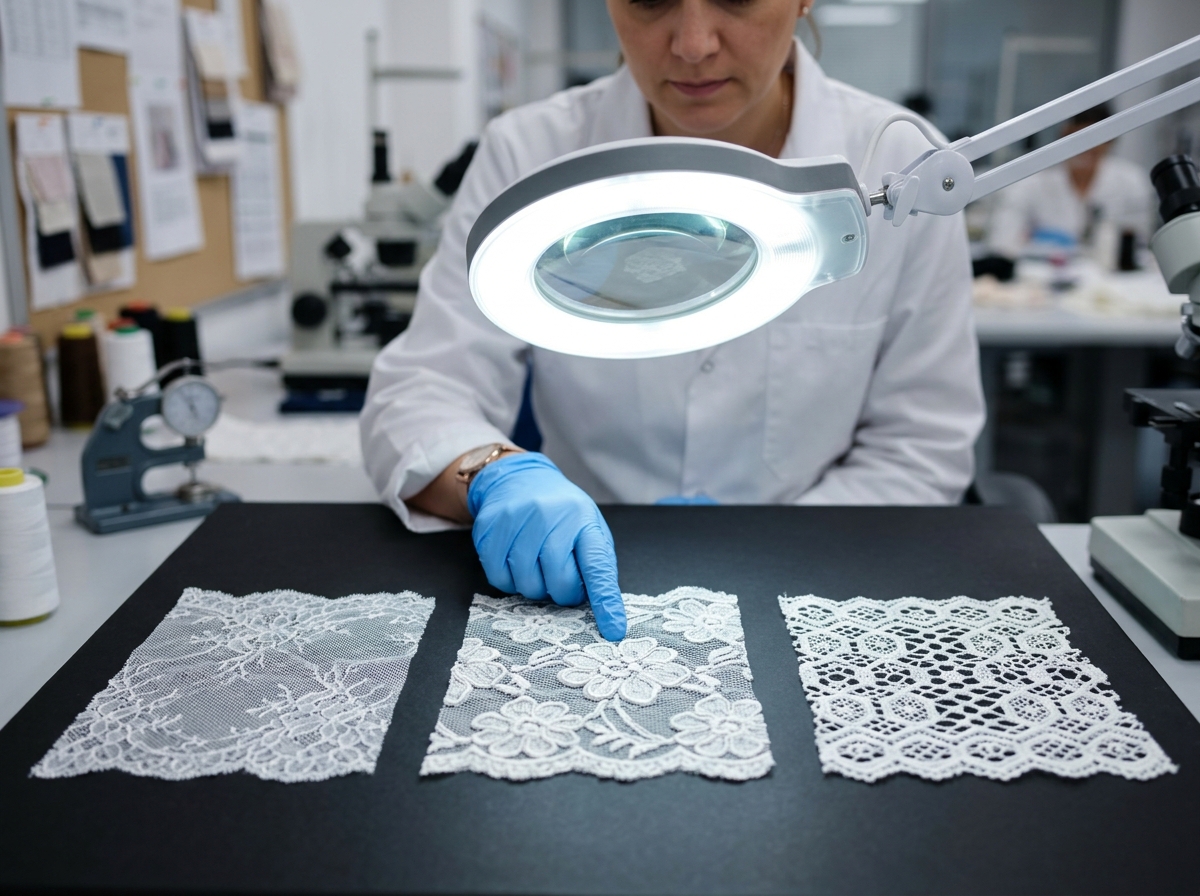
![Prompt: Industrial lace production comparison showing three different lace types on factory inspection tables, mesh on left, crochet in middle, chemical lace on right, bright factory lighting, realistic textile photography style, no text]
Mesh Lace (Embroidery on Net Base)
Mesh lace is the workhorse of industrial lace production. We take a pre-woven polyester or nylon net base and embroider patterns directly onto it using multi-head Tajima machines.
Key characteristics from a production perspective:
- The net base provides inherent stability, making it the fastest to embroider
- Minimal shrinkage after washing (typically 1-2%)
- Can be produced on standard embroidery equipment without special setup
- Patterns are limited by the net grid size (usually 5mm or 10mm)
In our factory, mesh lace accounts for about 65% of total lace production volume. It's the default choice for most fast fashion brands and high-volume basics collections.
Crochet Lace (Woven Directly on Looms)
Crochet lace is not embroidered—it's created directly on specialized crochet looms that interlace yarns to form the pattern simultaneously with the base structure. There's no separate net base; the entire piece is one continuous textile.
Key characteristics from a production perspective:
- Heavier weight and more pronounced texture than mesh lace
- Higher raw material consumption (uses 2-3x more yarn per square yard)
- Production speed is limited by loom speed, not embroidery heads
- Edge stability is excellent—rarely curls or distorts during garment sewing
Crochet production is more capital-intensive, so fewer factories specialize in it. We partner with three dedicated crochet mills in Zhejiang that handle this category exclusively.
Chemical Lace (Water-Soluble Process)
Chemical lace starts with embroidery on a water-soluble PVA (polyvinyl alcohol) base film. After embroidery is complete, the entire piece goes through a washing process that dissolves the base completely, leaving only the embroidered pattern.
Key characteristics from a production perspective:
- Most intricate patterns possible—no net grid limitations
- Lightest weight and most delicate hand feel
- Additional washing and drying steps add to production time
- Higher defect rate due to thread breakage during washing
Chemical lace is the premium category, accounting for about 10% of our total lace production. It's primarily used in bridal, evening wear, and high-end lingerie.
Side-by-Side Comparison (Cost, MOQ, Lead Time, Quality)
Here's the actual factory data from our 2025 production records. These are real numbers, not the "estimates" you'll see on supplier websites.
| Parameter | Mesh Lace | Crochet Lace | Chemical Lace |
|---|---|---|---|
| Cost per Yard (USD) | $1.20 - $2.80 | $3.50 - $6.20 | $4.20 - $8.50 |
| Standard MOQ | 500 yards | 1,000 yards | 800 yards |
| Production Lead Time | 10-15 days | 20-30 days | 18-25 days |
| Typical Defect Rate | < 1.5% | < 2.0% | < 3.5% |
| Max Weekly Output | 25,000 yards | 8,000 yards | 6,000 yards |
| Wash Shrinkage | 1-2% | 3-5% | 2-4% |
| OEKO-TEX Certified? | Yes | Yes | Yes |
What these numbers mean for your planning:
Cost premium: Crochet lace costs about 2.5x more than basic mesh lace, while chemical lace sits in between but can go higher for very intricate designs.
Lead time impact: If you're on a 30-day total production schedule, crochet lace is already at the edge of what's feasible without expediting charges.
Quality considerations: The higher defect rate for chemical lace means you should budget 5% extra yardage for cutting wastage, compared to 2-3% for mesh lace.
How to Match Lace Type to Your Collection
Now let's translate these technical specs into actual decision guidelines based on what you're producing.
Choose Mesh Lace When:
- You're producing fast fashion or high-volume basics (5,000+ yards per style)
- Cost efficiency is your primary concern
- You need fast turnaround for replenishment orders
- The design uses geometric patterns or allover designs that work within a grid
- The final garment will be lined (mesh lace is slightly see-through on its own)
Example: A European fast fashion brand recently ordered 12,000 yards of black mesh lace for their summer dress collection. Total production time was 12 days, and the final cost came in 40% below their initial crochet lace estimate.
Choose Crochet Lace When:
- You're working on premium or designer collections where texture is a key selling point
- You need heavy-weight lace for outerwear or structured garments
- The collection has longer lead times (minimum 45 days from order to delivery)
- Edge stability during garment sewing is critical
- Your brand positions itself on material quality and craftsmanship
Our crochet lace production has grown 38% year-over-year as more mid-tier brands upgrade from mesh to differentiate their collections.
Choose Chemical Lace When:
- You need intricate, free-flowing patterns (florals, vines, organic shapes)
- The garment is bridal, evening wear, or lingerie where a delicate hand feel is essential
- You want the "no base" look that only soluble lace can achieve
- Your customers are premium price-point buyers who value craftsmanship over cost
- You've built extra time into your production schedule for the washing process
One important caveat: chemical lace cannot be stretched or pulled during garment assembly, as it has no elastic base structure. Your sewing team will need to adjust their handling accordingly.
Common Pitfalls When Ordering Lace in Bulk
After processing thousands of lace orders, these are the three most common mistakes that cause production delays or quality issues.
Pitfall #1: Choosing Chemical Lace for Tight Deadlines
Brands often see the beautiful chemical lace samples and decide to switch last minute, forgetting that the washing and drying process adds a minimum of 5 business days to production. We had a US bridal brand push back their entire collection launch by 3 weeks because they made this exact switch 10 days before their original ship date.
The fix: Lock in your lace type at the tech pack stage, not during sampling.
Pitfall #2: Underestimating Crochet Lace Shrinkage
Crochet lace has higher natural shrinkage (3-5%) because of its looser weave structure. Brands that don't account for this in their pattern grading end up with garments that run small after washing. We recommend ordering a 2-yard test strip, washing it according to your care instructions, and measuring the actual shrinkage before bulk production.
Pitfall #3: Assuming All Mesh Lace Is the Same
Mesh lace quality varies dramatically based on the net base quality. Cheap polyester nets have uneven tension that causes embroidery patterns to shift, resulting in a wavy, distorted final product. Our QC team rejects about 8% of incoming mesh base fabric for this exact reason.
The floor team has a simple test: hold the mesh up to the light and look for consistent grid spacing. If you see wavy lines or uneven openings, that base will cause problems during embroidery.
Frequently Asked Questions
Which lace is most cost-effective for bulk orders?
Mesh lace is almost always the most cost-effective choice for high-volume orders. The combination of faster production speed, lower defect rate, and readily available raw materials makes it 30-50% cheaper than the other two categories per finished yard.
Can chemical lace be produced in large quantities?
Yes, chemical lace can be produced in large quantities, but not at the same speed as mesh lace. Our maximum weekly output for chemical lace is 6,000 yards, compared to 25,000 yards for mesh lace. For orders over 20,000 yards, we recommend phased delivery schedules to maintain consistent quality.
What's the minimum order quantity for each lace type?
Our standard MOQs are 500 yards for mesh lace, 1,000 yards for crochet lace, and 800 yards for chemical lace. For existing clients with consistent order history, we can occasionally negotiate lower MOQs for repeat designs where the production setup already exists.
Your Three-Step Decision Framework
Before placing your next lace order, run through this quick framework:
- Calculate your volume: If ordering 5,000+ yards, start with mesh lace unless you have specific texture requirements.
- Check your timeline: If production turnaround is under 20 days, eliminate crochet and chemical lace from consideration.
- Define your value proposition: If your brand sells on "affordable style" → mesh. If "premium texture" → crochet. If "intricate craftsmanship" → chemical.
There's no universally "best" lace type—each has its place depending on your brand's priorities. The mistake I see most often is choosing based on sample aesthetics alone, without considering what that choice means for bulk production, cost, and timeline.
Need help deciding which lace type fits your next collection? Our production team can provide sample cards with actual cost estimates based on your design specs. Send us your tech pack and we'll get back within 24 hours.
When to Use & Avoid
Mesh Lace
✅ Use When
- Fast fashion / High-volume basics (5,000+ yards)
- Cost efficiency priority
- Fast turnaround / Replenishment orders
- Grid-friendly geometric designs
⚠️ Avoid When
- Tight deadlines < 20 days
- Premium texture requirements
- Intricate free-flowing patterns
Crochet Lace
✅ Use When
- Premium / Designer collections
- Heavy-weight lace for outerwear
- Longer lead times (45+ days)
- Edge stability critical
⚠️ Avoid When
- High-volume replenishment
- Tight deadlines
- Delicate hand feel needed
Chemical Lace
✅ Use When
- Intricate free-flowing floral patterns
- Bridal / Evening wear / Lingerie
- No-base transparent look
- Premium price-point customers
⚠️ Avoid When
- Tight deadlines
- High-volume orders > 20K yards
- Stretch garment applications
Comparison
| Parameter | Mesh Lace | Crochet Lace | Chemical Lace |
| Cost per Yard (USD) | $1.20 - $2.80 | $3.50 - $6.20 | $4.20 - $8.50 |
| Standard MOQ | 500 yards | 1,000 yards | 800 yards |
| Production Lead Time | 10-15 days | 20-30 days | 18-25 days |
| Typical Defect Rate | < 1.5% | < 2.0% | < 3.5% |
| Max Weekly Output | 25,000 yards | 8,000 yards | 6,000 yards |
| Wash Shrinkage | 1-2% | 3-5% | 2-4% |
| OEKO-TEX Certified | Yes | Yes | Yes |
⚡ Common Mistakes to Avoid
Everything You Need to Know
Conclusion