.png?w=970&h=250)
From Design to Sample: How Fominte's Sampling Process Protects Your Bulk Order
What It Really Means
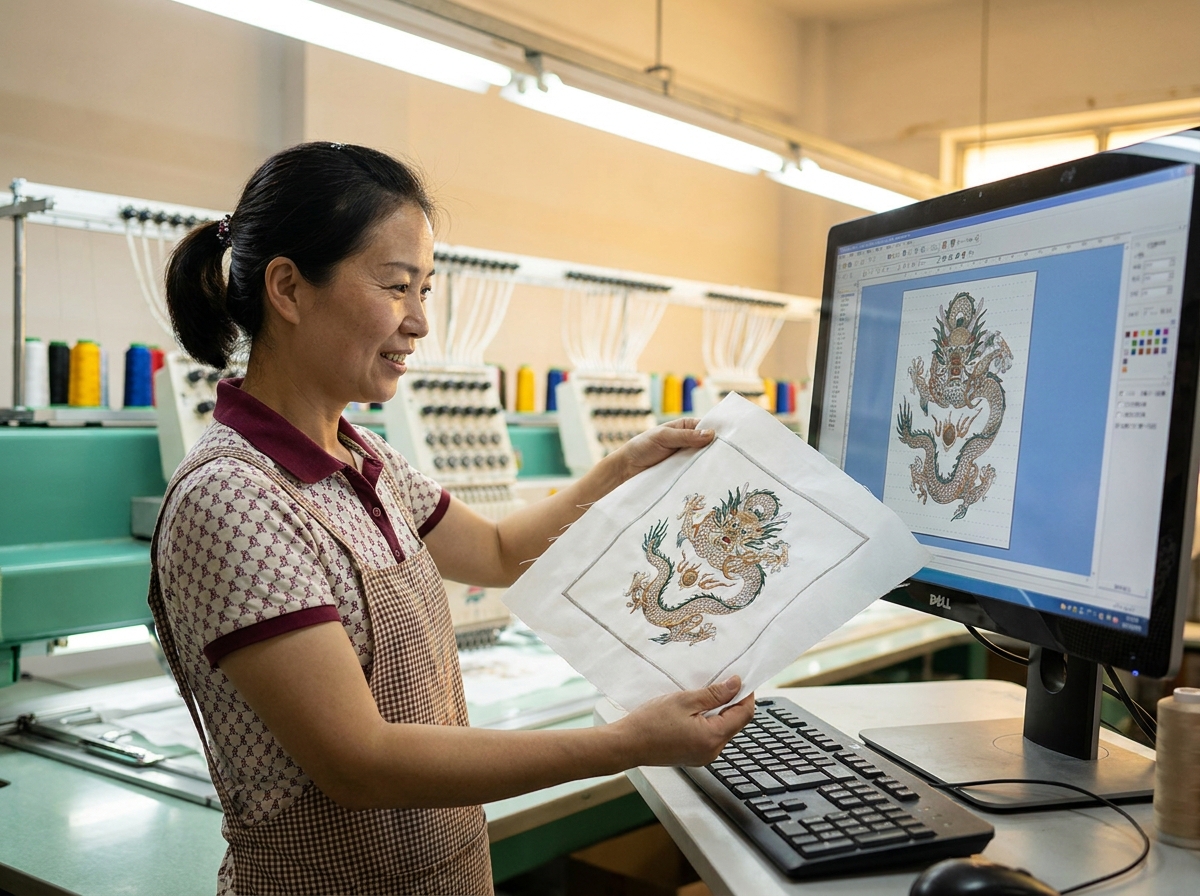
How Our Sampling Process Works: Step by Step
When a buyer sends us artwork for a new embroidery order, the first question is always the same: how long until I can hold the sample? At Fominte, the answer is 7 to 15 days from confirmed specifications to shipped sample. The range depends on craft complexity, and I want to walk you through exactly what happens in that window. Not the polished version. The real one, with the checkpoints, the potential delays, and the reasons behind each step.
Step 1 — Requirement Review (1–2 days)
We don't start digitizing the moment an inquiry lands. Eric's team asks questions first. What fabric base? What's the end use? A bridal gown, a tablecloth, a fashion garment? Do you have Pantone references? What stitch density are you targeting? Are there special materials involved — sequins, beads, 3D foam?
These questions matter because the same design on mesh fabric versus cotton will behave completely differently. Thread tension, stabilizer choice, hooping pressure. All of it changes based on the answers.
What we need from you at this stage:
- Design artwork (vector file, high-res image, or even a rough sketch)
- Fabric base preference
- Color specifications (Pantone numbers or physical swatches)
- Intended application
- Any special material requirements
If you're not sure about some of these, that's fine. Our design team, 10 people focused on digitizing, process optimization, and pattern refinement, can make recommendations. But the more specific you are upfront, the fewer revision rounds you'll need later.
Step 2 — Digitizing and File Review (2–3 days)
Once we have your specifications, the digitizing team converts the artwork into a machine-readable embroidery file. This is the blueprint that tells the machines where to place every stitch, what density to use, which direction the threads should run.
Here's something most buyers don't realize: about 15% of digitizing files get sent back for revision before they ever touch a machine. Our team reviews every file for stitch path efficiency, underlay structure, density distribution, and trim sequences. If the digitizing is wrong, no amount of skilled machine operation can fix it.
Our chief embroiderer, who has over 30 years of experience with these machines, puts it simply: the digitizing file is the blueprint. If the blueprint is wrong, nothing after it will be right.
During this stage we also determine which of our 27 embroidery machines (each with 62 heads and a 6-needle configuration) is best suited for this particular design, what stabilizer and backing materials are required, and whether the design needs any modifications for production feasibility.
If we spot a potential problem (density too high for the chosen fabric, a color sequence that will cause thread breaks, a design element that won't translate well to machine embroidery), we flag it now, not after we've wasted thread and machine time.
Step 3 — Sample Production (3–7 days)
This is where the actual embroidery happens, and the timeline varies the most depending on craft type.
For standard flat embroidery on mesh or cotton, we can typically produce a sample in 3 to 4 days. The process is straightforward: load the file, set up the machine, run the sample, inspect it.
For more complex crafts (3D puff, sequin work, water-soluble embroidery, or multi-craft combinations), expect 5 to 7 days. I'll explain why in the next section.
During production, we run 3 to 5 units as the initial sample batch. This isn't waste. It's how we verify consistency. If all 5 pieces come out identical, the machine settings are dialed in. If there's variation, we adjust before sending you anything.
Every sample goes through our standard quality inspection:
- Stitch density verification against specifications
- Color matching under D65 and TL84 dual-light-source conditions (following AATCC test methods)
- Dimensional accuracy check (placement within 5mm tolerance)
- Thread tension consistency across the design
- Fabric integrity (no puckering, no needle damage, no grin-through)
Step 4 — Quality Check and Shipping (1–3 days)
After the sample passes inspection, we photograph it for your reference and prepare it for shipping. We use express couriers (DHL, FedEx, or UPS depending on your location).
You'll receive:
- The physical sample(s)
- High-resolution photos of front and back
- A specification sheet with the exact machine settings used (stitch count, density, thread types, backing materials)
- Any notes or recommendations from our production team
That specification sheet is the document that ensures your bulk order will match your sample. We keep it on file. When your bulk order enters production, the same machine parameters are applied.
Step 5 — Client Feedback and Revisions
Most buyers have some adjustments after receiving the sample. Maybe the density needs to be slightly higher. Maybe a color looks off under your store's lighting. Maybe the hand feel isn't what you expected.
For returning customers, we offer up to 3 free revisions within the original scope. For new clients, we discuss revision terms upfront so there are no surprises.
A typical revision cycle takes 3 to 5 days. Minor changes, like adjusting density by 10% or swapping a thread color, are faster. If the change involves redesigning the digitizing file, it takes longer.
The goal is to get to a sample you're confident placing a bulk order against. We'd rather spend an extra revision round now than deal with problems in a 50,000-yard production run.
Why Different Embroidery Crafts Need Different Sampling Approaches
Most articles about embroidery sampling treat all crafts the same. They don't. The sampling process for flat embroidery is fundamentally different from water-soluble or sequin work, and understanding those differences will save you time and money when planning your order.
Flat Embroidery — The Baseline
Standard flat embroidery, thread on fabric with no added materials, is the most straightforward to sample. The variables are limited: thread color, stitch density, design complexity, fabric base.
We can typically produce a flat embroidery sample in 3 to 4 days. The main risk factors are thread tension consistency and color matching. If your design uses metallic threads or specialty yarns, add a day for material sourcing and testing.
3D Puff Embroidery — Foam and Density Testing
3D puff embroidery adds a foam layer under the stitches to create a raised, three-dimensional effect. Sampling this is more involved because we need to test foam thickness (typically 2mm and 3mm options), foam color matching, stitch density over foam, and foam removal after embroidery.
Too dense and the foam compresses unevenly. Too sparse and the foam shows through. The heat settings for foam removal have to be precise: too hot damages the stitches, too cold leaves residue.
Sampling time: 5 to 6 days. The extra time goes to density testing and foam removal trials.
Sequin and Bead Embroidery — Material Matching Is Critical
When sequins or beads are involved, sampling has an additional layer: material verification.
Our equipment handles various sequin shapes — flat sequins up to 18mm on the edge hole, other types up to 8mm. Colors are unlimited, but we recommend no more than 10 per fabric to maintain production efficiency.
During sampling we verify sequin attachment strength, placement accuracy, color consistency under different lighting, and edge finish quality.
For bead and tube embroidery, the tube diameter must match the adhesive viscosity. As our chief embroiderer explains: the tube's inner diameter and the adhesive have to be calibrated together. Too large an inner diameter with too little adhesive and the tubes won't stand up. Too small with too much and they push outward.
Sampling time: 5 to 7 days. Material matching and attachment testing drive the timeline.
Water-Soluble Embroidery — Dissolution and Finish Quality
Water-soluble embroidery uses a dissolvable backing that's removed after stitching, leaving only the embroidered design. We produce this up to 1.4 meters wide with up to 400,000 stitches.
Sampling is the most time-intensive because we verify backing dissolution quality (no residue), design integrity after dissolution, edge quality, and hand feel.
Eric has a way of explaining the cost to buyers: you're not paying for more material. You're paying for less. The process of removing the backing is what costs money, and what creates that floating effect your customer is willing to pay for.
Sampling time: 6 to 8 days. The dissolution and drying process adds time, and we typically run multiple trials to get the water temperature and soak duration right.
What Sampling Actually Costs
Let me break down the numbers.
Sampling Fee Structure
Sampling at Fominte is not free. A proper sample requires machine setup time, material costs, digitizing labor, and quality inspection. Running a sample ties up a machine that could be producing a bulk order.
Our sampling fees cover digitizing and file preparation, material costs (fabric, thread, backing, specialty materials), machine setup and production time, quality inspection and documentation, and photography with specification sheet preparation.
The exact fee depends on craft complexity and materials. A simple flat embroidery sample costs less than a multi-craft sample combining sequins, beads, and water-soluble elements.
How Bulk Orders Offset Sampling Costs
If your bulk order exceeds 1,000 yards, the sampling fee is deducted from your total invoice. This isn't a promotion. It's our standard policy.
We structure it this way because we want serious buyers to sample with us. The sampling process is where we build the mutual understanding that makes bulk production smooth. Think of the sampling fee as an investment in getting your bulk order right the first time, and when you commit, that investment comes back to you.
Revision Policy
For returning customers, we offer 3 free revisions within the original specification scope. Density adjustments, color swaps, placement tweaks — those are covered.
If the revision involves a fundamentally different design or a change in craft type, that's treated as a new sample. For new clients, we discuss revision terms before sampling begins.
How We Ensure Your Sample Matches Bulk Production
You've approved a sample. How do you know the 50,000 yards you order will look the same? This is where a lot of buyer-supplier relationships go wrong, and it's worth understanding the mechanics.
Same Machines, Same Settings
Your sample is produced on the same type of machine that will run your bulk order. We have 27 embroidery machines, all with 62-head, 6-needle configuration. When we dial in settings for your sample (thread tension, speed, density, bobbin tension), those settings are documented and transferred directly to the bulk production machine.
Some factories use different machines for sampling and production, which introduces variables. We don't.
First-Piece Approval: 3–5 Units Before Bulk
Before your bulk order goes into full production, we run 3 to 5 units as a first-piece approval batch. You review these units — through photos and video, or in person if you visit our facility.
Only after you approve the first-piece batch do we start the full run. This is your checkpoint to catch any discrepancy between the sample and actual production output.
QC Checkpoints That Protect Consistency
During bulk production, our quality control system runs inspections at multiple stages:
Raw material inspection: every batch of fabric is checked for width consistency (±1cm), weaving defects (≤2 per 50 yards), color matching under D65 lighting, and weight (±5% tolerance).
In-line inspection: during production, our QC team randomly pulls pieces for inspection. They check stitch density, thread tension, color consistency, and placement accuracy.
Final inspection: before packing, every piece passes through our needle detection machine and is inspected under dual-light-source conditions. Our defect rate stays below 2%. If you want the full breakdown of our QC process from raw material to packing, we cover that in detail in our quality control process article.
The specification sheet from your sample is the reference document for all these inspections. If bulk production deviates from the sample parameters, it gets flagged and corrected before it reaches you.
Common Sampling Failures and How We Prevent Them
I'd rather tell you what can go wrong than pretend everything is always perfect.
Fabric Shrinkage and Puckering
Different fabrics react differently to the embroidery process. Mesh can stretch under hoop pressure. Cotton can pucker if stitch density is too high. Silk is unforgiving. Any tension imbalance shows immediately.
We test a small swatch of your chosen fabric before committing to the full sample. This tells us how the fabric behaves under embroidery stress, and we adjust the stabilizer and hooping pressure accordingly.
Thread Tension Inconsistency
If thread tension isn't consistent across the design, you'll see areas where the bobbin thread shows on top, or where the top thread loops on the back. This is especially visible on light-colored fabrics.
We run a 2-inch satin stitch test before every sample to calibrate tension. Our machines are serviced on a preventive maintenance schedule — we don't wait for problems to appear.
Pattern Distortion on Different Fabrics
A design that looks perfect on cotton might distort on mesh. A pattern optimized for flat embroidery might not translate well to 3D puff. The digitizing file needs to account for the specific fabric and craft.
This is why we spend 2 to 3 days on digitizing and file review. We test the design parameters against the fabric type before running the sample.
Color Matching Issues
Thread colors can look different under different lighting conditions — what the industry calls metamerism. A color that matches perfectly under daylight might look wrong under fluorescent store lighting.
We match colors under both D65 (daylight) and TL84 (retail store) light sources, following AATCC standard test methods for colorfastness evaluation. We send you color swatches under both conditions so you can make an informed decision.
Sampling Timeline by Craft Type
| Craft Type | Typical Sampling Time | Key Variable |
|---|---|---|
| Flat embroidery (standard) | 7–10 days | Color matching, density testing |
| 3D puff embroidery | 9–12 days | Foam thickness, density over foam |
| Sequin/bead embroidery | 10–13 days | Material matching, attachment strength |
| Water-soluble embroidery | 10–15 days | Dissolution quality, edge finish |
| Multi-craft combination | 12–15 days | All of the above, plus coordination |
These timelines include the full process from requirement review to shipped sample. Clear specifications and straightforward designs land on the faster end. Complex requirements or unclear specifications take longer.
FAQ
How long does it take to get an embroidery sample from China?
At Fominte, our standard sampling timeline is 7 to 15 days from confirmed specifications to shipped sample. Simple flat embroidery takes 7 to 10 days. Multi-craft or water-soluble embroidery takes 12 to 15 days. Express courier shipping adds 3 to 5 days depending on your location.
Can I use the sample fee as credit toward my bulk order?
Yes. If your bulk order exceeds 1,000 yards, the sampling fee is deducted from your total invoice. This is our standard policy, not a limited-time promotion. The sampling process builds the foundation for smooth bulk production.
What if my sample doesn't match what I expected?
We build revision cycles into the process. Returning customers receive up to 3 free revisions within the original specification scope. For new clients, we discuss revision terms upfront. A typical revision takes 3 to 5 days. We'd rather get the sample right than rush into bulk production with unresolved questions.
Do you use the same machines for sampling and bulk production?
Yes. Your sample is produced on the same machine type that will run your bulk order — 27 machines, 62 heads each, 6-needle configuration. The settings are documented during sampling and transferred directly to bulk production.
What information do I need to provide for a sample?
At minimum: design artwork, fabric base preference, color specifications (Pantone or physical swatches), and intended application. If you have special material requirements (sequins, beads, 3D foam), include those details. Our design team can fill in technical gaps, but specificity upfront speeds up the process.
Ready to see how your design translates into embroidery? Send us your artwork and specifications at info@fominte.com — we'll provide a sampling timeline and cost estimate within 24 hours. No commitment required.
If you're evaluating multiple suppliers, we're happy to walk you through our sampling process in detail. We hold OEKO-TEX Standard 100, Higg Index, and Amfori certifications, and we can verify material compliance during the sampling stage so there are no surprises at bulk production. Transparency is how trust starts.
Step-by-Step Guide
Prepare your sampling request
Review the digitizing file
Approve the first-piece batch
Confirm bulk production settings
When to Use & Avoid
Flat embroidery sampling
✅ Use When
- Standard thread designs on mesh or cotton, simple color palettes
⚠️ Avoid When
- Metallic threads, specialty yarns, high-density fills on lightweight fabrics
3D puff sampling
✅ Use When
- Raised foam effect designs, promotional items, caps and hats
⚠️ Avoid When
- Designs requiring precise foam color matching, very thin foam layers
Sequin and bead sampling
✅ Use When
- Decorative fashion fabrics, evening wear, bridal embellishments
⚠️ Avoid When
- Designs mixing more than 10 sequin colors, very small bead sizes under 3mm
Water-soluble sampling
✅ Use When
- Lace effects, open-work designs, delicate floating patterns
⚠️ Avoid When
- Designs with very dense fill areas that may not hold structure after dissolution
Multi-craft combination sampling
✅ Use When
- Complex designs combining embroidery with sequins, beads, and water-soluble elements
⚠️ Avoid When
- Rushing all crafts through simultaneously without staging the sampling process
⚡ Common Mistakes to Avoid
Everything You Need to Know
Conclusion