.png?w=970&h=250)
Inside Fominte's Outdoor Jacket Production Flow: From Tech Pack to Packed Carton
What It Really Means
The Production Flow Starts Before Cutting
An outdoor jacket factory does not prove itself at the sewing machine. It proves itself earlier, when the buyer's idea is still a tech pack, a reference sample, a fabric target, or sometimes just a product direction with a few non-negotiable requirements.
At FOMINTE, we treat outdoor jacket production as a control system. The garment may look simple from the outside, but the production risk sits in many places: shell fabric behavior, lining balance, zipper choice, seam allowance, seam tape compatibility, hood shape, pocket construction, drawcord position, measurement tolerance, and final packing.
That is why our process starts before cutting. A jacket that is rushed into bulk production without a proper review may still look acceptable in a photo. The problems usually appear later: zipper waviness, sleeve drag, water entry at the pocket, poor hood coverage, uneven hem, tight arm movement, color-lot difference, or cartons that fail the buyer's packing requirement.
FOMINTE's outdoor-jacket work is supported by our own apparel manufacturing base, an integrated outdoor-jacket production supply chain, and FOMINTE-managed factory-level quality control. Our production team scales around 100-200 people depending on order volume, and our 10-person design and technical support team helps with pattern, process suggestions, and production optimization. For a private label jacket buyer, that structure matters because the factory needs to connect decisions that are often discussed separately.
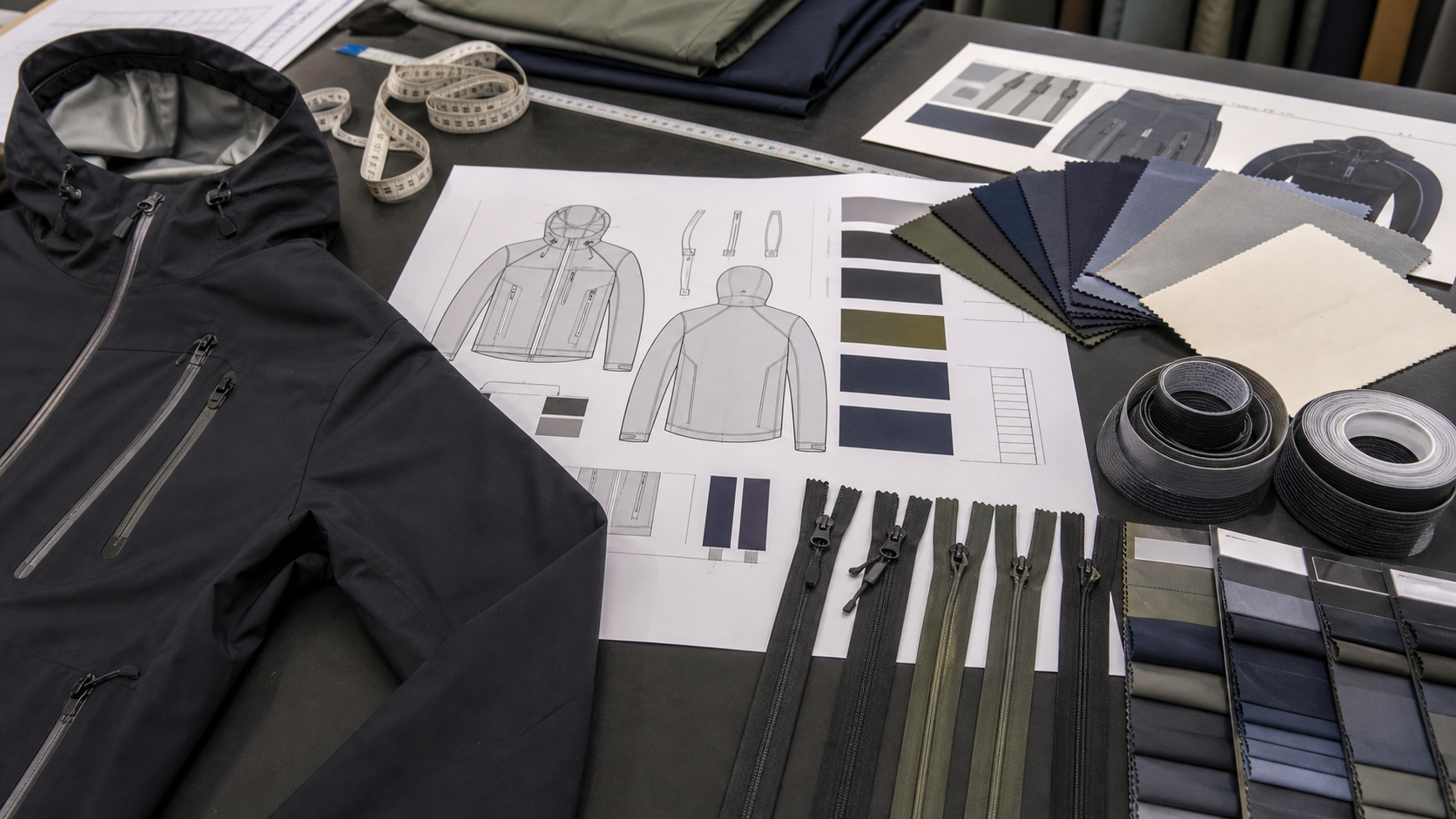
Inquiry and Tech Pack Review
The first stage is not quoting. It is understanding what the buyer is really asking the jacket to do.
When Eric's team reviews an outdoor jacket inquiry, we look for the basic commercial information first: target market, jacket type, expected order volume, size range, gender or fit direction, required delivery window, and whether the order is for a single style or a longer private-label outdoor program.
Then we look at the technical information:
- shell fabric direction
- lining requirement
- waterproof or water-resistant claim
- breathability expectation
- seam taping or seam sealing requirement
- zipper type and zipper protection
- hood, cuff, hem, and pocket construction
- logo method
- label, hangtag, polybag, and carton requirements
- compliance or retailer testing requirements
If the buyer has a complete tech pack, good. If the buyer only has a reference sample and target price, the review becomes more important. We need to separate what is design preference from what is production requirement.
For example, a buyer may send a competitor's rain jacket and ask for "similar quality." That phrase is not enough. Similar fabric handfeel, similar waterproof construction, similar zipper, similar lining, similar pocket structure, and similar packing standard can all mean different costs. A factory should ask those questions early, before the buyer compares quotes that are not built on the same specification.
This is one of the reasons we prefer a transparent factory conversation. A low quote can be created by removing things the buyer did not know to ask about. Seam tape becomes partial seam tape. Waterproof zipper becomes standard zipper with a flap. Lining weight changes. Pocket bag fabric changes. The jacket still looks similar at first glance, but it is no longer the same product.
Fabric, Lining, Seam Tape, and Trim Confirmation
Outdoor jackets are not built from one material. They are built from a material system.
For a softshell jacket, we may review stretch woven face fabric, bonded backing, membrane option, DWR direction, zipper strength, cuff finish, and logo compatibility. For a hardshell or rain jacket, we review shell layer structure, coating or membrane, seam tape, zipper protection, hood pattern, pocket opening, and water-entry points. For a fleece-lined jacket, we review shell fabric and lining as one garment, because lining pile, sleeve glide, shrinkage, bulk, and warmth all affect fit.
This stage is where many buyer problems can be prevented. A shell fabric may pass handfeel review but still be difficult to sew cleanly. A lining may feel warm but create too much sleeve friction. A zipper may look premium but be too stiff for a lightweight shell. A seam tape may not bond well to the selected fabric. A drawcord position may look fine in a sketch but become uncomfortable when the jacket is worn under a backpack.
For water-resistance and rainwear discussions, buyers should also understand that test language matters. AATCC's overview of impact penetration testing for textiles explains how fabric rain penetration can be evaluated under controlled conditions. The sourcing point is simple: do not rely only on words like waterproof or water-repellent. Decide what claim the garment needs to support, then build the fabric and construction plan around that claim.
Compliance is also better handled at this stage. If the buyer needs OEKO-TEX related documentation, recycled material documentation, PFAS-free DWR direction, or retailer chemical compliance, the factory needs to know before fabric sourcing begins. OEKO-TEX STANDARD 100 is widely recognized for textiles tested for harmful substances, but the correct documentation depends on the actual fabric, trims, and supplier chain used for the order.
For PFAS, buyers should be careful with claims. The U.S. EPA explains PFAS as long-lasting chemicals used across many products and materials. Outdoor-apparel markets are moving quickly on this issue, so we prefer to define the buyer's target market and documentation requirement before making any DWR or chemical claim.
Pattern Development, Sample Making, and Fit Review
After the material direction is clear, the next step is pattern and sample development.
Outdoor jacket patterns need more attention than flat measurement tables suggest. A jacket is worn over other clothing. It may need arm movement, hood coverage, cuff adjustment, hem control, pocket access, and enough chest and back room for real use. A buyer may approve a front photo and still miss the most important question: can the customer move comfortably in it?
Our technical team reviews the pattern with the garment function in mind. A cycling softshell, a hiking rain shell, a school windbreaker, and a fleece-lined work jacket should not use the same fit logic. Sleeve pitch, armhole depth, shoulder width, body length, hood height, collar comfort, pocket height, and hem shape all need to match the product's intended market.
Sampling is where production risks become visible. The first sample helps us check:
- whether the fabric behaves correctly during cutting and sewing
- whether lining and shell balance well
- whether the zipper sits flat
- whether hood and collar shape protect the wearer
- whether the pocket openings are practical
- whether seam positions create discomfort
- whether logo placement works on the chosen fabric
- whether the garment can be produced consistently in bulk
FOMINTE's existing sampling policy for established categories is usually 7-15 days, but outdoor jackets can vary more because fabric sourcing, seam tape confirmation, special trims, waterproof testing, and buyer revisions may add time. I would rather be honest about that than promise a number that only works for the easiest style.
Pre-Production Approval and Size Grading
Before bulk production, the buyer should approve more than a nice-looking sample.
The pre-production stage should lock the important details: fabric, color, lining, trims, zipper, tape, pattern, measurements, logo method, label placement, packing method, and inspection standard. If the buyer changes zipper type after grading, or changes lining after fit approval, the garment may need another review.
Size grading is especially important for outerwear. A mistake in grading does not only make one size uncomfortable. It can change how the whole size range performs. Sleeve length, bicep width, chest ease, hem sweep, hood opening, and front zipper length all need to scale in a way that keeps the jacket wearable.
For 3-in-1 jacket systems, grading becomes even more sensitive because the outer shell and liner must work together. If the liner grows differently from the shell, the attachment points may pull, twist, or create bulk at the neckline. This is why we do not treat 3-in-1 systems as simple jackets with an extra piece inside. They are two garments that must behave as one product.
At this stage, the best buyer habit is to approve with production in mind. Do not only say, "The sample looks good." Ask whether the factory can repeat it at the approved size range, color count, delivery window, and packing standard.
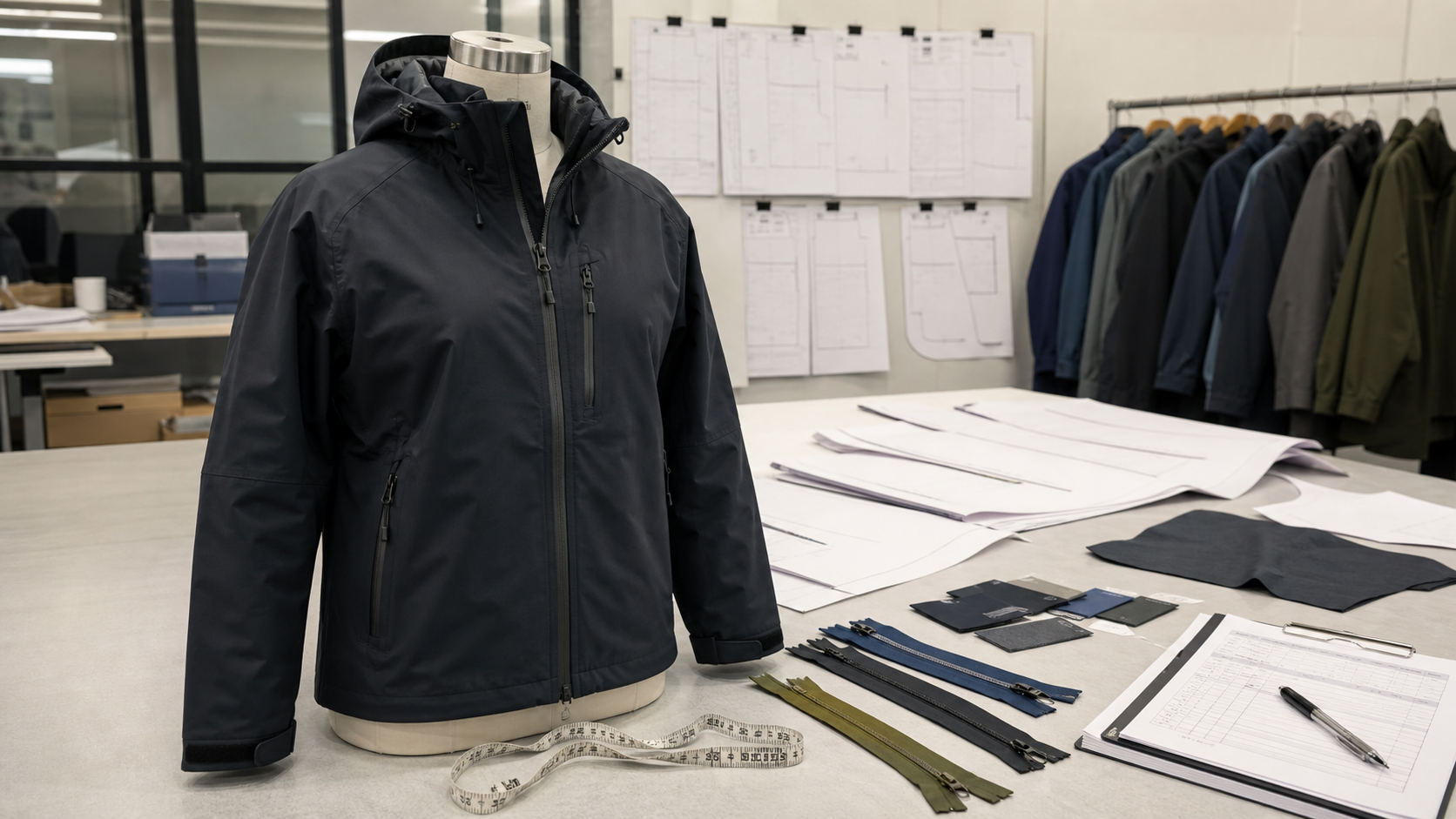
Cutting Room Control
Cutting is where the approved jacket becomes production reality.
For many outerwear styles, cutting must control fabric direction, marker placement, shade variation, panel matching, lining behavior, and component accuracy. A shell fabric with coating or lamination may behave differently from a basic woven fabric. Lightweight shells can shift. Fleece lining can bulk. Softshell may need careful handling because the bonded structure can affect thickness at seams.
The cutting team needs clear instructions before fabric is opened. Which side is face? Is there a nap or direction? Are panels shade-sensitive? Are contrast panels used? Does the fabric have stretch direction? Are there bonded or coated surfaces that need careful handling? Are there small parts that must match specific color lots?
A bad cut creates problems that sewing cannot fully fix. If the panels are off-grain, the jacket may twist. If lining parts are cut inconsistently, sleeve comfort suffers. If contrast panels are mixed across shade lots, the product looks unstable. If pocket parts are inaccurate, the sewing line spends extra time forcing pieces into place.
This is why production flow matters. The cutting room is not a separate island. It must understand the sample approval, the material behavior, and the sewing construction that follows.
Sewing, Seam Allowance, and Construction Checks
Sewing is where buyers usually imagine factory quality happens. It does, but only if the previous stages have been controlled.
For outdoor jackets, sewing quality is not only straight stitches. We check seam allowance, stitch density, tension, pocket symmetry, zipper insertion, hood attachment, collar shape, cuff finish, hem control, and reinforcement at stress points. The more technical the jacket, the more small construction decisions matter.
A softshell jacket may need clean topstitching and stable zipper insertion because the fabric has body and stretch. A lightweight windbreaker may need careful tension control because puckering is easy to see. A rain jacket may need seam construction that supports later taping. A fleece-lined jacket may need sleeve construction that prevents dragging when the customer puts it on.
In-line checks protect the order while there is still time to correct the line. Waiting until final inspection is too late for many construction issues. If zipper waviness appears in the first batch, the sewing method or operator handling can be adjusted. If pocket openings are inconsistent, the line can be corrected before the problem spreads. If seam allowance is unstable on a taped seam, the waterproof construction is already at risk.
This is also where a factory-based manufacturer has an advantage over a purely trading-style workflow. The team can connect the problem to the source: pattern, cutting, fabric behavior, machine setting, operator method, or trim compatibility.
Waterproof Details: Seam Taping and Water-Entry Points
Not every outdoor jacket needs seam taping. But when a buyer wants a serious rainwear or waterproof claim, seam control becomes one of the most important factory stages.
Needle holes can create water-entry points. Pocket openings, hood seams, shoulder seams, armhole seams, zipper areas, and hem transitions all deserve attention. A jacket can use waterproof fabric and still leak if the construction does not support the claim.
Seam taping is not just adding tape. The factory has to consider tape width, tape type, fabric compatibility, seam allowance, temperature, pressure, speed, operator control, and inspection. If the seam is bulky, uneven, contaminated, or badly sewn, the tape may not bond consistently. If the design has too many complicated seam intersections, taping becomes harder and cost rises.
This is why we prefer to discuss waterproof expectations before sampling. A buyer may want a clean retail look, a sharp price, a lightweight handfeel, and full waterproof construction. Those goals can conflict. The factory's job is not to say yes to every word. The factory's job is to show the trade-offs before bulk production.
For buyers who are not building a technical rain shell, a different construction may be better: DWR-treated softshell, storm flap over a standard zipper, selected seam sealing, or a water-resistant positioning instead of a full waterproof claim. The right answer depends on the market promise.
In-Line QC and Finished Garment Inspection
FOMINTE's broader quality philosophy is built around inspection before, during, and after production. For outdoor jackets, we apply that same logic to the risks of outerwear.
Raw material inspection checks whether fabric, lining, trims, zipper, tape, labels, and packaging inputs match the approved direction. First-piece confirmation checks whether the sewing line is producing the garment as approved. In-line QC looks for problems while production can still be corrected. Finished inspection checks measurements, appearance, construction, trims, labels, packing, and buyer-specific requirements before shipment.
For jacket orders, common inspection points include:
- body length, chest, sleeve, shoulder, hem, and hood measurements
- zipper function and zipper alignment
- pocket position and pocket opening consistency
- seam appearance and stitch stability
- hood, cuff, and hem adjustment function
- lining attachment and sleeve comfort
- logo placement and label accuracy
- color and shade consistency
- loose threads, stains, puckering, skipped stitches, and damaged trims
- packing method, carton marks, and size/color ratio
For rain-focused jackets, the inspection plan may also include seam leakage checks or buyer-specified water resistance tests. The exact requirement should be agreed before production, because testing affects timeline, cost, and documentation.
The best QC system is not dramatic. It is repetitive. It catches small problems before they become expensive ones.
Packing, Carton Review, and Export Readiness
Packing looks like the last step, but it should be planned earlier.
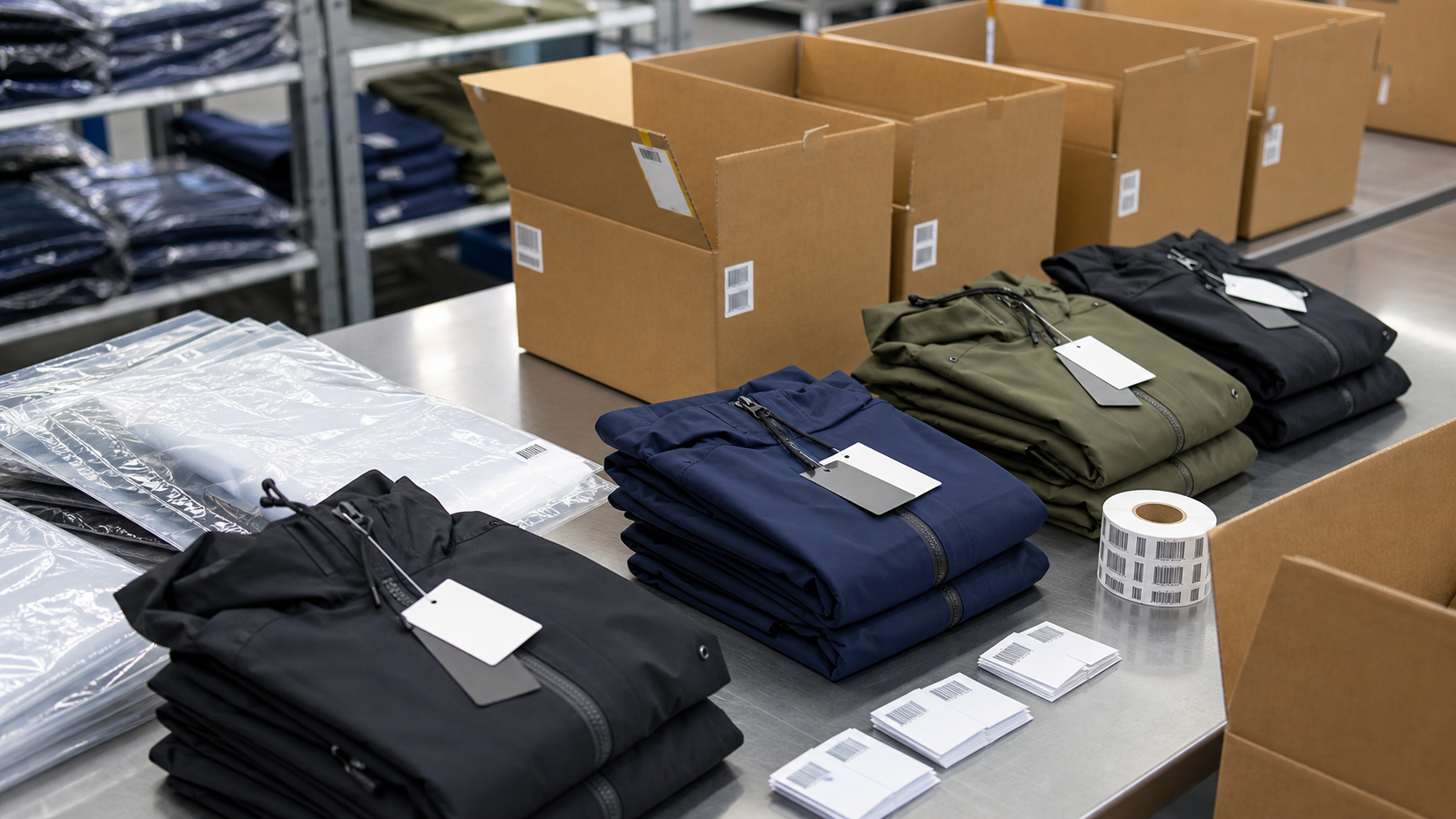
For private label outdoor jackets, packing may include hangtags, barcode labels, size stickers, polybags, carton marks, assortment ratios, folded dimensions, moisture-control requirements, and buyer routing instructions. If these details are not confirmed before bulk packing, the factory may need to reopen cartons or repack finished goods. That wastes time and creates avoidable handling risk.
Carton review also matters for jackets because bulky garments can change carton size and shipping efficiency. A fleece-lined jacket, a 3-in-1 system, and a lightweight shell do not pack the same way. If the buyer has warehouse or retailer requirements, those requirements should be included in the pre-production file.
For export preparation, we also check whether the order documents, packing list, and carton information match the buyer's instructions. The garment is not truly finished when it leaves the sewing line. It is finished when the buyer can receive, scan, store, and distribute it without avoidable problems.
Why This Process Matters for Private Label Jacket Buyers
Private label jacket buyers are often comparing factories by price, MOQ, sample speed, and product photos. Those are useful signals, but they do not tell the whole story.
The real question is whether the factory can protect the order from predictable mistakes. Outdoor jackets have more variables than a basic garment. Fabric, lining, trim, pattern, sewing, seam control, weather claim, QC, and packing must work together. If one decision is isolated from the others, the buyer may save money in one place and lose it later through returns, delays, or inconsistent bulk quality.
FOMINTE is not trying to be the cheapest answer to every jacket inquiry. We are building a factory-level outdoor jacket manufacturing system for buyers who want stable execution, transparent communication, and a long-term production partner. That means we ask more questions before quoting. It also means the quote is built on a clearer production path.
If your team is developing softshell jackets, hardshell rain jackets, lightweight windbreakers, fleece-lined outdoor jackets, or a multi-style private-label outdoor program, send your product target, tech pack or reference sample, shell fabric direction, lining requirement, zipper and trim expectations, weather claim, compliance needs, size range, and seasonal volume to info@fominte.com.
I will make sure Eric's team reviews it as a factory-level outdoor jacket inquiry, not just a generic jacket quote request.
Step-by-Step Guide
Inquiry and tech pack review
Material and trim confirmation
Pattern and sample development
Pre-production approval
Cutting room control
Sewing and construction control
Seam and weather-protection review
Finished inspection
Packing and carton review
When to Use & Avoid
Softshell jacket
✅ Use When
- Stretch comfort
- workwear
- teamwear
- light weather protection
⚠️ Avoid When
- When the product needs full rain-shell waterproof construction
Hardshell rain jacket
✅ Use When
- Rain protection
- technical retail
- waterproof-breathable shell programs
⚠️ Avoid When
- When the buyer wants only a simple lifestyle windbreaker
Fleece-lined outdoor jacket
✅ Use When
- Fall winter warmth
- workwear
- outdoor lifestyle retail
⚠️ Avoid When
- When low weight and packability are the main selling points
Lightweight windbreaker
✅ Use When
- Spring outerwear
- travel
- running clubs
- school programs
⚠️ Avoid When
- When the buyer will market the product as a serious waterproof shell
3-in-1 jacket system
✅ Use When
- Multi-season outdoor programs
- retail collections with removable liner
⚠️ Avoid When
- When the buyer cannot support careful sampling, attachment review, and grading approval
Comparison
| Production Stage | Buyer Risk Controlled | Factory Checkpoint |
| Tech pack review | Quotes based on unclear or unequal specifications | Confirm product claim, fabric direction, trims, compliance, order volume, and delivery target |
| Material confirmation | Fabric, lining, zipper, and seam tape do not work together | Review shell, lining, tape, zipper, trims, DWR direction, and documentation needs as one system |
| Sampling | Bulk defects hidden until production | Check fit, movement, hood shape, pocket function, zipper behavior, lining balance, and construction feasibility |
| Pre-production approval | Uncontrolled changes after sample approval | Lock pattern, measurement, fabric, trims, labels, packing, and inspection standard before cutting |
| Cutting | Twisted panels, shade issues, wrong parts, lining mismatch | Control fabric direction, marker, shade lots, contrast panels, small parts, and lining components |
| Sewing | Zipper waviness, unstable seams, poor pockets, uneven hood or hem | Use in-line QC to check seam allowance, stitch tension, zipper setting, pocket symmetry, and trim function |
| Waterproof construction | Rainwear claim not supported by seams and openings | Review seam tape, water-entry points, zipper protection, hood, pocket openings, and agreed test expectations |
| Final inspection and packing | Defects or packing errors found after shipment | Check measurements, appearance, labels, hangtags, polybags, carton marks, size/color ratio, and export readiness |
⚡ Common Mistakes to Avoid
Everything You Need to Know
Conclusion