.png?w=970&h=250)
MOQ, Lead Time, and Export: What to Expect When You Order Embroidery Fabric from Fominte
What It Really Means
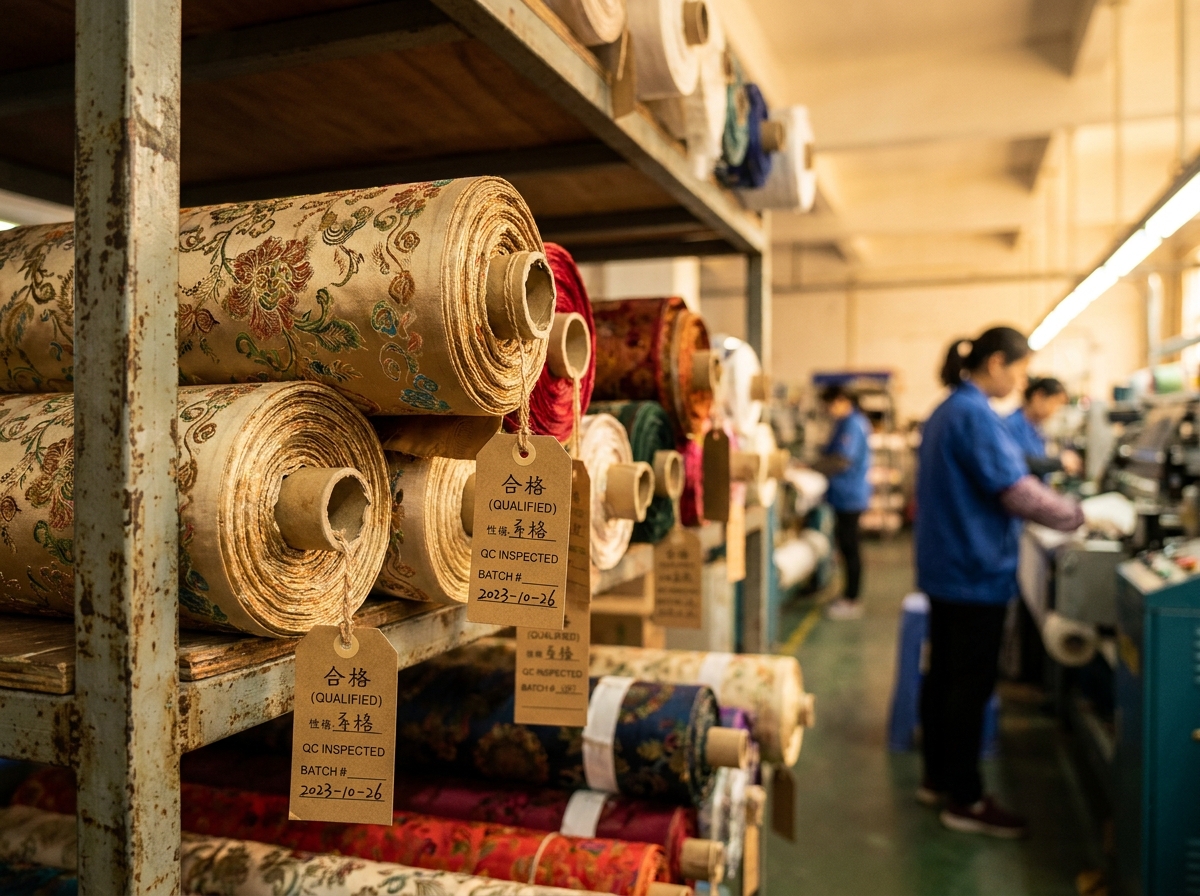
What Is Our Minimum Order Quantity and Why?
Our standard minimum order quantity is 100 yards. That number comes from how embroidery production actually works, not from an arbitrary policy designed to filter out small buyers.
Most people don't realize this, but embroidery MOQ works on a completely different logic than cut-and-sew garment MOQ. When a garment factory sets a minimum of 500 pieces, it's about fabric consumption and sewing line efficiency. When an embroidery factory sets a minimum, it's about machine setup time, thread changeover, and material procurement economics.
Every embroidery order requires the machine to be threaded, tensioned, and test-run before production begins. For a 6-color water-soluble design, that setup takes our team about 2-3 hours. If you're ordering 20 yards, the setup cost per yard is astronomical. At 100 yards, the math works for both sides.
Why 100 Yards — Not 50, Not 500
We landed on 100 yards because it's the break-even point where our production costs align with reasonable pricing for the buyer. Go below that, and we'd need to charge significantly more per yard to cover the fixed setup costs. Go above that, and we're happy — larger orders are more efficient for everyone.
Some buyers ask why we don't offer 50-yard minimums like certain Alibaba suppliers. Those suppliers are either running stock designs with zero customization, or they're folding setup costs into a higher per-yard price. Either way, it doesn't work for buyers who need consistent quality across a real order.
Eric, our head of sales, puts it this way: "If you're a first-time buyer asking for 200 yards of custom lace, the honest answer is: probably not. But if you're willing to choose from our stock patterns, or if you can commit to regular orders over time, we can work with you."
How Embroidery Type Affects MOQ
Not all embroidery is created equal when it comes to minimums:
Basic mesh embroidery — the workhorse of our production. Simple designs with 2-3 colors on standard mesh base. MOQ stays at 100 yards because setup is straightforward and thread changes are minimal.
Water-soluble embroidery — more complex. The dissolvable backing adds a material procurement step, and the higher stitch counts (up to 400,000 stitches per piece) mean longer production time per yard. We still start at 100 yards, but pricing reflects the additional complexity.
Sequin and bead embroidery — these require specialized material feeding systems. Each sequin color or bead size needs its own feeder calibration. A design with 5+ sequin colors on a single piece may push the effective MOQ to 200-300 yards, because the setup time is substantially longer.
Combination embroidery — when you're mixing techniques (say, water-soluble base with sequin overlay), we need to run multiple production passes. The MOQ reflects the total material needed across all passes.
Can You Order Less? Our Flexibility Policy for New Buyers
We do make exceptions. If you're evaluating Fominte as a potential long-term partner, we'll sometimes accept a first order below 100 yards — but with clear expectations. The per-yard price will be higher, and we'll ask you to commit to a specific timeline for your follow-up order.
This isn't a sales tactic. It's how we protect both parties. You get to test our quality without a massive commitment, and we get a genuine trial that could lead to a real partnership.
Shawn, our founder, has a saying about this: "The first to commit gets the first pick." Early commitment means you're choosing from our full production calendar, not scrambling for whatever slot is left.
How Order Specifications Change Your MOQ
Your MOQ isn't just a number we pull out of a hat. It shifts based on what you're actually ordering, and understanding these variables helps you plan smarter.
Stitch Count and Design Complexity
A simple geometric pattern might run 50,000-80,000 stitches per yard. An intricate floral with shading and detail? That could hit 300,000-400,000 stitches. The higher the stitch count, the longer each yard takes to produce, and the more thread consumed.
For high-stitch-count designs, we sometimes recommend a slightly higher MOQ — not because we're trying to upsell, but because the production economics make more sense at volume. Running a 400,000-stitch design for just 100 yards means our machines are occupied for extended periods with relatively low output.
Number of Thread Colors
Every color change requires a thread path adjustment. Our machines run 6 needles, so designs with 6 or fewer colors run smoothly. Go beyond that, and we need manual intervention between production runs — stopping, rethreading, recalibrating.
A 2-color design? Fast, efficient, 100 yards is plenty. An 8-color design with gradient effects? We'll want to discuss whether 200-300 yards makes more sense for your budget.
Material and Base Fabric Choice
Standard mesh and cotton bases are always in stock. But if you need a specific base fabric — say, a particular weight of polyester mesh or a specialty stretch material — we may need to source it. Minimum order quantities from our fabric suppliers add another layer.
For stock bases, 100 yards works. For custom-sourced bases, we'll factor in the fabric supplier's MOQ, which typically ranges from 300-500 yards per color.
Our Lead Time: 20-40 Days, Broken Down Step by Step
When we say 20-40 days, we mean production days from confirmed order to finished goods ready for packing. The breakdown looks like this.
Day 1-3: Design Programming (Custom Orders)
If you're providing your own design, our digitizing team converts it into a machine-readable file. This isn't just a format conversion — it's a technical translation that determines stitch direction, density, underlay patterns, and thread sequencing.
About 15% of the design files we receive from clients need adjustments before they'll run cleanly on our equipment. Our team catches these issues during the programming stage, not after we've started wasting material.
If you're ordering from our existing pattern library, this step is already done. You skip straight to material prep.
Day 4-8: Raw Material Sourcing
Thread, backing fabric, stabilizers, and any specialty materials (sequins, beads, tubes) need to be in stock before we start. For standard orders using our regular materials, this takes 3-5 days. If you've specified a particular thread color that we don't stock, add 2-3 days for sourcing.
This is where early planning pays off. Buyers who confirm their specifications quickly get their materials sourced in parallel with the design programming, shaving days off the total timeline.
Day 9-25: Production
This is the variable window. The exact number of days depends on your order quantity and embroidery complexity.
For a 500-yard order of basic mesh embroidery, expect about 5-7 production days. For a 2,000-yard order of water-soluble embroidery with complex patterns, we might need 12-15 days.
Our 27 machines run with 62 heads each, and we maintain a monthly capacity of 300,000 meters. That capacity gives us flexibility — if your order is urgent, we can allocate more machines to your production run. But that requires advance notice and, frankly, advance booking.
Day 26-28: Quality Inspection
Every yard goes through our inspection process. We run needle detection across 100% of production, check color consistency under dual-light sources (D65 and TL84), and verify that defect rates stay below our 2% threshold.
This step is non-negotiable. We've had buyers ask us to skip it to save time. Our answer is always the same: the 2 days we spend on inspection prevent the 2 weeks you'd spend dealing with defective goods after they arrive. If you want to see how this plays out in a real large order, we broke down the entire process in How We Deliver Large Orders.
Day 29-35: Finishing and Packaging
Final finishing includes edge treatment, rolling or folding (depending on your preference), moisture protection wrapping, and labeling. We pack to your specifications — if you need retail-ready packaging with your branding, that's part of this stage.
Standard packaging is roll packing with moisture-barrier wrapping. Each roll is labeled with the design reference, yardage, lot number, and production date.
What Affects Your Lead Time — And What You Can Control
The 20-40 day range isn't random. It reflects real variables, some in our control and some in yours.
Embroidery Technique
Different techniques run at different speeds. Based on our production data:
Basic mesh embroidery is the fastest. The machine runs continuously with minimal intervention. For a standard 100-yard order, you're looking at the lower end of our range — around 20-25 days total.
Water-soluble embroidery adds the dissolvable backing process, which means an extra production pass and a water treatment step. Expect 25-35 days for comparable quantities.
Sequin and bead embroidery is the slowest. Each sequin placement requires precise mechanical action, and the material feeding systems operate at lower speeds than standard thread embroidery. A complex sequin order can push toward 35-40 days.
Order Quantity Impact
This one is straightforward: more yards means more production days. But the relationship isn't perfectly linear. A 200-yard order doesn't take twice as long as a 100-yard order, because setup time is fixed. The per-yard production time actually decreases with larger orders.
For planning purposes, use these rough multipliers: 100 yards = baseline. 500 yards = add 30-40% to production days. 1,000+ yards = add 50-70%.
Peak Season Planning
August through November is our busiest period. Every year, Eric sees the same pattern: "Buyers often misunderstand what 'peak season' means. They think it means 'when you should buy.' It actually means 'when everyone who didn't plan ahead is now scrambling.'"
During peak season, lead times extend by 30-50%. Our production floor runs at full capacity, and scheduling gets tight. The buyers who plan ahead — confirming orders in June or July for fall delivery — get their preferred production slots. The ones who show up in September compete for whatever's left.
Chinese New Year (January-February) and National Day (early October) add 10-15 days of factory closure. Plan around these windows.
How to Shorten Your Lead Time
Two things move the needle more than anything else.
Book early. If you tell us in June that you'll need 2,000 yards by September, we'll lock in capacity and materials ahead of time. That's faster, and it's cheaper — we're not paying rush sourcing premiums on your behalf.
Confirm specs fast. Every day spent going back and forth on thread colors or design tweaks is a day added to your timeline. Come to us with finalized specifications and we start the same week. If your design works with our standard thread palette and base fabrics, you skip the material sourcing delay entirely.
Export and Shipping: How We Get Your Order to You
Most embroidery suppliers stop talking after production. But getting the fabric made is only part of the job. Getting it to your warehouse, in the right condition, with the right paperwork — that's where things often go wrong.
Our Export Port: Shanghai
We ship from Shanghai, which gives us access to the most comprehensive global shipping network from China. Shanghai handles more container volume than any other port in the world, which translates to more carrier options, more sailing frequencies, and generally more competitive freight rates.
For buyers in the Middle East and Southeast Asia, transit times from Shanghai typically run 10-18 days by sea. For European destinations, expect 25-35 days. For the US East Coast, 28-38 days. These are port-to-port estimates — add 3-5 days for inland trucking at the destination end.
Packaging Standards for Embroidery Fabric
Embroidery fabric needs proper packaging to survive ocean transit. Our standard approach:
Each roll is wrapped in moisture-barrier film. Embroidery thread is hygroscopic — it absorbs moisture from the air, which can cause dimensional changes and mildew during ocean transit. The barrier wrap prevents this.
Rolls are packed in sturdy cardboard cartons with internal dividers to prevent crushing. For sequin and bead embroidery, we add extra cushioning because the embellishments can crack under pressure.
We label every carton with the design reference, color, yardage, lot number, gross and net weight, and your purchase order reference. If you have specific labeling requirements for your warehouse receiving process, we accommodate those.
Inspection and Quality Documentation
Before shipping, we provide:
A pre-shipment inspection report covering defect rates, color consistency measurements, and yardage verification. This is the same inspection data our QC team uses internally, formatted for your records.
If you require third-party inspection (SGS, Bureau Veritas, or similar), we coordinate that as well. We've worked with all major inspection agencies and we're comfortable with their processes. Just give us 3-5 days notice to schedule the inspection.
For buyers who need OEKO-TEX or other certification documentation, we provide certificates per lot. Our OEKO-TEX, Higg Index, and Amfori certifications cover our standard production processes.
Shipping Terms (FOB/CIF/EXW)
We offer three standard shipping terms:
FOB Shanghai — the most common choice. We handle everything up to loading the container onto the vessel. You arrange ocean freight and insurance from there. This gives you the most control over carrier selection and transit time.
CIF [your port] — we handle freight and insurance to your destination port. You handle customs clearance and inland delivery. Convenient if you don't have a freight forwarder, though the total cost may be slightly higher than arranging your own.
EXW (Ex Works) — you arrange everything from our factory door. This is rare for international orders, but some buyers with established China logistics operations prefer it.
For first-time orders, we usually recommend FOB. It's the simplest way to get started, and your freight forwarder can advise on the best routing for your specific destination.
Step-by-Step Guide
Design Programming
Raw Material Sourcing
Production
Quality Inspection
Finishing and Packaging
When to Use & Avoid
First-time buyer evaluating quality
✅ Use When
- Order 100 yards of stock mesh embroidery at standard MOQ; request a sample first
⚠️ Avoid When
- Do not order 500+ yards of custom design without sampling first
Scaling brand planning seasonal collections
✅ Use When
- Book production slots 3-4 months ahead; confirm specs in June for September delivery
⚠️ Avoid When
- Wait until August peak season to start planning
Large retailer with recurring orders
✅ Use When
- Commit to quarterly order schedule for priority production slots and better pricing
⚠️ Avoid When
- Scatter orders randomly without volume commitment
Buyer needing custom base fabric
✅ Use When
- Account for fabric supplier MOQ (300-500 yards per color) on top of embroidery MOQ
⚠️ Avoid When
- Assume standard 100-yard MOQ applies to all orders
Comparison
| Technique | MOQ (yards) | Lead Time (days) | Setup Complexity | Notes |
| Basic Mesh Embroidery | 100 | 20-25 | Low | Fastest production; 2-3 thread colors standard |
| Water-Soluble Embroidery | 100 | 25-35 | Medium | Dissolvable backing adds extra production pass; up to 400K stitches per piece |
| Sequin and Bead Embroidery | 200-300 | 35-40 | High | Each sequin color needs separate feeder calibration |
| Combination Embroidery | 200-300 | 30-40 | High | Multiple production passes required for mixed techniques |
⚡ Common Mistakes to Avoid
Everything You Need to Know
Conclusion