.png?w=970&h=250)
Embroidery Defects: How to Spot Them and How We Prevent Them
What It Really Means
The 12 Most Common Embroidery Defects (and What Causes Each)
Every embroidery order carries risk. Thread breaks mid-run, fabric puckers around the design, colors shift between production batches. Most buyers discover these problems after the goods arrive at their warehouse. By then, the damage is done.
I've spent years reviewing quality reports from our production floor, and I can tell you this: the defects that cost buyers the most money are almost never the ones they were watching for. The expensive ones are subtle, easy to miss on a photo sample, and only obvious when you're looking at 5,000 meters under proper lighting.
The 12 defects below are grouped by where they originate, because understanding the source is the first step to prevention.
Thread and Stitch Defects
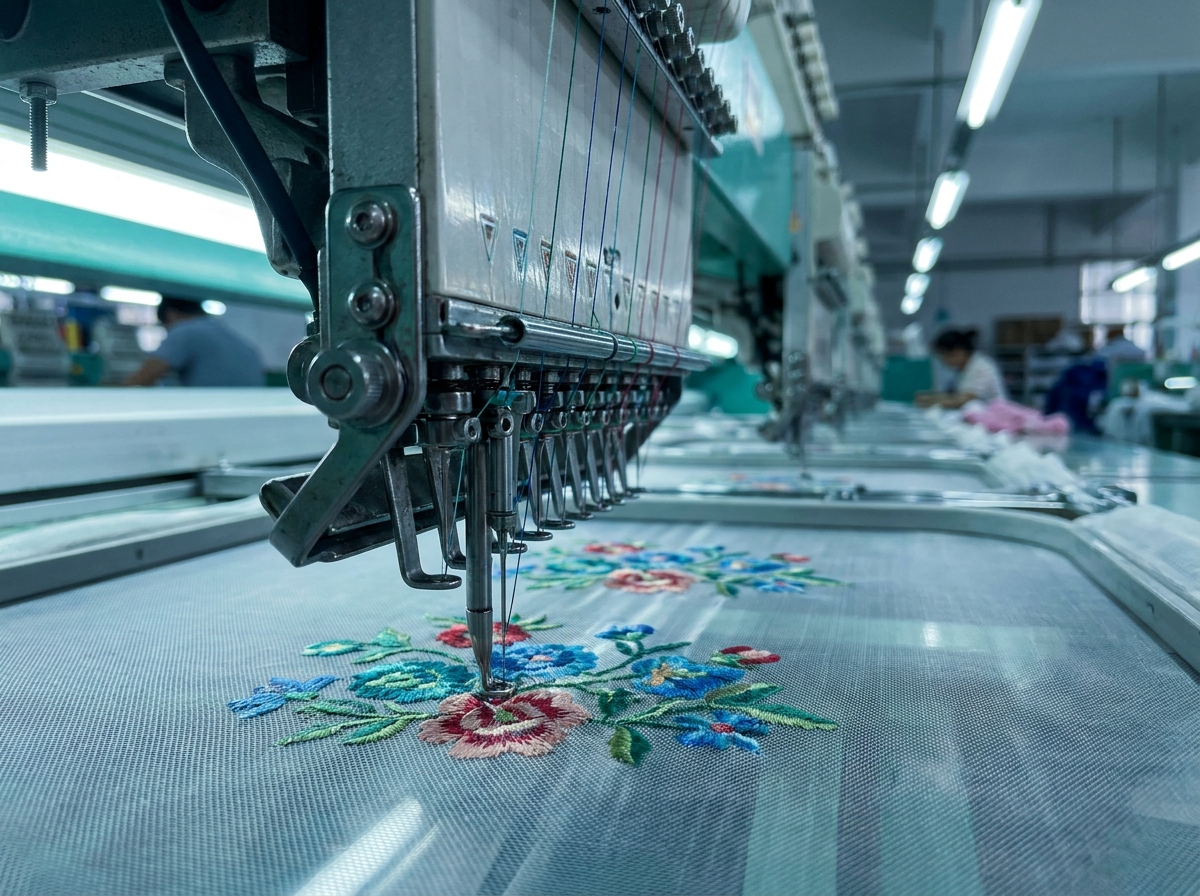
Thread breakage is the number one production stopper. When a thread snaps, the machine halts, the operator rethreads, and the design restarts from a programmed backup point. If the break happens in a dense fill area, you get a visible restart line. Causes include incorrect tension settings, needle burrs from wear, and low-quality thread that frays under high-speed stitching. We monitor our breakage rate at 1-3 breaks per 10,000 stitches and replace needles every four hours to keep this under control.
Skipped stitches look like small gaps in the design where the needle went through the fabric but didn't lock the thread. The usual culprits are dull needles, incorrect needle-to-fabric timing, or bobbin tension that's too loose. On mesh fabrics, skipped stitches are particularly visible because there's no dense ground to hide them.
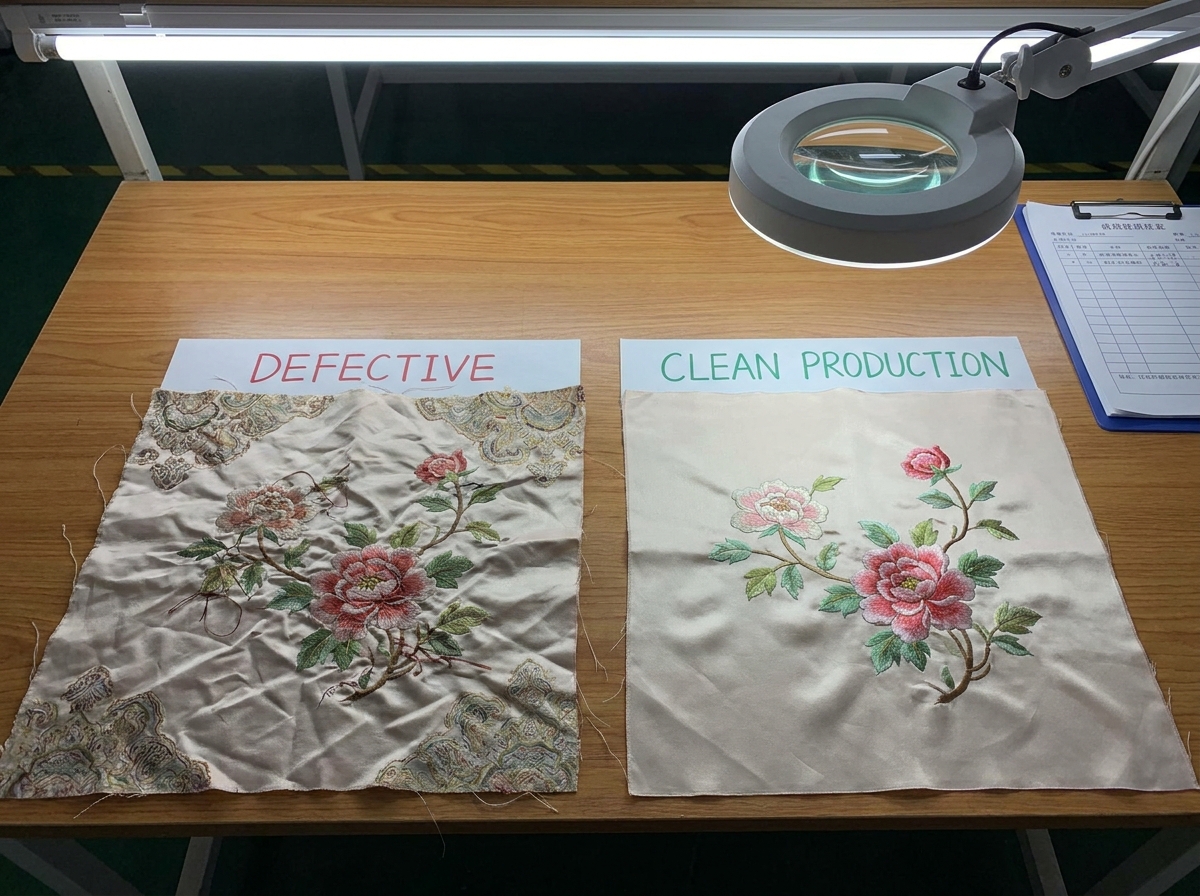
Bird nesting happens when tangled thread bunches up on the underside of the fabric, creating a messy knot that pushes through to the front. It's almost always a bobbin tension problem, sometimes made worse by incorrect threading. You'll spot it if you flip the fabric over. The back of good embroidery should be clean, with minimal loose threads.
Jump stitches and uncut trims are long thread spans between design elements that weren't trimmed by the machine. Some digitizers program jump stitches intentionally to avoid unnecessary trims, but when they're visible on the finished product, they look unprofessional. This is a digitizing file issue, not a machine problem. As our chief embroiderer puts it: "The digitizing file is the blueprint. If the blueprint is wrong, no amount of skilled machine operation can fix it."
Fabric and Surface Defects
Puckering is when the fabric gathers or wrinkles around the embroidered area, creating a raised, uneven surface. It happens when stitch density is too high for the fabric weight, when the backing stabilizer is insufficient, or when the fabric itself has too much stretch. Puckering is one of the most common reasons buyers reject bulk orders, because it's immediately visible and makes the product look cheap.
Fabric grin-through (also called gapping) occurs when you can see the base fabric through the stitches, especially on open-weave materials like mesh or lace. It's caused by low stitch density or incorrect pull compensation in the digitizing file. The fix is straightforward: increase density or adjust the underlay stitches, but it has to be done before production starts.
Needle damage shows up as small cuts or holes in the fabric around the embroidered area. It's most common on delicate substrates like silk or fine mesh, where too many needle penetrations in a small area literally tear the fabric apart. Needle size matters here — a needle that's too thick for the fabric will leave permanent holes.
Hoop marks are circular impressions left on the fabric where the embroidery hoop held it in place. On darker fabrics, these show as lightened rings. On lighter fabrics, they appear as creases. The cause is usually over-tightening the hoop or skipping protective backing between the hoop and the fabric. Most hoop marks steam out, but severe ones are permanent.
Design and Registration Defects
Poor registration means design elements don't line up correctly. Outlines don't match fills, colors overlap where they shouldn't, or the whole design appears shifted. This usually comes from fabric slipping in the hoop during production, or from digitizing errors where the design file has misaligned layers. Multi-color designs are especially vulnerable because each color pass adds another chance for misalignment.
Color shift is when the thread color in bulk production doesn't match the approved sample. The most common cause is thread lot variation — the same color number from different dye batches can look noticeably different under standard lighting. We check every thread delivery against our master color cards under D65 and TL84 dual-light sources before it goes to the production floor.
Thick or rigid embroidery happens when the stitch count is too high, creating an area that feels stiff and uncomfortable against the skin. It's often the result of an inexperienced digitizer trying to compensate for potential registration issues by adding extra density. The irony is that over-dense embroidery is more likely to pucker, not less.
Incomplete design occurs when the machine stops before finishing — usually because the thread ran out or the machine encountered an error the operator didn't catch in time. On a large production run with hundreds of pieces, a few incomplete designs are almost inevitable. The question is whether the factory catches them before they ship.
How Fabric Type Changes Your Defect Risk
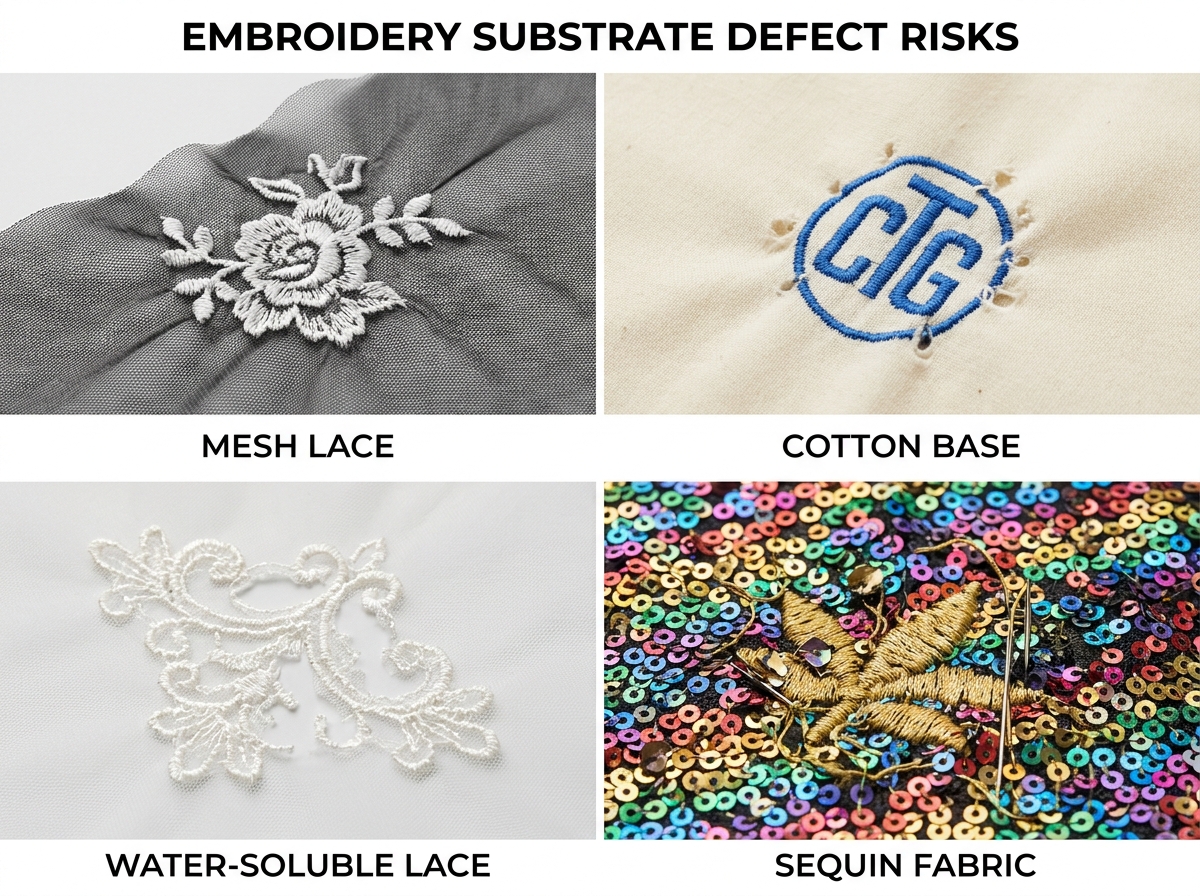
Not all embroidery defects are created equal. The fabric you choose for your order changes which problems you're most likely to encounter, and a factory that treats every substrate the same is a factory that's going to give you surprises.
Mesh and lace fabrics are the most forgiving visually because the open weave hides minor imperfections, but they're also the most fragile. Hoop damage is a real risk. The thin ground fabric can tear if the operator over-tightens the clamp. Thread visibility is another issue: on white mesh, the bobbin thread can show through as a gray haze if the top-to-bottom tension ratio isn't dialed in. We adjust our machine settings specifically for mesh substrates, which is why our operators are assigned to fabric-craft combinations they've mastered, rather than rotating randomly across all machines.
Cotton and polyester base fabrics are more stable, but they bring their own problems. Cotton shrinks. If the embroidery is digitized without accounting for post-wash shrinkage, the design distorts after the buyer's garment wash process. Polyester doesn't shrink, but it's slippery, which means registration errors are more common if the hoop grip isn't secure. On tight-weave cotton, needle damage from excessive penetrations can weaken the fabric enough to cause tearing during garment construction.
Water-soluble embroidery is its own category. The backing is chemically dissolved after production, leaving only the stitched design. Defects here include incomplete dissolution (sticky residue on the final product), fragile final structure (not enough stitches to hold the design together without backing), and color bleeding during the dissolution process if the thread dye isn't stable. We produce water-soluble embroidery up to 1.4 meters wide with up to 400,000 stitches. At that scale, even a 1% defect rate means 4,000 stitches that could go wrong.
Sequin, bead, and tube embroidery introduces defects that don't exist in standard thread embroidery. Sequins can detach if the securing stitch isn't tight enough. Beads can crack if the thread tension is too high. Tubes can split if the internal diameter doesn't match the thread specification. Our chief embroiderer describes it this way: "Bead embroidery needs stiffness — the paste viscosity and tube inner diameter have to match. If the diameter is too large and there's too little paste, the tubes won't stand up. If it's too small and there's too much paste, they push outward."
The takeaway for buyers: ask your supplier what their defect rate is on your specific fabric type. A factory that quotes a generic "2% defect rate" without specifying substrate is giving you a meaningless number.
How We Prevent Defects: Fominte's Three-Layer System
I've described what goes wrong. Now here's what a serious factory does to make sure it doesn't reach your warehouse. Our prevention system has three layers, and each one catches different types of problems.
Layer 1: Before Production
Everything starts with the digitizing file. About 15% of the files we receive from clients get sent back for rework before they ever touch a machine. The most common issues are excessive density, missing underlay stitches, and incorrect pull compensation for the target fabric. Fixing these at the file stage costs hours; fixing them after production costs weeks and thousands of dollars in rejected goods.
Material matching is the next checkpoint. Thread type, fabric weight, and needle size have to work together. A polyester thread on a cotton substrate behaves differently than a rayon thread on the same fabric. We match these combinations based on decades of production data, not guesswork.
Then comes the pre-production sample: we run 3-5 pieces on the actual production machine with the actual materials. The buyer approves this sample before we start bulk. This is where problems like color shift, density issues, and registration errors show up — when they're still cheap to fix.
Every machine goes through calibration before a new production run. Tension gauges check the top thread and bobbin. Needles are inspected for burrs. The hoop pressure is set for the specific fabric. These aren't optional steps. They're written into our production protocol.
Layer 2: During Production
Inline inspection happens every two hours on our floor. A QC technician pulls random pieces from each machine and checks them against the approved sample under standardized lighting. They're looking for the defects I described earlier — thread breaks, skipped stitches, puckering, registration drift.
Thread breakage rate is monitored in real time. If a machine starts breaking thread more frequently than the 1-to-3 per 10,000 stitches benchmark, it gets pulled from production for maintenance. This isn't just about the visible defect. A thread break that gets repaired creates a weak point in the design that can fail during the buyer's garment washing process.
Each operator is trained on specific fabric-craft combinations. Someone who's spent years running mesh embroidery doesn't get moved to sequin production without training and qualification. This specialization is how we maintain consistency across 27 machines and 300,000 meters of monthly output.
Every defect found during inline inspection gets logged with a root cause, not just counted. If three machines in a row show the same puckering issue, we can trace it to a specific thread batch, a specific fabric delivery, or a calibration drift. Counting defects tells you how bad things are. Tracking root causes tells you how to prevent them from happening again.
Layer 3: After Production
Every piece goes through needle detection. This isn't about embroidery quality — it's about safety. A broken needle fragment embedded in fabric is a consumer safety hazard and a liability issue for your brand. Our detection system scans 100% of output.
Color checking happens under D65 and TL84 dual-light sources, following AATCC test methods and the same testing standards we use for all quality certifications. D65 simulates daylight, TL84 simulates the fluorescent lighting common in retail stores. A color that looks perfect under one light source can look completely wrong under the other. We check both because your customers will see the product in both conditions.
Bulk orders go through AQL sampling, as we detail in our full QC process breakdown. Critical defects (broken needles, major color mismatches) have a zero-tolerance standard. Major defects follow AQL 2.5. If the sample exceeds the acceptance number, the entire lot gets re-inspected. This is the same standard that third-party inspection agencies use, but we do it in-house before the goods ever leave our facility.
Our overall defect rate is under 2%, based on actual production data. That number includes everything: thread breaks that left marks, minor registration drift, fabric imperfections. For critical defects, the rate is zero. That's not an aspiration. That's the standard we reject against.
Shawn Wang, our founder, started his career as a quality inspector in a textile factory. He says quality isn't a cost. It's an investment. I've seen what he means. The cost of catching a defect during inline inspection is measured in minutes. The cost of catching it after the goods arrive at your warehouse is measured in weeks of delay, thousands in shipping costs, and sometimes a buyer relationship that doesn't recover.
What B2B Buyers Should Ask Their Embroidery Supplier
After reading this far, you know more about embroidery defects than most buyers who walk into a factory. Here's how to use that knowledge.
When you're evaluating a new embroidery supplier, these are the questions that separate serious factories from the rest:
"What is your defect rate on my specific fabric type?" Not a general number. The rate for mesh, or cotton, or water-soluble, whichever you're ordering. A factory that tracks defects by substrate understands the variables.
"How many inline inspection points do you have per production run?" If the answer is "we check at the end," that's a red flag. Defects caught at the end can only be scrapped or reworked. Defects caught inline get stopped before they spread.
"What's your needle replacement schedule?" We replace needles every four hours. A factory that runs needles until they break is accepting unnecessary defect risk.
"Can you show me your last five QC reports?" Not a summary. The actual inspection records with defect counts, root causes, and corrective actions. If a supplier can't produce these, they either don't track quality or they don't want you to see the numbers.
"What happens when you find defects? Repair, rework, or scrap?" A good factory has a clear triage system. Minor issues like loose threads or small misalignment get hand-repaired. Moderate issues like puckering or density problems get reworked. Severe issues like wrong color or structural damage get scrapped. If everything gets "repaired," the factory is prioritizing output over quality.
"Do you have OEKO-TEX or equivalent certification?" We hold OEKO-TEX, Higg Index, and Amfori certifications. These aren't just logos for the website. They represent third-party verification of our chemical safety, environmental practices, and social compliance.
One more thing. If a supplier tells you they "never have quality problems," walk away. Every factory has defects. The question is whether they have a system to catch them before you do.
FAQ
What is the most common embroidery defect?
Thread breakage is the most common defect in machine embroidery. It's caused by tension issues, needle wear, or low-quality thread. In our factory, we monitor thread breakage rate at 1-3 breaks per 10,000 stitches and replace needles every four hours to minimize production stops and visible repair marks.
How do I check embroidery quality before accepting a bulk order?
Check three things: stitch density consistency across the piece (use a magnifying loupe), color matching under D65 standard lighting, and back-side cleanliness. Loose threads and bird nesting on the back indicate poor machine calibration. Always compare the bulk sample against the pre-production approval sample side by side.
What is an acceptable defect rate for wholesale embroidery fabric?
Industry standard ranges from 2-5% depending on the factory and fabric type. High-quality factories target under 2%. Our defect rate is under 2% based on production data. For critical defects like broken needles, major color shift, or structural failures, the acceptable rate should be zero.
Can embroidery defects be fixed after production?
Some can. Loose threads can be hand-trimmed, minor misalignment can sometimes be steamed back into place, and small puckering may relax after washing. But severe defects like wrong color, deep needle damage, or major registration errors require rework or scrap. Prevention during production is always cheaper than correction after.
Step-by-Step Guide
Specify defect tolerance in your PO
Request pre-production samples
Inspect under multiple light sources
Check the back of the fabric
When to Use & Avoid
Thread breakage prevention
✅ Use When
- High-speed production runs, dense fill designs, metallic threads
⚠️ Avoid When
- Loose tension settings, worn needles, low-quality thread
Puckering prevention
✅ Use When
- Dense embroidery on lightweight fabrics, stretch substrates
⚠️ Avoid When
- Skipping backing stabilizer, exceeding fabric-appropriate density, ignoring fabric shrinkage
Registration accuracy
✅ Use When
- Multi-color designs, large format embroidery, slippery fabrics
⚠️ Avoid When
- Rushing digitizing review, skipping hoop grip tests, ignoring fabric stretch
Color consistency
✅ Use When
- Multi-batch orders, matching to approved samples, cross-lighting inspection
⚠️ Avoid When
- Accepting thread without lot verification, single-light inspection, skipping master color card comparison
⚡ Common Mistakes to Avoid
Everything You Need to Know
Conclusion