.png?w=970&h=250)
What Determines Outdoor Jacket Price? Fabric, Membrane, Seam Tape, Zippers, and MOQ
What It Really Means
A Jacket Price Is the Output of a Specification
When two outdoor jackets look similar in a catalog, buyers often expect their factory prices to be similar too. That assumption causes more confusion than almost anything else in an outerwear quotation.
A photograph does not reveal the face-fabric yarn, usable width, laminate structure, coating, backer, lining, seam-tape map, zipper grade, pocket construction, reinforcement, test scope, inspection level, packing method, or order split. Yet each of those decisions affects the bill of materials or the manufacturing route. The price is therefore not attached to the silhouette. It is attached to the specification and the conditions under which that specification will be produced.
At FOMINTE, our team first translates the buyer's product target into a production definition. A commuter rain shell, a promotional windbreaker, a workwear jacket, and a three-layer hiking shell may share a hooded outline, but they should not share an unexamined quote. Before we discuss a final price, we need to understand the intended weather protection, wearing conditions, target market, order structure, and claim the brand plans to make.
This distinction matters when comparing suppliers. A low quote may be completely valid for a simpler specification. It becomes misleading only when it is compared with a technically different product as though both offers include the same materials, construction, controls, and commercial terms.
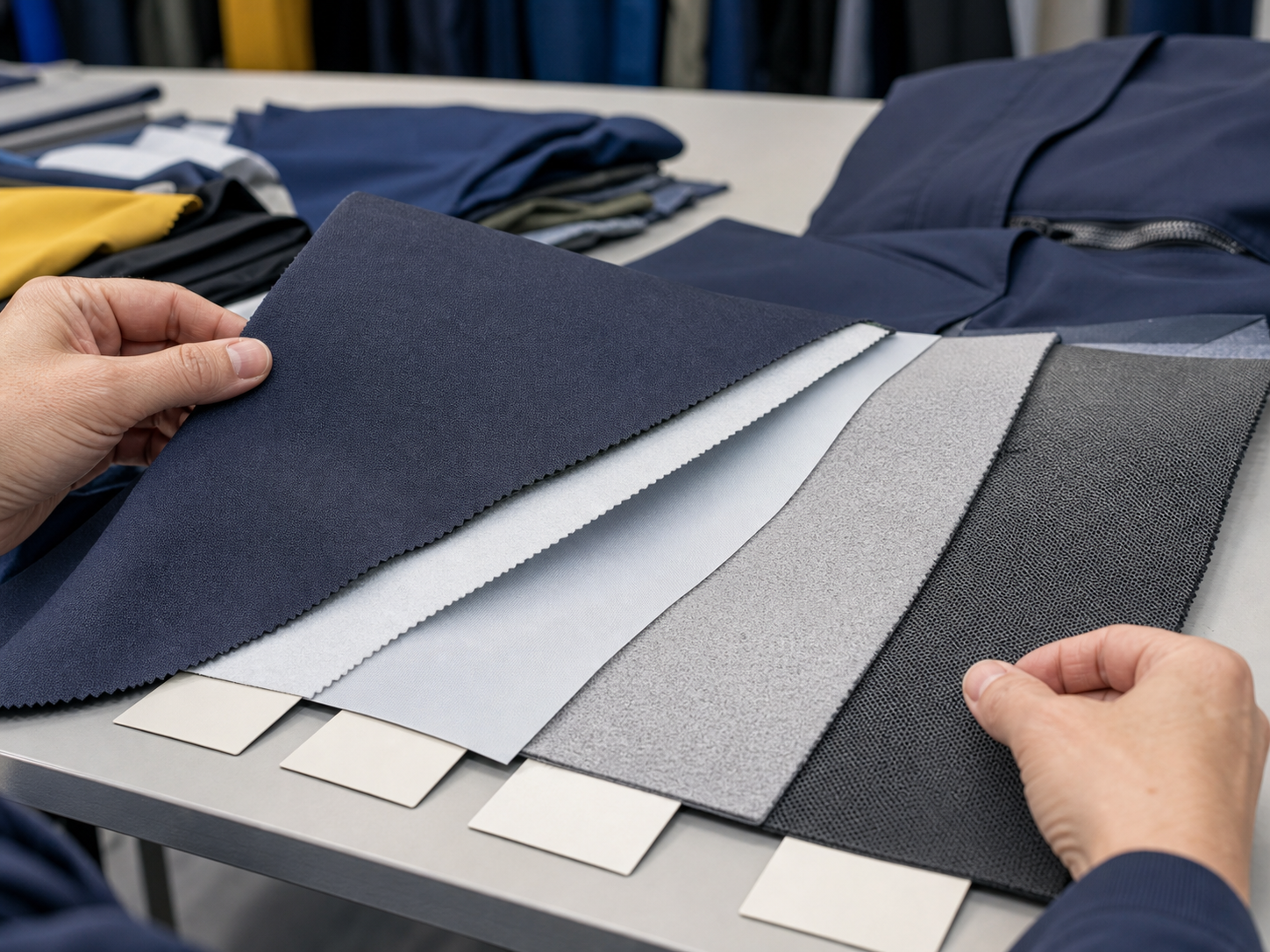
1. The Shell Material Is a System, Not One Cost Line
Buyers often write “100% polyester waterproof fabric” in an inquiry. That description is too broad for reliable costing. The shell may be a light woven fabric with a simple coating, a two-layer laminate used with a separate lining, a 2.5-layer construction with a printed or textured inner surface, or a three-layer laminate with an integrated backer. Even before performance is discussed, these routes create different material and assembly requirements.
The material system can include:
- the face textile, including fiber, denier, weave, weight, color, and recycled-content requirement;
- a PU, TPU, or other coating or membrane direction;
- a backer or separate lining;
- a water-repellent surface finish;
- print, melange, ripstop, stretch, or mechanical-finish requirements;
- certification, chemical, or traceability requirements;
- the target test method and performance level.
The important question is not whether the fabric is called waterproof. It is what the approved material is designed and tested to do. ISO 811:2018, for example, specifies a hydrostatic-pressure method for determining a fabric's resistance to water penetration. A test method helps define what a number means; it does not make every jacket built from that fabric perform identically.
Color also changes the calculation. A standard available color may be easier to source than a custom color that requires a lab dip, minimum dye lot, and buyer approval. Light colors, high-visibility colors, or tightly controlled brand colors may require additional attention to shade, opacity, or lot consistency. Certified recycled fabric or a proprietary laminate may have different supply conditions from a conventional stock quality.
This is why substituting “similar waterproof fabric” to meet a target price is risky. Similar handfeel or appearance does not prove equivalent construction, durability, waterproofing, breathability, color consistency, or compliance. Any substitution should be documented and approved against the product target.
2. Fabric Yield Can Change Even When the Fabric Price Does Not
Fabric cost is not only the price per meter. It is the price per meter multiplied by consumption, adjusted for usable width, cutting efficiency, size ratio, shrinkage or relaxation requirements, and an appropriate allowance for production loss.
Pattern geometry affects yield. A long body, extended hood, articulated sleeve, dropped tail, large pocket bag, facing, storm flap, or reinforcement panel may prevent efficient marker nesting. Directional prints, one-way surface effects, checks, or a fabric with a clear grain constraint can reduce marker efficiency further. A size assortment weighted toward larger sizes also changes average consumption.
The same fabric quote can therefore produce two different garment costs. One jacket may use broad, clean panels that nest efficiently. Another may have numerous curved pieces, contrast panels, and directional components that leave more unusable space in the marker. Neither result is arbitrary; it comes from the approved pattern and order ratio.
Buyers can improve quote accuracy by providing a measurement chart, size range, expected size ratio, and reference pattern or approved sample. Without those inputs, early consumption is an estimate and should be labelled as such. Once the pattern and marker are stable, the factory can replace a broad allowance with a more defensible consumption figure.
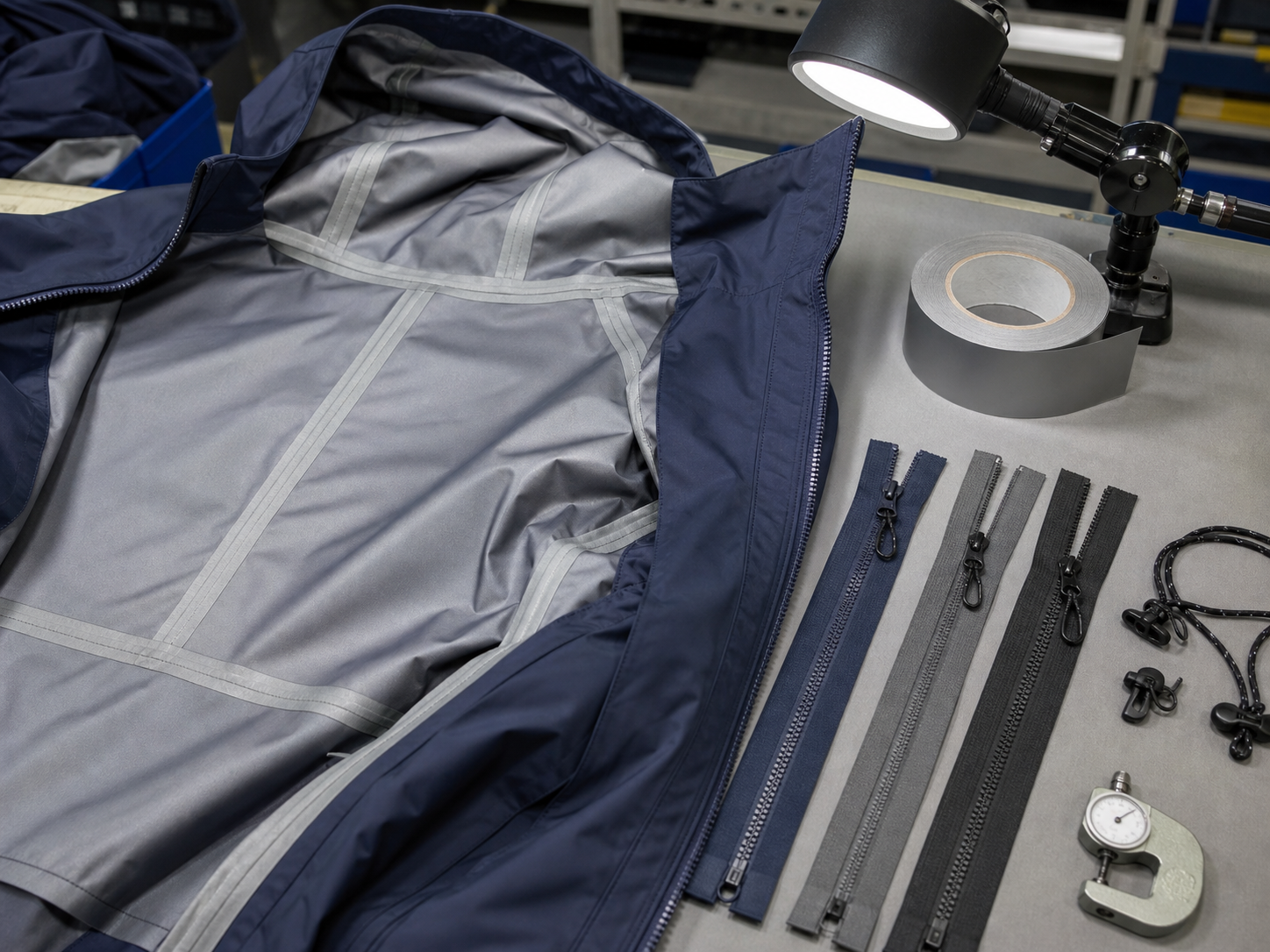
3. Seam Tape Adds Material, Equipment Time, and Process Control
Stitching a waterproof or highly water-resistant shell creates needle holes. If the product promise requires those seams to resist water penetration, the seam route must address them. That may mean full seam taping, critical-seam taping, welded construction in selected areas, or another approved solution.
Seam tape affects price in several ways. There is the tape itself, but also the seam length, tape width, compatibility with the laminate or coating, machine setup, temperature, pressure, speed, operator skill, and inspection. A jacket with many small panels or complex intersections has more tape length and more difficult application points than a clean shell with fewer seams.
The tape map should be explicit. “Taped seams” can mean every applicable shell seam or only selected critical seams. Those are not equivalent offers. Tape compatibility also matters because an adhesive system that works on one backer or coating may not bond correctly to another. Sample approval should examine appearance and adhesion, while the quality plan should define how the production team monitors the process.
GORE-TEX's own technical explanation makes the broader point clearly: a laminate alone is not the finished waterproof system; seam tapes, qualified components, garment construction, and assessment all contribute. Buyers do not need to specify GORE-TEX to apply that lesson. A material claim and a garment construction claim should never be treated as the same thing.
If cost needs to come down, reducing unnecessary seam length is often more honest than quietly changing from full taping to partial taping. Panel simplification can save fabric, sewing time, and taping time at once, while leaving the buyer in control of the final protection target.
4. Zippers and Trims Can Move a Quote More Than Their Size Suggests
A jacket may use one center-front zipper, three pocket zippers, pit zips, an inner security zipper, snaps, hook-and-loop tabs, cord locks, drawcord, elastic, toggles, eyelets, pullers, badges, labels, and packaging accessories. Small components accumulate quickly.
Zipper cost depends on brand or supplier, chain type and size, length, slider, coating or water-resistant construction, reverse-coil or conventional orientation, two-way function, custom puller, color matching, and order minimum. A water-resistant zipper is not automatically a watertight closure, and a zipper choice should match the intended garment claim and pocket design.
Pocket architecture adds both trims and labor. A simple patch pocket differs from a zippered welt pocket with a storm cover, bonded detail, reinforcement, and internal pocket bag. Chest pockets, sleeve pockets, pass pockets, ventilation openings, and media routing each add pieces and operations. Every new opening in the shell also deserves review within the weather-protection plan.
Branded hardware can make a product distinctive, but it may introduce tooling, sampling, color matching, minimum quantities, and longer procurement. For an initial order, a standard proven component with a branded puller or label can sometimes achieve the commercial goal with less risk. For a repeat program with sufficient volume, fully customized hardware may be justified.
The correct choice depends on where the feature creates buyer value. Removing a decorative zipper may reduce cost cleanly. Downgrading the main closure without considering durability, operation with gloves, or the storm-flap design may simply transfer cost into complaints and returns.
5. Construction Complexity Is Labor That Can Be Counted
Outdoor-jacket labor is shaped by operations, not by the number of words in a tech pack. More panels usually mean more cutting bundles, matching points, seams, handling, and inspection. Curved seams, narrow allowances, laminated materials, stretch mismatch, bulky intersections, and exact topstitching all affect production difficulty.
Common labor drivers include:
- articulated sleeves and elbow shaping;
- multi-panel or helmet-compatible hoods;
- hidden adjustment systems;
- underarm ventilation;
- internal and external storm flaps;
- multiple pocket types;
- reinforcement at shoulders, elbows, cuffs, or hem;
- lining attachment and clean-finish requirements;
- reflective details, bonding, welding, or precise logo placement;
- full seam taping after sewing.
These details are not inherently good or bad. They should earn their place by supporting fit, mobility, protection, durability, merchandising, or brand identity. A feature that does not serve the target user is an obvious cost-engineering candidate.
Pattern development also influences downstream cost. A stable pattern reduces correction, handling problems, measurement failures, and rework. Buyers can review how FOMINTE moves from specification to bulk production in our outdoor-jacket production flow. The purpose of development is not to add bureaucracy; it is to remove uncertainty before expensive bulk work begins.
6. MOQ Changes the Unit Economics Through Several Different Minimums
MOQ is often discussed as one factory rule, but an outdoor-jacket order contains several minimums. The face fabric may have a minimum by quality and color. Lamination, coating, printing, dyeing, zipper color, custom puller, seam tape, label, packaging, and production setup may each have their own condition.
A 600-piece order split across one style and two colors is not costed like the same total split across six colors, especially if every color needs a custom fabric lot and matching trims. The second order creates smaller material lots, more approvals, more changeovers, more leftover exposure, and less efficient cutting. A wide size assortment with an irregular ratio may add another layer of complexity.
Fixed work is also distributed across the quantity. Pattern development, sample review, artwork setup, testing, and certain production preparations do not fall in direct proportion to units. At a lower volume, the same fixed effort is spread over fewer jackets. That does not mean every low-volume order is impossible. It means the specification and material route need to be chosen with the order architecture in mind.
Our outdoor jacket MOQ and lead-time guide explains why a useful minimum should state whether it applies by style, color, material lot, or custom component. The same discipline applies to price: a unit quote is meaningful only when the quantity and split are clear.
7. Testing, Inspection, Packaging, and Commercial Terms Belong in the Comparison
Two factory prices may differ because one includes services or commercial exposure that the other excludes. Before deciding that one supplier is expensive, normalize the scope.
Testing may cover fabric water resistance, surface wetting, breathability, colorfastness, dimensional change, seam performance, restricted substances, or another buyer-defined requirement. The correct plan depends on the claim, market, material, and risk. Testing has a direct fee and may require extra samples and calendar time. It also reduces the risk of making an unsupported claim.
Inspection scope matters as well. Incoming material review, inline checks, measurement audits, seam-tape inspection, final random inspection, metal detection where required, and third-party inspection are not interchangeable. The quotation should state what is included and what remains the buyer's responsibility.
Packaging can range from a standard polybag and export carton to custom printed bags, tissue, hangers, size clips, RFID, retail labels, carton marks, assortment packing, and special sustainability requirements. Carton dimensions and garment compression affect freight volume even if they do not change the ex-factory price much.
Finally, compare the same commercial basis. EXW, FOB, CIF, DDP, and other terms allocate cost and responsibility differently. Currency, payment terms, duty, freight, insurance, destination charges, and taxes can change the landed result. A lower FOB price can still produce a higher landed cost if packing, freight efficiency, quality risk, or excluded charges are different.
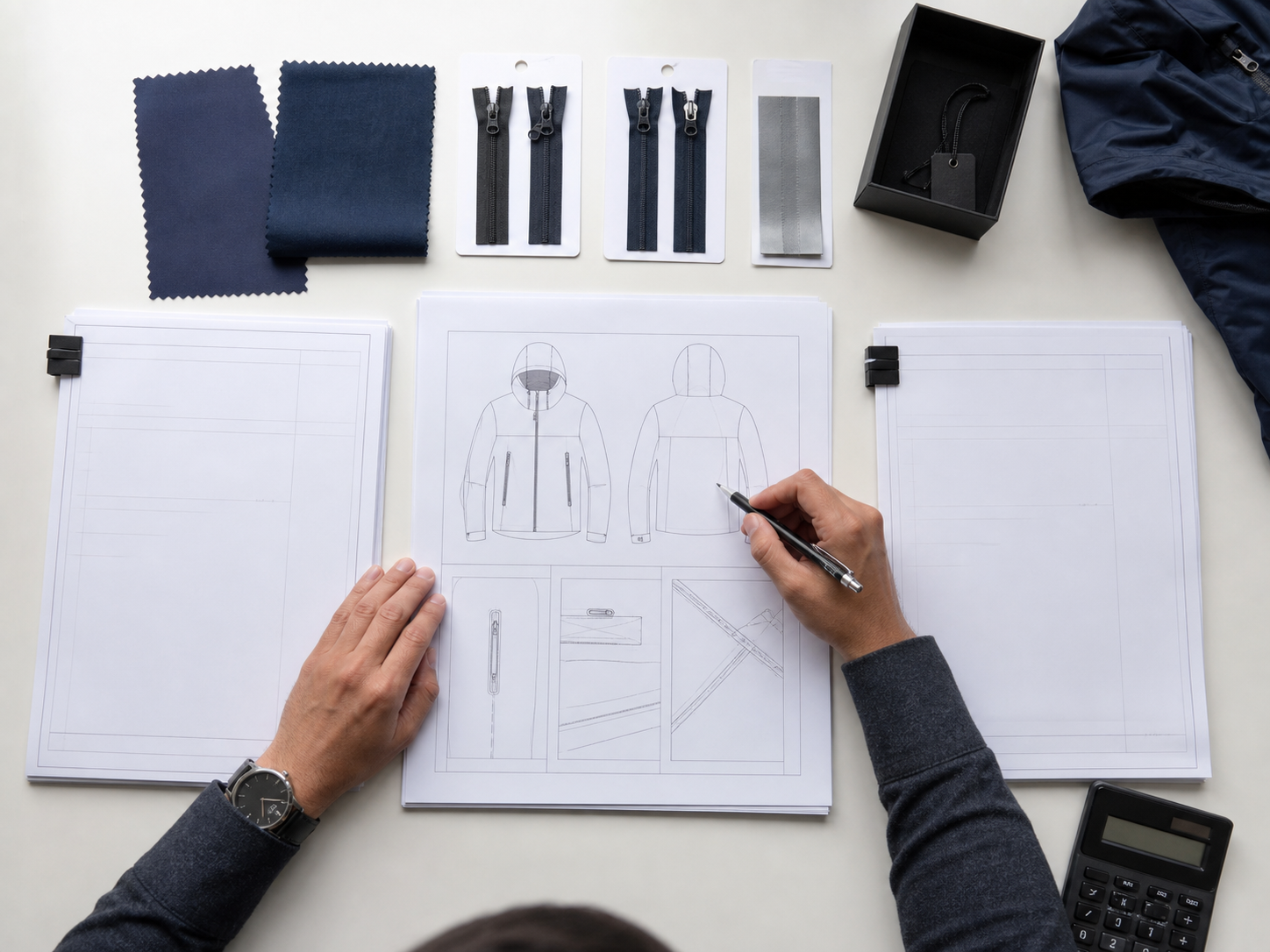
8. How to Compare Two Custom Jacket Quotations Fairly
Start by placing both offers against one controlled specification. The comparison should identify the exact shell quality, color route, membrane or coating, lining, DWR or finish, zipper models or performance class, seam-tape scope, pocket count, logo methods, labels, packaging, quantity by color and size, test plan, inspection plan, Incoterm, currency, and delivery basis.
Mark every deviation. If Supplier A offers a three-layer laminate and Supplier B offers a coated two-layer shell with mesh lining, the price difference is not a negotiation result; it is primarily a product difference. If one quote includes custom zipper colors and full seam taping while another uses stock zippers and critical-seam taping, the buyer needs to decide which specification serves the market.
Then separate confirmed items from provisional allowances. Early quotations often contain assumptions because the pattern, consumption, artwork, or final trim has not been approved. A professional quote should make those assumptions visible. After sample and material confirmation, the final commercial review can close them.
This approach also makes negotiation more productive. Instead of demanding an unexplained percentage reduction, the buyer and factory can identify the few decisions that carry real cost: material tier, panel count, zipper package, seam-tape scope, color count, packaging, or order volume. The discussion becomes product engineering rather than pressure.
9. Reducing Cost Without Breaking the Product Promise
Cost engineering works best when the brand ranks requirements. Define what must not change: perhaps the target use, waterproof test basis, full seam taping, fit block, main zipper durability, or recycled-content requirement. Everything else can then be reviewed according to customer value.
Practical options may include simplifying decorative paneling, sharing shell fabric across styles, reducing color count, using standard trim colors, selecting an available lining, standardizing cord locks and pullers, removing low-value pockets, aligning size ratios with demand, consolidating packaging, or planning earlier to avoid rush sourcing.
Some changes need greater caution. Changing the laminate or coating, reducing seam-tape coverage, replacing the main zipper, removing reinforcement, or lowering test scope may affect the product claim or return risk. These decisions should never be hidden inside a lower quote. They should be presented as alternatives with their consequences.
The lowest responsible price is not found by deleting every control. It is found by removing specifications the customer does not value while protecting the few things the product is expected to do. That is the logic behind FOMINTE's factory-level review.
What to Send for a Usable FOMINTE Quotation
Send the tech pack or a clear reference, intended use, target market, weather-protection claim, quantity by color and size, preferred shell and lining direction, zipper and trim requirements, seam-tape scope, logo methods, labels, packaging, testing needs, destination, target delivery date, and requested Incoterm.
If some decisions are open, say so. Our team can return alternatives instead of pretending the specification is already fixed. To see the product families we can review, start with FOMINTE's outdoor jacket product range.
Send the package to info@fominte.com. I will hand it to the appropriate product, sourcing, and production team for a normalized quotation review under FOMINTE's manufacturing standards.
Step-by-Step Guide
Define the product promise
Normalize the material system
Map construction and trims
Confirm order architecture
Align verification and commercial scope
Review cost alternatives
When to Use & Avoid
Promotional windbreaker
✅ Use When
- Simple woven shell
- basic weather resistance
- standard trims
- high-volume campaign
⚠️ Avoid When
- When the product is expected to make a technical waterproof claim
Commuter rain shell
✅ Use When
- Moderate rain protection
- clean styling
- practical pockets
- controlled budget
⚠️ Avoid When
- When alpine durability or helmet-compatible construction is essential
Technical hiking shell
✅ Use When
- Defined waterproof and breathability target
- full seam plan
- articulated fit
- performance trims
⚠️ Avoid When
- When the buyer cannot provide a test basis or approve technical materials
Multi-style private-label line
✅ Use When
- Shared fabrics
- standardized trims
- planned color palette
- repeat-order strategy
⚠️ Avoid When
- When every low-volume style uses unrelated materials and custom hardware
Comparison
| Quote Element | Incomplete Description | Normalized Description |
| Shell material | Waterproof polyester | Face textile, weight, weave, color route, coating or membrane, backer or lining, finish and test basis |
| Seam sealing | Taped seams | Full or critical coverage, tape type or width direction, applicable seam map and inspection requirement |
| Zippers | Waterproof zippers | Supplier or performance class, chain size, length, slider, color, puller and opening location |
| Quantity | 600 pieces | Quantity by style, color and size with material and custom-trim minimums |
| Quality | Standard QC | Included tests, incoming checks, inline checks, final inspection and third-party scope |
| Commercial basis | Unit price | Currency, Incoterm, packaging, sample or testing charges, validity and delivery basis |
⚡ Common Mistakes to Avoid
Everything You Need to Know
Conclusion