Why Our Prices Are More Competitive: Fominte's Raw Material Sourcing Advantage

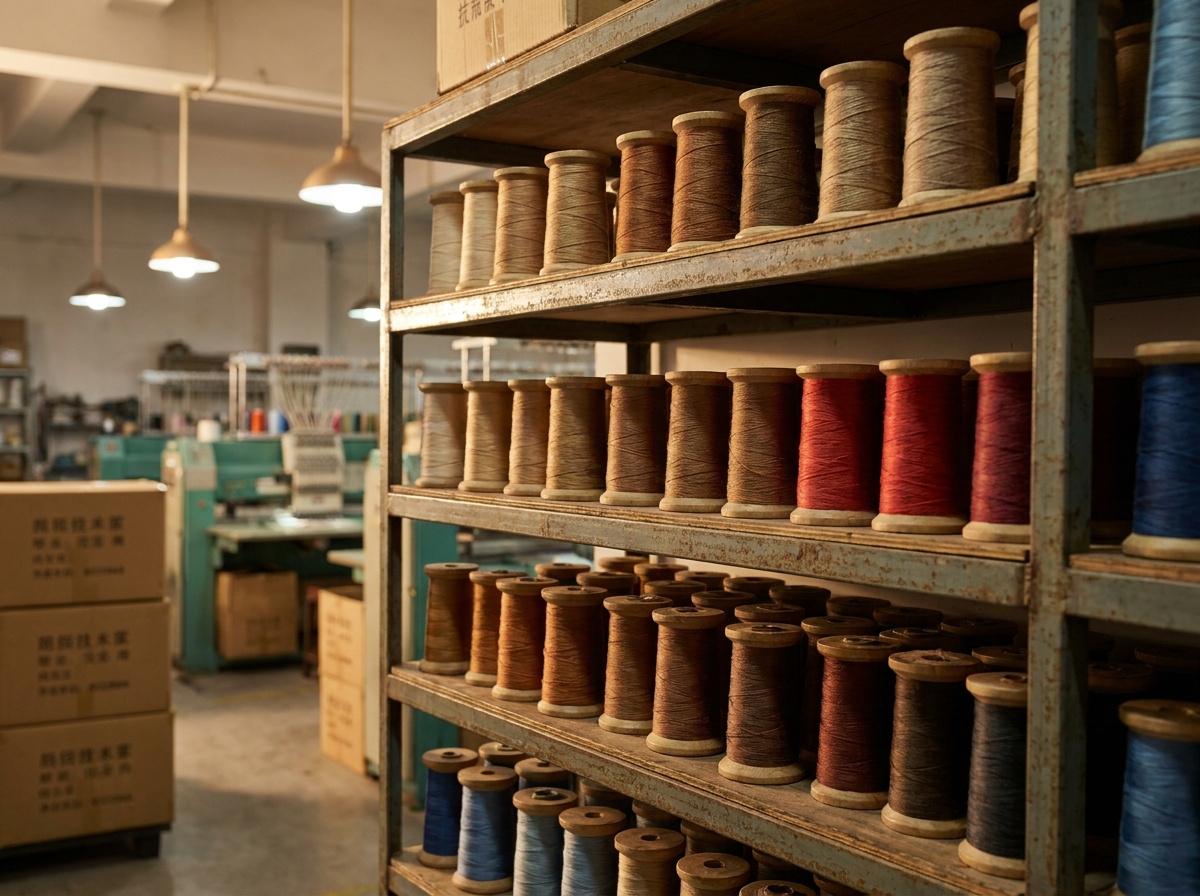
![Prompt: Close-up of embroidery thread spools organized on industrial shelving in a textile factory warehouse, warm lighting, professional B2B photography style]

What "Raw Material Sourcing Advantage" Actually Means

A buyer from Turkey emailed me last month. His message was direct: "Your pricing is 18% lower than the factory we currently use in Guangdong. What's the catch?"

I get this question a lot. And I understand why. When someone quotes you a lower price, the first instinct is to look for what's missing. Lower thread count? Thinner base fabric? Skipping QC steps?

In our case, none of those things are true. The answer is simpler and less dramatic than most people expect. It comes down to where we buy our raw materials.

Most embroidery manufacturers in China buy their threads, base fabrics, and embellishments through distributors or trading companies. A typical supply chain looks like this: the thread mill sells to a regional distributor, the distributor sells to a trading company, and the trading company sells to the factory. Every step adds margin. Depending on the material, those middlemen collectively add 15-30% to the cost before the thread even reaches the production floor.

Shawn has been building direct relationships with material mills since the early 1990s. He started with thread suppliers when we were still based in Shenzhen. Over the decades, those relationships expanded to include base fabrics, sequins, beads, and specialty materials. We now source the majority of our core materials directly from the mills that produce them.

That's the sourcing advantage. Nothing secret about it. Just decades of building direct procurement channels that most smaller factories either can't or won't invest in.

As Shawn puts it: "Price is information. But it's not the only information. If someone's price is significantly lower, there's a reason. Find out what it is." Our reason is structural, not suspicious.
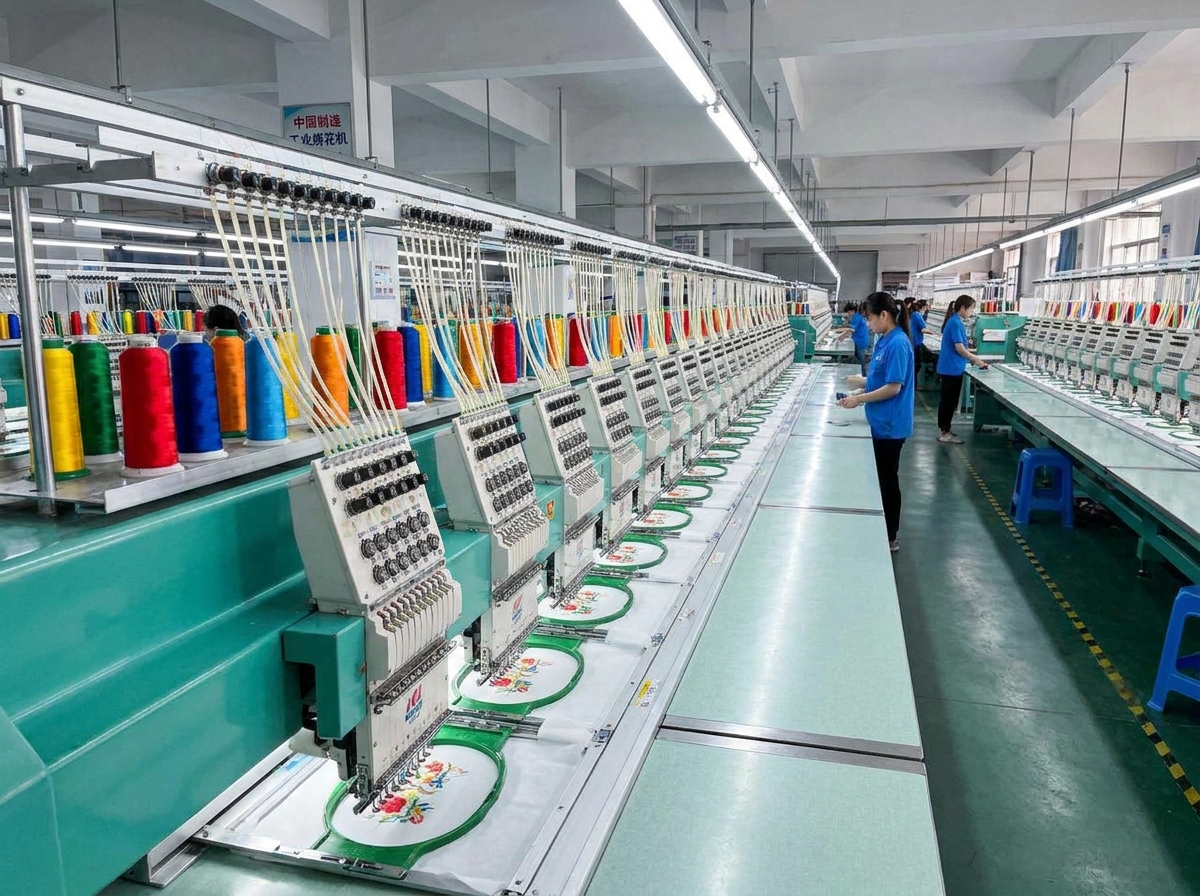
![Prompt: Industrial embroidery machine with colorful threads feeding into multi-head setup, factory floor background, showing scale of production]

How Direct Sourcing Changes Your Per-Yard Cost

Let me walk through the cost chain of a typical embroidered mesh fabric order, because understanding this changes how you evaluate suppliers.

When you get a quote from a factory, that price includes raw materials, labor, overhead, quality control, and margin. For most embroidery orders, raw materials account for 40-55% of the total cost. That's the biggest single component. (If you want the full breakdown of what drives embroidery pricing, I covered that in our guide to embroidery fabric cost factors.)

Here's where it gets interesting. A factory that buys through distributors pays, say, $2.80 per spool for embroidery thread. A factory that buys directly from the thread mill pays $2.10 for the same spec. That's a 25% difference on just one input. Multiply that across thread, base fabric, sequins, and stabilizers, and the gap compounds.

Now multiply that across 300,000 meters of monthly production capacity.

Our 27 embroidery machines, each running 62 heads, consume raw materials at a scale that gives us genuine purchasing power. (You can read more about our production floor setup in our equipment and capacity overview.) When we approach a thread mill with a forecast of 50,000 spools per quarter, we're not just another customer. We're a strategic account. That means better pricing, priority allocation during tight supply periods, and consistent quality because the mill knows we'll be back next month.

Let me give you a concrete example. For a standard mesh embroidery order of 10,000 yards, raw materials might represent $2.50 out of a $5.80 per-yard price. If a factory buying through distributors pays 20% more for those materials, that's $0.50 per yard going to middlemen. On 10,000 yards, that's $5,000 in unnecessary cost. On a 50,000-yard order, it's $25,000.

Eric once told me about a buyer who compared our quote to three other suppliers. Two of them were trading companies masquerading as factories. The third was a real factory, but smaller, buying materials through the same distribution chain everyone else uses. Our price was 15% lower than the real factory and 22% lower than the trading companies. The buyer assumed we were cutting corners.

We weren't. We were just sitting at a different point in the supply chain.

The practical implication for procurement teams: when you're comparing quotes from different suppliers, ask each one the same question. "Where do you buy your raw materials, and can you show me the purchasing records?" A factory with real sourcing advantages will be able to answer that clearly. A factory that's just quoting low to win the order will dodge the question.
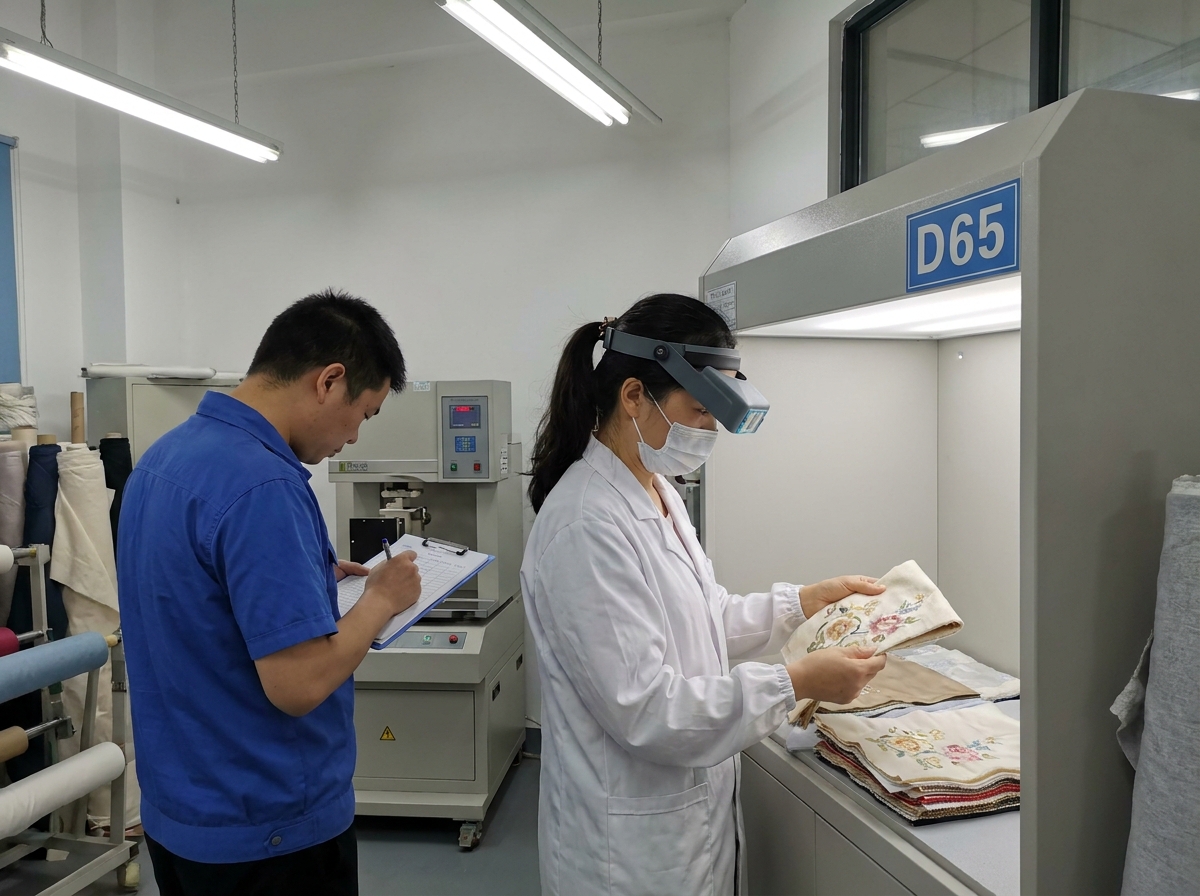
![Prompt: Quality control inspector examining embroidery fabric samples under D65 lighting in a textile testing room, professional industrial setting]

Why We Choose to Pass Savings to Buyers

This is the part that confuses people. We could charge the same as everyone else and pocket the margin. Our pricing would still be "competitive" in the market, and nobody would know the difference.

Shawn made a deliberate choice years ago. He'd rather have 50 long-term partners paying a fair price than 500 one-time buyers paying a premium. That philosophy shapes everything, including how we handle our sourcing advantage.

When our raw material costs drop because of volume negotiations or market shifts, we pass a portion of that to our repeat clients. Not all of it, because we need to maintain our own margins and reinvest in equipment. But enough that our long-term partners see their costs improve over time, not just stay flat.

The client who's been with us for years and orders 2000万 RMB annually? Their per-yard cost today is lower than when they started, even though global material prices have fluctuated. We call it "volume trust." As your order volume grows, our raw material purchasing power grows with it, and we share the benefit.

Compare that to the typical factory model: you get a quote, negotiate hard, and the price stays the same regardless of how much you order. Or worse, the factory raises prices the moment raw material costs go up, but never lowers them when costs come down.

I'm not saying every supplier operates that way. But enough do that buyers have learned to treat pricing as adversarial. We'd rather treat it as collaborative.

One thing Eric emphasizes to new clients: "You're not paying for more material. You're paying for less." He means that in the context of water-soluble embroidery, where the backing gets dissolved after stitching. But the principle applies broadly. What you're paying for isn't just thread and fabric. You're paying for the efficiency of the entire system that brings those materials to the production floor.

A factory that sources directly, controls quality at the origin, and maintains consistent supply doesn't need to pad its prices to cover supply chain uncertainty. That's a structural advantage, not a promotional one.

Quality Control Starts at the Source

There's a misconception I want to address directly. Some buyers assume that competitive pricing means we're using cheaper materials or skipping inspections. The opposite is true.

When you buy materials through three layers of distribution, you lose visibility into what you're actually getting. The thread that arrived this month might be from a different mill than last month's batch, even though the spec sheet looks identical. The base fabric might have slightly different tension characteristics because the weaving mill changed their machine settings.

When you buy directly from the mill, you know exactly what you're getting, every time. We specify our thread requirements at the source: the exact denier, the twist direction, the color fastness rating. The mill produces to our spec because we're a standing account with consistent volume.

Every batch of raw material that arrives at our facility goes through incoming inspection before it enters the production flow. We check thread consistency with a denier tester. We verify base fabric width to within plus or minus 1 centimeter. We inspect for weaving defects, allowing no more than two per 50 yards. We test color matching under D65 standard lighting. If a batch doesn't pass, it goes back. Not to storage. Back to the supplier.

This is something most factories skip when they buy through distributors, because the distributor doesn't accept returns as easily as a mill that depends on your next quarterly order.

This is why our quality metrics hold up even at competitive pricing:

  • Defect rate stays under 2%. Our needle inspection machine runs across 100% of production.
  • Shrinkage stays under 3%. We test base fabric before it reaches the cutting table.
  • Color fastness holds at rating 4, verified under D65 and TL84 dual-light-source inspection. (For context on how color fastness testing works in the textile industry, AATCC publishes the standard methods most factories reference.)

These numbers aren't aspirational. They're what we actually achieve, month after month, across 300,000 meters of production. And they hold up because we control the inputs, not just the process. (For a detailed look at how our inspection system works from raw material to packing, see our quality control process breakdown.)

Shawn has a saying I've heard him repeat to visiting buyers: "The first to commit gets the first pick." In raw material terms, this means our long-standing mill relationships give us priority access to the best batches. When a thread mill has a production run with exceptional color consistency, we get first refusal. When a base fabric mill produces a batch with unusually tight weave tolerances, we're the call they make first.

That priority access doesn't show up in a per-yard quote. But it shows up in your quality reports when your goods arrive.
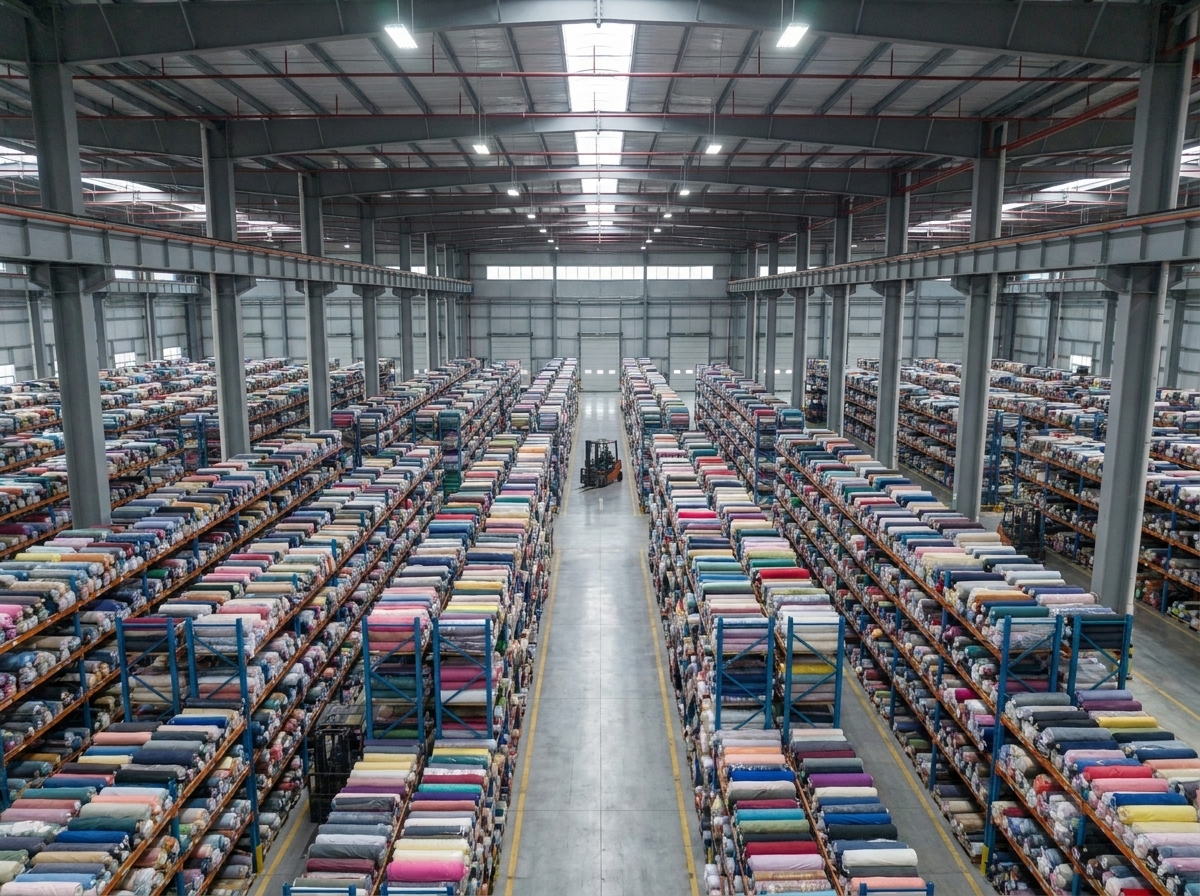
![Prompt: Aerial view of textile factory warehouse with organized rolls of base fabric and embroidery materials stored on industrial shelving, showing scale and organization]

What This Means for Your Sourcing Decision

If you're evaluating suppliers for embroidery fabric, here's what I'd suggest based on what I've seen work for our long-term clients.

First, look beyond the per-yard price. Two factories might quote you $4.50 per yard, but one sources materials through three intermediaries and the other sources directly from mills. The final product might look the same in a sample, but the consistency over 50,000 meters will be different.

Second, ask about supply chain depth, not just capacity. A factory can tell you they produce 300,000 meters per month. But can they tell you where their thread comes from? Can they show you their base fabric supplier relationship? Can they explain how they handle material quality variations between batches?

Third, consider the long-term pricing trajectory. A supplier with real sourcing advantages will be able to offer more stable pricing over time, because they're not exposed to the same middleman markup fluctuations. A supplier who's just quoting low to win your first order will eventually need to raise prices when their own costs go up.

Fourth, look at the certifications and ask what they cost. We hold OEKO-TEX Standard 100, Higg Index, and Amfori certifications. Some buyers assume these add significant cost. They don't, when your raw materials already meet the standards. The cost of compliance comes from testing and documentation, not from the materials themselves. A factory using lower-grade materials has to spend more on remediation to pass the same certifications. We start closer to the finish line because of how we source.

Eric tells me he sees this pattern regularly. A buyer gets three quotes, picks the lowest, and six months later is back looking for a new supplier because quality dropped or prices jumped. The supplier who was cheapest on day one wasn't actually cheapest over the life of the relationship.

We're not the right fit for every buyer. If you need 200 yards for a test run, there are better options than us. If you need a one-time order with no commitment, we're probably not your best choice.

But if you're a brand that plans three seasons ahead, that values consistency over novelty, and that understands the difference between a low price and a good price, then we should talk.

Our sourcing advantage isn't just about what we pay for materials. It's about what that means for the reliability and consistency of what you receive. And over the course of a long partnership, that matters more than any single quote.

If this sounds like what you're looking for, drop a message to info@fominte.com. I'll make sure Eric's team gets back to you within 24 hours.

Kembali ke Blog
0 komentar
Kirim komentar
Harap perhatikan bahwa komentar harus disetujui sebelum dipublikasikan

Why Our Prices Are More Competitive: Fominte's Raw Material Sourcing Advantage

Most embroidery factories buy threads, base fabrics, and embellishments through distributors who add 15-30% markup. Fominte sources directly from mills. This article explains how that sourcing model works, why it produces more competitive pricing, and what it means for your procurement decisions.

What It Really Means

Raw material sourcing advantage refers to the cost benefit a manufacturer gains by purchasing threads, base fabrics, and embellishments directly from producing mills rather than through intermediary distributors or trading companies. Each intermediary layer adds 15-30% to material costs before they reach the factory floor. Manufacturers with direct mill relationships and high volume (300,000+ meters monthly) can negotiate better pricing, priority allocation, and consistent quality specifications.

![Prompt: Close-up of embroidery thread spools organized on industrial shelving in a textile factory warehouse, warm lighting, professional B2B photography style]

What "Raw Material Sourcing Advantage" Actually Means

A buyer from Turkey emailed me last month. His message was direct: "Your pricing is 18% lower than the factory we currently use in Guangdong. What's the catch?"

I get this question a lot. And I understand why. When someone quotes you a lower price, the first instinct is to look for what's missing. Lower thread count? Thinner base fabric? Skipping QC steps?

In our case, none of those things are true. The answer is simpler and less dramatic than most people expect. It comes down to where we buy our raw materials.

Most embroidery manufacturers in China buy their threads, base fabrics, and embellishments through distributors or trading companies. A typical supply chain looks like this: the thread mill sells to a regional distributor, the distributor sells to a trading company, and the trading company sells to the factory. Every step adds margin. Depending on the material, those middlemen collectively add 15-30% to the cost before the thread even reaches the production floor.

Shawn has been building direct relationships with material mills since the early 1990s. He started with thread suppliers when we were still based in Shenzhen. Over the decades, those relationships expanded to include base fabrics, sequins, beads, and specialty materials. We now source the majority of our core materials directly from the mills that produce them.

That's the sourcing advantage. Nothing secret about it. Just decades of building direct procurement channels that most smaller factories either can't or won't invest in.

As Shawn puts it: "Price is information. But it's not the only information. If someone's price is significantly lower, there's a reason. Find out what it is." Our reason is structural, not suspicious.

![Prompt: Industrial embroidery machine with colorful threads feeding into multi-head setup, factory floor background, showing scale of production]

How Direct Sourcing Changes Your Per-Yard Cost

Let me walk through the cost chain of a typical embroidered mesh fabric order, because understanding this changes how you evaluate suppliers.

When you get a quote from a factory, that price includes raw materials, labor, overhead, quality control, and margin. For most embroidery orders, raw materials account for 40-55% of the total cost. That's the biggest single component. (If you want the full breakdown of what drives embroidery pricing, I covered that in our guide to embroidery fabric cost factors.)

Here's where it gets interesting. A factory that buys through distributors pays, say, $2.80 per spool for embroidery thread. A factory that buys directly from the thread mill pays $2.10 for the same spec. That's a 25% difference on just one input. Multiply that across thread, base fabric, sequins, and stabilizers, and the gap compounds.

Now multiply that across 300,000 meters of monthly production capacity.

Our 27 embroidery machines, each running 62 heads, consume raw materials at a scale that gives us genuine purchasing power. (You can read more about our production floor setup in our equipment and capacity overview.) When we approach a thread mill with a forecast of 50,000 spools per quarter, we're not just another customer. We're a strategic account. That means better pricing, priority allocation during tight supply periods, and consistent quality because the mill knows we'll be back next month.

Let me give you a concrete example. For a standard mesh embroidery order of 10,000 yards, raw materials might represent $2.50 out of a $5.80 per-yard price. If a factory buying through distributors pays 20% more for those materials, that's $0.50 per yard going to middlemen. On 10,000 yards, that's $5,000 in unnecessary cost. On a 50,000-yard order, it's $25,000.

Eric once told me about a buyer who compared our quote to three other suppliers. Two of them were trading companies masquerading as factories. The third was a real factory, but smaller, buying materials through the same distribution chain everyone else uses. Our price was 15% lower than the real factory and 22% lower than the trading companies. The buyer assumed we were cutting corners.

We weren't. We were just sitting at a different point in the supply chain.

The practical implication for procurement teams: when you're comparing quotes from different suppliers, ask each one the same question. "Where do you buy your raw materials, and can you show me the purchasing records?" A factory with real sourcing advantages will be able to answer that clearly. A factory that's just quoting low to win the order will dodge the question.

![Prompt: Quality control inspector examining embroidery fabric samples under D65 lighting in a textile testing room, professional industrial setting]

Why We Choose to Pass Savings to Buyers

This is the part that confuses people. We could charge the same as everyone else and pocket the margin. Our pricing would still be "competitive" in the market, and nobody would know the difference.

Shawn made a deliberate choice years ago. He'd rather have 50 long-term partners paying a fair price than 500 one-time buyers paying a premium. That philosophy shapes everything, including how we handle our sourcing advantage.

When our raw material costs drop because of volume negotiations or market shifts, we pass a portion of that to our repeat clients. Not all of it, because we need to maintain our own margins and reinvest in equipment. But enough that our long-term partners see their costs improve over time, not just stay flat.

The client who's been with us for years and orders 2000万 RMB annually? Their per-yard cost today is lower than when they started, even though global material prices have fluctuated. We call it "volume trust." As your order volume grows, our raw material purchasing power grows with it, and we share the benefit.

Compare that to the typical factory model: you get a quote, negotiate hard, and the price stays the same regardless of how much you order. Or worse, the factory raises prices the moment raw material costs go up, but never lowers them when costs come down.

I'm not saying every supplier operates that way. But enough do that buyers have learned to treat pricing as adversarial. We'd rather treat it as collaborative.

One thing Eric emphasizes to new clients: "You're not paying for more material. You're paying for less." He means that in the context of water-soluble embroidery, where the backing gets dissolved after stitching. But the principle applies broadly. What you're paying for isn't just thread and fabric. You're paying for the efficiency of the entire system that brings those materials to the production floor.

A factory that sources directly, controls quality at the origin, and maintains consistent supply doesn't need to pad its prices to cover supply chain uncertainty. That's a structural advantage, not a promotional one.

Quality Control Starts at the Source

There's a misconception I want to address directly. Some buyers assume that competitive pricing means we're using cheaper materials or skipping inspections. The opposite is true.

When you buy materials through three layers of distribution, you lose visibility into what you're actually getting. The thread that arrived this month might be from a different mill than last month's batch, even though the spec sheet looks identical. The base fabric might have slightly different tension characteristics because the weaving mill changed their machine settings.

When you buy directly from the mill, you know exactly what you're getting, every time. We specify our thread requirements at the source: the exact denier, the twist direction, the color fastness rating. The mill produces to our spec because we're a standing account with consistent volume.

Every batch of raw material that arrives at our facility goes through incoming inspection before it enters the production flow. We check thread consistency with a denier tester. We verify base fabric width to within plus or minus 1 centimeter. We inspect for weaving defects, allowing no more than two per 50 yards. We test color matching under D65 standard lighting. If a batch doesn't pass, it goes back. Not to storage. Back to the supplier.

This is something most factories skip when they buy through distributors, because the distributor doesn't accept returns as easily as a mill that depends on your next quarterly order.

This is why our quality metrics hold up even at competitive pricing:

  • Defect rate stays under 2%. Our needle inspection machine runs across 100% of production.
  • Shrinkage stays under 3%. We test base fabric before it reaches the cutting table.
  • Color fastness holds at rating 4, verified under D65 and TL84 dual-light-source inspection. (For context on how color fastness testing works in the textile industry, AATCC publishes the standard methods most factories reference.)

These numbers aren't aspirational. They're what we actually achieve, month after month, across 300,000 meters of production. And they hold up because we control the inputs, not just the process. (For a detailed look at how our inspection system works from raw material to packing, see our quality control process breakdown.)

Shawn has a saying I've heard him repeat to visiting buyers: "The first to commit gets the first pick." In raw material terms, this means our long-standing mill relationships give us priority access to the best batches. When a thread mill has a production run with exceptional color consistency, we get first refusal. When a base fabric mill produces a batch with unusually tight weave tolerances, we're the call they make first.

That priority access doesn't show up in a per-yard quote. But it shows up in your quality reports when your goods arrive.

![Prompt: Aerial view of textile factory warehouse with organized rolls of base fabric and embroidery materials stored on industrial shelving, showing scale and organization]

What This Means for Your Sourcing Decision

If you're evaluating suppliers for embroidery fabric, here's what I'd suggest based on what I've seen work for our long-term clients.

First, look beyond the per-yard price. Two factories might quote you $4.50 per yard, but one sources materials through three intermediaries and the other sources directly from mills. The final product might look the same in a sample, but the consistency over 50,000 meters will be different.

Second, ask about supply chain depth, not just capacity. A factory can tell you they produce 300,000 meters per month. But can they tell you where their thread comes from? Can they show you their base fabric supplier relationship? Can they explain how they handle material quality variations between batches?

Third, consider the long-term pricing trajectory. A supplier with real sourcing advantages will be able to offer more stable pricing over time, because they're not exposed to the same middleman markup fluctuations. A supplier who's just quoting low to win your first order will eventually need to raise prices when their own costs go up.

Fourth, look at the certifications and ask what they cost. We hold OEKO-TEX Standard 100, Higg Index, and Amfori certifications. Some buyers assume these add significant cost. They don't, when your raw materials already meet the standards. The cost of compliance comes from testing and documentation, not from the materials themselves. A factory using lower-grade materials has to spend more on remediation to pass the same certifications. We start closer to the finish line because of how we source.

Eric tells me he sees this pattern regularly. A buyer gets three quotes, picks the lowest, and six months later is back looking for a new supplier because quality dropped or prices jumped. The supplier who was cheapest on day one wasn't actually cheapest over the life of the relationship.

We're not the right fit for every buyer. If you need 200 yards for a test run, there are better options than us. If you need a one-time order with no commitment, we're probably not your best choice.

But if you're a brand that plans three seasons ahead, that values consistency over novelty, and that understands the difference between a low price and a good price, then we should talk.

Our sourcing advantage isn't just about what we pay for materials. It's about what that means for the reliability and consistency of what you receive. And over the course of a long partnership, that matters more than any single quote.

If this sounds like what you're looking for, drop a message to info@fominte.com. I'll make sure Eric's team gets back to you within 24 hours.

When to Use & Avoid

Direct mill sourcing

✅ Use When

  • Best for brands ordering 10,000+ yards per design who need consistent batch-to-batch quality and stable long-term pricing

⚠️ Avoid When

  • Not ideal for one-off small orders under 500 yards where distributor convenience may outweigh cost savings

Volume-based pricing model

✅ Use When

  • Ideal for brands planning 3+ seasons ahead with growing order volumes that unlock better per-yard costs

⚠️ Avoid When

  • Not suitable for brands that need fixed pricing regardless of volume

Certification-aligned sourcing

✅ Use When

  • Works for buyers requiring OEKO-TEX or Higg Index compliance where raw materials already meet standards

⚠️ Avoid When

  • May not apply to buyers who don't require specific certifications

⚡ Common Mistakes to Avoid

Choosing suppliers by lowest per-yard price alone
Consequence: Six months later, quality drops or prices jump when the supplier's own costs increase
Solution: Ask suppliers where they source raw materials and request purchasing records to verify

Everything You Need to Know

Does competitive pricing mean lower quality materials?
No. Our competitive pricing comes from sourcing raw materials directly from mills rather than through distributors who add 15-30% markup. We maintain defect rates under 2% and color fastness at rating 4 because we control material quality at the source, not just at the factory.

Conclusion

A manufacturer's raw material sourcing strategy is a better indicator of long-term pricing stability than any single per-yard quote. Direct mill relationships, high-volume purchasing power, and a philosophy of passing savings to partners create a pricing advantage that compounds over time. If you're evaluating embroidery suppliers, ask about sourcing depth, not just capacity.
Stephen
Stephen
Stephen is the Head of Brand & Strategy at Fominte. He reviews incoming inquiries, educates buyers on what to look for in a supplier, and connects clients with the right team members. His focus is building long-term partnerships rather than processing one-time orders. Head of Brand & Strategy at Fominte

Troli

Memuat