.png?w=970&h=250)
What Determines Embroidery Fabric Price? 5 Key Cost Factors Every Buyer Should Understand
What It Really Means
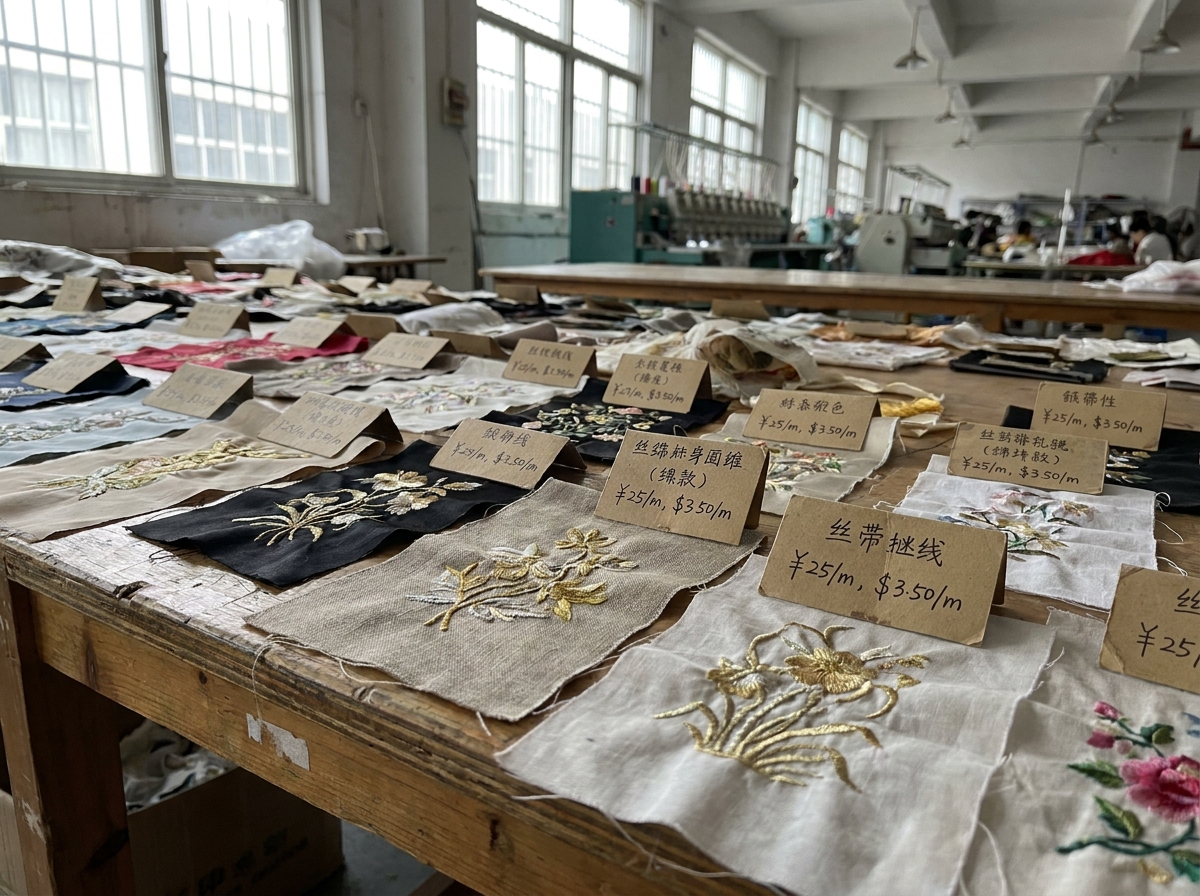
Raw Materials: The Biggest Variable in Your Quote
When a buyer sends us an inquiry, the first question is almost always about price. Fair enough. But here's what most buyers don't realize: two embroidery fabrics that look nearly identical on a sample card can have a 40% price difference, and the reason is almost never about markup. It's about what's inside.
The base fabric alone can swing your quote by 20-30%. A standard mesh backing is our most economical option — you can see the full range of embroidery products and base fabric choices we offer. It works well for most applications and handles high-volume production reliably. But the moment you switch to a stretch base, the cost goes up — not because stretch fabric is expensive, but because it requires tighter tension control during embroidery. One of our QC supervisors put it simply: "Stretch fabric punishes you for every shortcut."
Then there's thread. This is where buyers often get confused. Polyester thread and rayon thread look almost the same in a finished product, but they behave very differently under production conditions. Rayon gives a smoother sheen, but it's more sensitive to machine tension and breaks more often. Polyester is tougher and more colorfast, which means fewer production interruptions and lower defect rates. We default to polyester for most orders because it runs cleaner at scale. But when a buyer specifically requests rayon for that premium look, the price reflects the higher scrap rate and slower machine speed.
Now add embellishments — sequins, beads, tubes. This is where costs can escalate fast. A flat sequin up to 18mm is straightforward. But once you start mixing sequin sizes, adding tube beads under 8mm, or combining more than 10 colors on a single fabric, you're looking at a completely different production setup. Each additional embellishment type means recalibrating the machine, changing the attachment head, and running more quality checks. We had a client last year who wanted a design with 8 different sequin colors and 3 bead sizes on one panel. Beautiful design. But the production time was roughly 2.5 times what a standard sequin order would take, and the price per yard reflected that.
The takeaway: when you compare quotes from different suppliers, make sure you're comparing the same raw material specifications. A quote for "embroidery fabric" means nothing until you know the base, the thread, and every embellishment included.
Design Complexity and Stitch Count
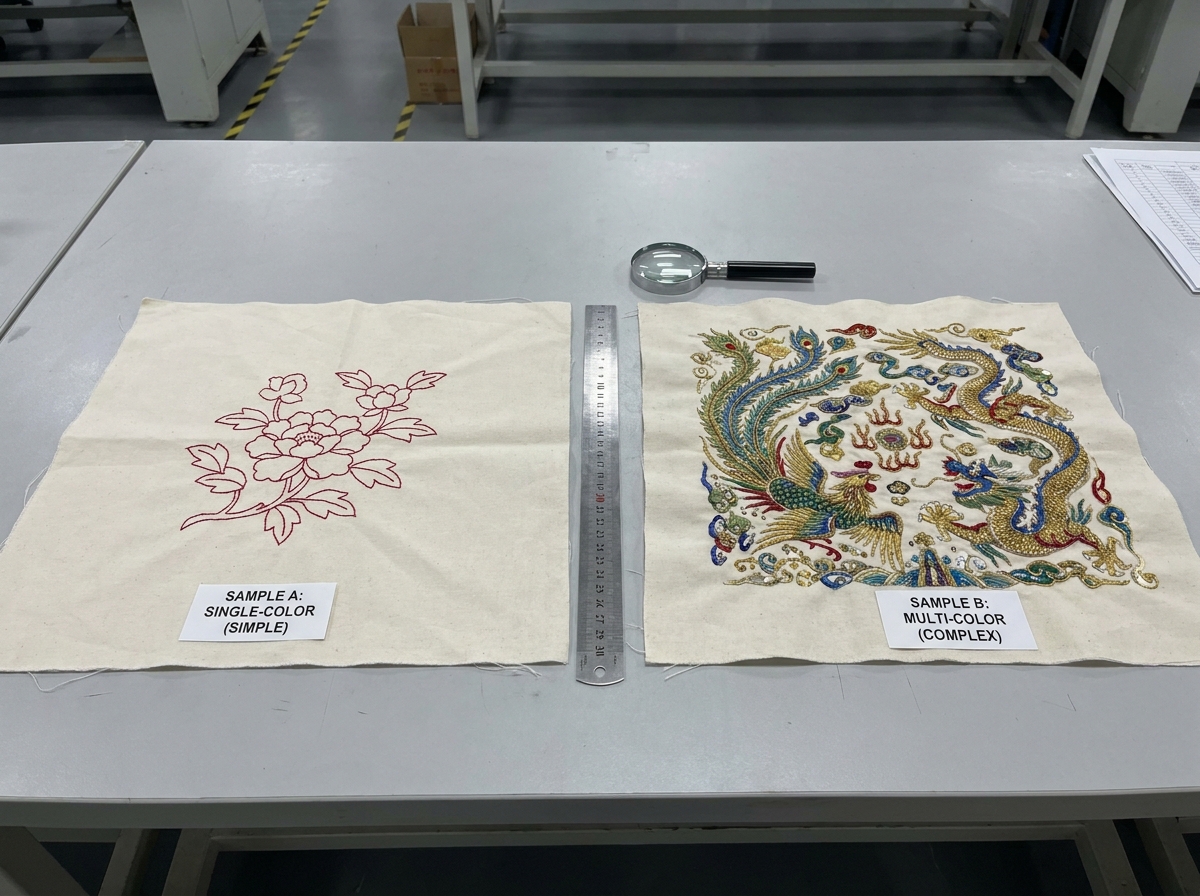
Stitch count is the number most buyers fixate on, and they're not wrong to care about it. But the relationship between stitch count and price isn't as linear as people think.
Our machines run 6 needles per head, 62 heads per machine, across 27 machines in the facility. That setup is optimized for efficiency on standard designs — roughly 300,000 meters of output per month when running at capacity. But "standard" means a design with a reasonable stitch density, consistent color blocks, and no extreme density zones.
When stitch density goes up, several things happen at once. Thread consumption increases, obviously. But more importantly, the machine slows down to maintain precision. A high-density design — say, a solid fill pattern running at maximum needle count — might reduce machine speed by 15-25% compared to a typical open-work design. That slower speed means fewer meters per hour, which means higher cost per yard.
Color changes add another layer. Each color change on a 6-needle machine means a thread swap, which introduces a brief pause in production. One or two color changes per design? Negligible impact. But when you get to 5 or 6 colors, the cumulative pause time adds up across a 300,000-meter monthly run. It's not dramatic on a single piece, but across a full order it shows up in the quote.
The most common mistake I see buyers make is assuming that a "simple" design is always cheaper. Not necessarily. A design with very tight tolerances — where the placement of each stitch has to be exact — can be more expensive than a denser but more forgiving pattern. Precision costs money, regardless of stitch count.
Here's a practical example: a client came to us with two designs they thought were comparable. Design A had 80,000 stitches with 3 colors. Design B had 120,000 stitches with 1 color. Design B was actually 10% cheaper per yard, because the single-color run was more efficient and the machine didn't have to slow down for color changes.
Order Volume and the MOQ Equation
MOQ — minimum order quantity — is one of those terms that gets thrown around a lot in sourcing conversations. But most buyers don't think about why it exists, and that misunderstanding leads to bad purchasing decisions.
Our MOQ is 100 yards — you can read more about our MOQ policies, lead times, and export process here. That's not an arbitrary number designed to shut out small buyers. It's the break-even point where the setup cost — programming the design, calibrating the machine, running test pieces, threading the bobbin — gets amortized across enough yards to make the per-yard price reasonable.
Here's the math behind it. Every new order requires a setup process: loading the digitized design file, adjusting machine parameters for the specific fabric and thread combination, running 3-5 test pieces for approval, and doing a final calibration. That setup takes time whether you're ordering 100 yards or 10,000 yards. On a 100-yard order, the setup cost might add $0.30-0.50 per yard. On a 10,000-yard order, it adds less than $0.01 per yard.
Volume also changes how we schedule production. When you order 5,000+ yards, we can dedicate machines to your run and optimize the production sequence. Shorter runs get batched with other orders, which means more transitions and more idle time between runs. The per-yard cost difference between a 500-yard order and a 5,000-yard order can be 15-25%, depending on the complexity.
But here's what Eric always tells clients: don't inflate your order to hit a volume discount if you don't actually need that quantity. Over-ordering to get a better per-yard price, then sitting on inventory for 6 months, costs more than paying a slightly higher rate for the quantity you actually need. The math only works when the fabric moves.
For brands that order regularly — say, 3,000 yards per month across multiple designs — we can set up a production framework that locks in pricing and guarantees capacity. That's a different conversation than a one-off order, and the economics reflect it.
Lead Time — When Urgency Costs More
Standard lead time at Fominte is 20-40 days, depending on the order. (If you want the full picture of how we handle large orders from start to finish, take a look at our large order delivery process.) That's a wide range, and buyers often want to know why it's not more precise. The answer is that production time depends on several variables, and each one can shift by a few days.
Here's how a typical order breaks down: digitizing and design programming takes 2-3 days for custom patterns. Raw material sourcing takes 3-5 days if we need to source specific threads or base fabrics. Production setup and calibration takes 1-2 days. Actual embroidery production takes 5-15 days depending on quantity and complexity. Quality inspection takes 1-2 days. Finishing and packing takes 2-3 days.
Add those up, and you get roughly 16-30 days for production, plus some buffer for the inevitable small delays. The 20-40 day range accounts for the variance.
Now, what happens when a buyer needs it faster? Rush orders are possible, but they come at a cost. When you compress the timeline, several things change. We may need to prioritize your order over others, which means rescheduling production for other clients. We may need to source materials at a premium because we can't wait for the standard supply chain. And we may need to run overtime or additional shifts, which increases labor costs.
The rush premium varies, but in my experience it's typically 10-20% above standard pricing for a 30-40% compression in lead time. Some buyers are happy to pay that because the timing is critical for their retail calendar. Others adjust their planning instead.
The cheapest strategy is always to plan ahead. Eric has a saying I've heard him use dozens of times with clients: "The client who orders early isn't just getting their product faster. They're getting better product because they had real choices." When you give us a reasonable lead time, we can optimize the production schedule, source materials at standard prices, and run the machines at their natural pace. All of that shows up as a lower per-yard cost.
I've seen buyers pay 15% more for the same fabric simply because they placed their order two weeks later than they should have. Not because the fabric changed, but because their window for efficient production shrank.
Quality Standards and Certifications
This is the factor that separates experienced buyers from everyone else. New buyers focus on price per yard. Experienced buyers ask about defect rates, testing standards, and certifications — because they know that a lower price per yard means nothing if 5% of the shipment fails inspection.
Our defect rate is under 2%. That number comes from our QC process: raw material inspection checks every roll for width consistency (within 1cm), weaving defects (no more than 2 per 50 yards), color matching under D65 lighting, and weight tolerance (within 5%). During production, we run needle detection on 100% of output and do dual-light source color checks under both D65 and TL84 lighting. Every piece gets inspected before packing.
Why does this matter to your price? Because defect rate has a direct cost impact. If a supplier quotes you $3.50 per yard but delivers 5% defective material, your effective cost is actually $3.68 per yard — and that doesn't count the cost of sorting, returns, or production delays on your end. A supplier quoting $3.80 with a 1% defect rate is actually giving you a better deal.
Certifications add another dimension. OEKO-TEX Standard 100 certification means the fabric has been tested for harmful substances. Higg Index evaluates our environmental and social practices. Amfori covers business social compliance. Each of these certifications requires testing, auditing, and ongoing compliance — which costs money. But for brands selling into the EU or North American markets, these certifications aren't optional. They're table stakes.
The cost of certification gets built into the fabric price, typically adding a small percentage. But the alternative — buying uncertified fabric and then scrambling to get it tested before your retailer rejects the shipment — is far more expensive. I've watched brands pay rush testing fees that cost more than the entire certification premium would have been.
Color fastness at grade 4, shrinkage under 3%, and tensile strength meeting international standards (tested per ASTM D5034 and AATCC methods) — these aren't marketing claims. They're the minimum specifications we guarantee, backed by testing data we share with every serious buyer. When you're comparing quotes, ask the supplier for their testing data. If they can't produce it, the price doesn't matter.
FAQ
What is the average price range for wholesale embroidery fabric?
Wholesale embroidery fabric pricing varies widely based on the factors covered in this article. Standard mesh embroidery typically starts at a lower range, while water-soluble embroidery — which requires additional processing to dissolve the backing — runs about 30-40% higher. The best approach is to send your exact specifications (base fabric, thread type, design complexity, quantity, and delivery timeline) to get a precise quote. Generic "embroidery fabric" pricing is misleading without these details.
How much cheaper is bulk embroidery fabric compared to small orders?
Volume pricing scales differently depending on complexity, but as a general rule, orders above 5,000 yards can see 15-25% lower per-yard costs compared to minimum order quantities. The savings come from setup cost amortization, production scheduling efficiency, and raw material sourcing leverage. However, don't inflate your order just to hit a volume break — the math only works if you actually use the fabric.
Why do embroidery fabric prices vary so much between suppliers?
The biggest reason is raw material quality. Two suppliers might both quote "embroidery mesh with polyester thread," but the base fabric weight, thread brand, and embellishment specifications can differ significantly. Add in differences in QC standards, defect rates, and certifications, and the gap widens further. Always compare quotes based on identical specifications, and ask for testing data to verify quality claims.
Does rush production always cost more?
Typically yes, because compressing the lead time requires rescheduling, premium material sourcing, and sometimes overtime production. The rush premium is usually 10-20% above standard pricing. The most cost-effective approach is planning your orders with adequate lead time — ideally placing orders at least 6-8 weeks before you need delivery.
How do certifications like OEKO-TEX affect the price?
Certification costs are built into the fabric price as a small premium, but they protect you from much larger costs down the line. Uncertified fabric that fails retailer compliance testing can result in rejected shipments, rush re-testing fees, and lost selling days. For brands selling into regulated markets, certified fabric is the more economical choice overall.
Step-by-Step Guide
Gather your specifications
When to Use & Avoid
Price-sensitive buyer with flexible timeline
✅ Use When
- Order 5,000+ yards with standard 30-40 day lead time to unlock volume discounts of 15-25%
⚠️ Avoid When
- Rush buyer with fixed retail deadline
Comparison
| Cost Factor | Impact on Price | Buyer Action | Raw materials (base, thread, embellishments) | 20-40% variation | Specify exact materials in your RFQ | Design complexity & stitch count | 10-25% variation | Simplify designs or reduce color changes | Order volume & MOQ | 15-25% variation at scale | Order 5,000+ yards per design for best rates | Lead time urgency | 10-20% rush premium | Plan orders 6-8 weeks ahead | Quality standards & certifications | Small per-yard premium, major risk reduction | Always request testing data and certification proof |
⚡ Common Mistakes to Avoid
Everything You Need to Know
Conclusion