.png?w=970&h=250)
How We Cut Fleece: Grain Direction, Pile Matching, and Why It Matters for Your Order
What It Really Means
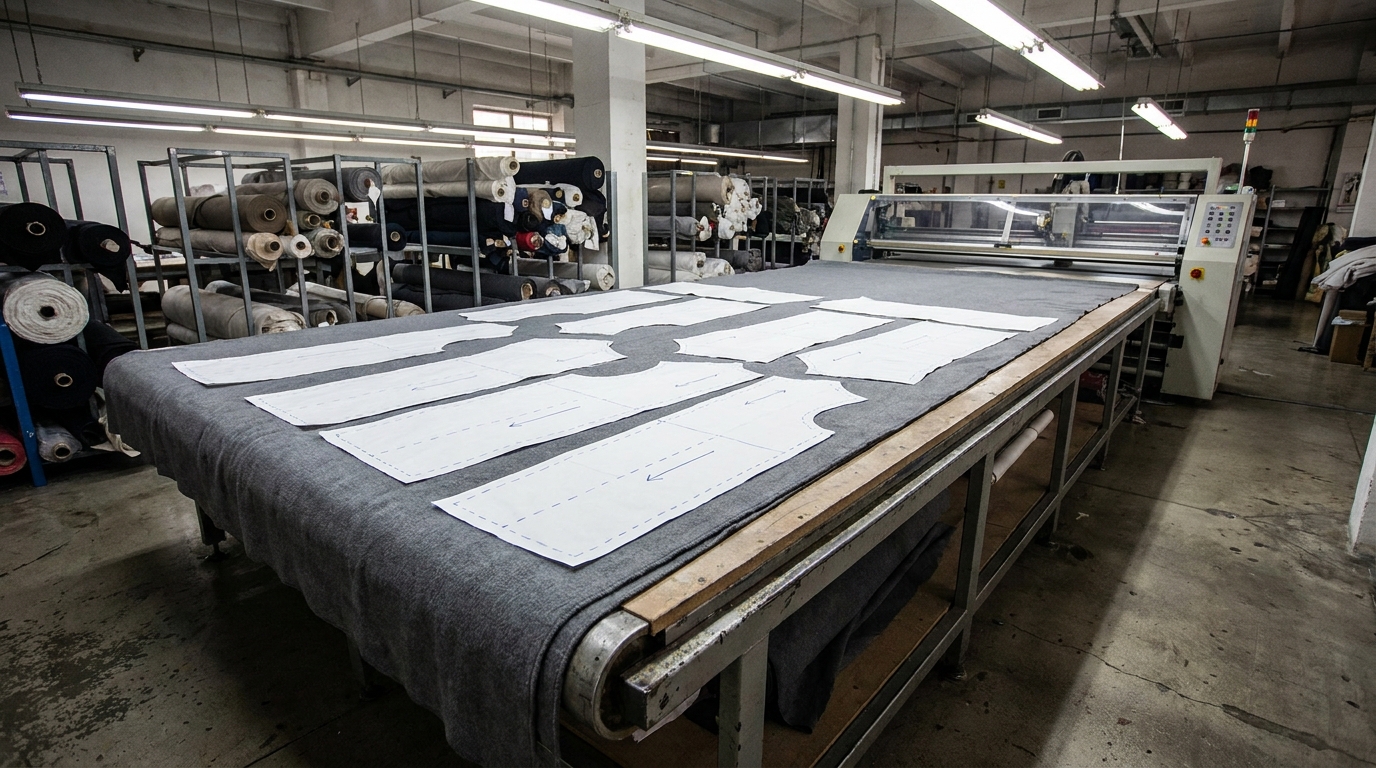
When a factory cuts fleece without controlling grain direction, every panel in your garment stretches differently. The sleeves twist after washing. The body hangs crooked on the hanger. And your reject rate climbs from under 2% to somewhere you do not want to be.
I learned this from Shawn, who spent years as a textile QC inspector before founding Fominte. He has a saying: "The cutting room is where 80% of garment quality is decided. By the time it reaches the sewing line, it is already too late to fix."
This article explains what happens in our cutting room before a single stitch is sewn, and what you should be checking in yours. If you want the full picture of how we produce fleece garments from roll to finished product, start with our fleece production line overview.
Why Grain Direction Is the First Thing We Check Before Cutting Fleece
Fleece is a knitted fabric, not a woven one. That distinction matters more than most buyers realize. Woven fabrics have a stable grid of warp and weft threads. Knitted fabrics are made of interlocking loops, which means they stretch — and they stretch differently depending on the direction.
In knitted fleece, the wale direction (the vertical columns of loops) runs parallel to the selvage edge. The course direction (the horizontal rows) runs across the fabric width. The greatest stretch is always in the course direction, perpendicular to the selvage. The wale direction has minimal stretch, sometimes almost none.
If a cutter lays a pattern piece off-grain, even by a few degrees, that panel will behave differently from the others when it is sewn, washed, or worn. The front body might stretch downward while the back body stays stable. The sleeves might twist after three washes while the torso does not.
At Fominte, we maintain a grainline tolerance of ±3% on every marker layout. That means each pattern piece must align with the wale direction within 3 degrees. We check this before cutting begins, not after. Our CAD nesting software displays grain arrows on every piece, and the cutting supervisor verifies alignment on the spread before the blade touches fabric.
Most factories skip this step. They focus on maximizing fabric yield — fitting as many pattern pieces as possible onto the marker — and treat grain direction as a suggestion rather than a specification. The result is a garment that looks fine in the sample but degrades after the first wash cycle.
What to ask your factory: "What is your grainline tolerance on fleece markers?" If they cannot give you a number, that is your answer.
Pile Direction: The Invisible Variable That Changes How Your Garment Looks
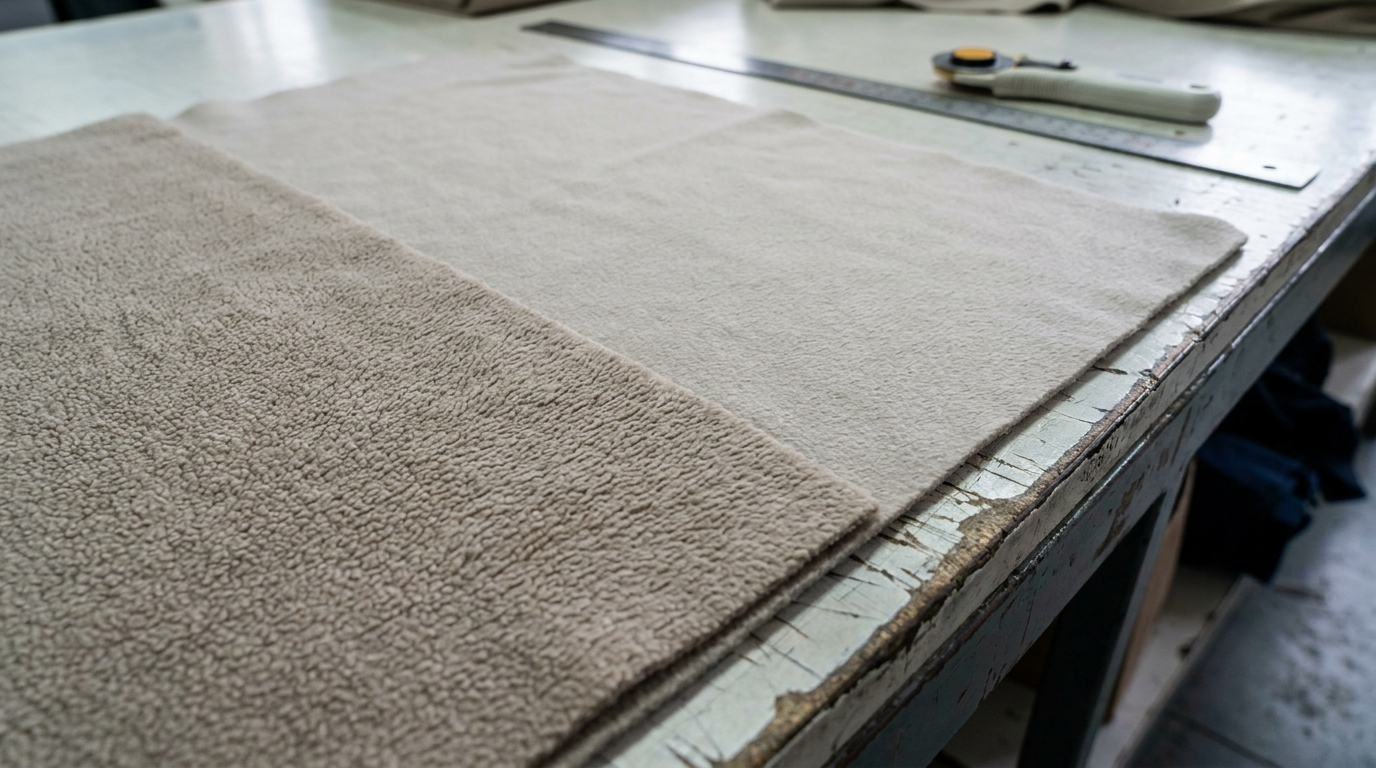
Every type of fleece fabric has a pile — the raised fibers on the surface that give it that soft, brushed texture. This pile has a direction. Run your hand across a fleece fabric one way, and it feels smooth. Run it the other way, and it feels rougher. That direction is called the nap, and it changes how the fabric looks under light.
When pile runs in one direction, the fabric appears lighter. When it runs the other way, it appears darker. The difference can be subtle — sometimes only visible under specific lighting — but it becomes a serious problem when different panels of the same garment have inconsistent pile orientation.
A fleece hoodie where the sleeves were cut with pile running upward and the body was cut with pile running downward will show a visible shade difference under store lighting. The customer sees two different colors. Your return rate goes up.
This is pile matching, and almost nobody talks about it.
At Fominte, we handle pile matching at three stages:
1. Marker planning: When we lay out the cutting marker, every pattern piece must have its pile direction arrow pointing the same way. This is non-negotiable. If the marker layout requires some pieces to be rotated for fabric efficiency, we flag it and discuss the trade-off with the buyer before cutting.
2. Spreading: When we spread fabric on the cutting table, we maintain consistent pile orientation across every layer. Face-up or face-down spreading is chosen based on the fabric's nap characteristics, and we never mix spreading directions within a single spread.
3. Bundle tracking: After cutting, each bundle is labeled with a pile direction indicator. The sewing line uses these labels to ensure every panel in a garment has consistent pile orientation. This step alone prevents most shade variation complaints.
What to ask your factory: "How do you track pile direction from cutting through sewing?" If the answer is "we don't," expect shade variation issues in your bulk order.
How GSM Weight Changes Everything About Cutting
Not all fleece is created equal. A 200 GSM microfleece behaves completely differently from a 400 GSM heavyweight hoodie fleece during cutting. Yet most factories use the same cutting parameters for both. That is a mistake.
Cutting parameters change significantly by weight class:
200-250 GSM (Lightweight / Microfleece):
- Max plies per spread: 40-60 layers
- Blade type: Standard rotary blade or straight knife
- Cutting speed: Full speed, no reduction needed
- Key risk: Fabric shift during spreading due to lightweight — requires spreading tension control
250-300 GSM (Mid-weight Polar Fleece):
- Max plies per spread: 30-40 layers
- Blade type: Heavy-duty straight knife or band knife
- Cutting speed: Slight reduction for dense constructions
- Key risk: Pile crush on bottom layers if plies are too high — blade compression compresses the pile
300-400 GSM (Heavyweight / Hoodie Fleece):
- Max plies per spread: 20-30 layers
- Blade type: Heavy-duty straight knife with fresh blade per spread
- Cutting speed: Reduced by 20-30% to maintain cut quality
- Key risk: Blade deflection on thick spreads — the blade bends under pressure and cuts at an angle, creating beveled edges that do not match the pattern specification
Laser vs. Mechanical Cutting:
Laser cutting works well for synthetic fleece (100% polyester) because the heat seals the cut edge and prevents fraying. But the laser power must be calibrated to the GSM weight. Too much power melts the fibers and creates a hard, fused edge that feels rough and can irritate skin. Too little power creates an incomplete cut that frays anyway.
For cotton-blend fleece, mechanical cutting is safer. Cotton has a lower melting point than polyester, and laser heat can scorch the surface or create brown burn marks along the cut edge. These marks do not wash out.
At Fominte, we match cutting method to fabric composition and GSM weight on every order. We do not default to laser or mechanical — we test both on the actual fabric before committing to a cutting method for the full production run.
What to ask your factory: "What cutting method do you use for my fleece weight, and why?" A factory that cannot explain its choice is a factory that is guessing.
The 24-Hour Rule: Why We Never Cut Fleece Immediately After Unrolling
Knitted fleece has memory tension. When it is wound onto a roll at the mill, the fabric is compressed under tension for days or weeks. That tension does not disappear when you unroll it — it takes time to release.
If you cut fleece immediately after unrolling, the pattern pieces will shrink after cutting. The front body panel might be 1.5 cm shorter than the back body panel. The sleeves might be 0.8 cm narrower than the specification. These differences are small enough to pass initial inspection but large enough to cause fit problems after the first wash.
This is why we follow a 24-hour relaxation rule at Fominte. Every roll of fleece is unrolled and laid flat on the cutting table at least 24 hours before cutting begins. For heavier GSM fabrics (350+), we extend this to 48 hours. The fabric must rest in the cutting room environment — same temperature, same humidity — so it reaches equilibrium with the production space.
During relaxation, we verify three things:
- Fabric width consistency: We measure width at three points (beginning, middle, end of the roll). Variance must be within ±1 cm.
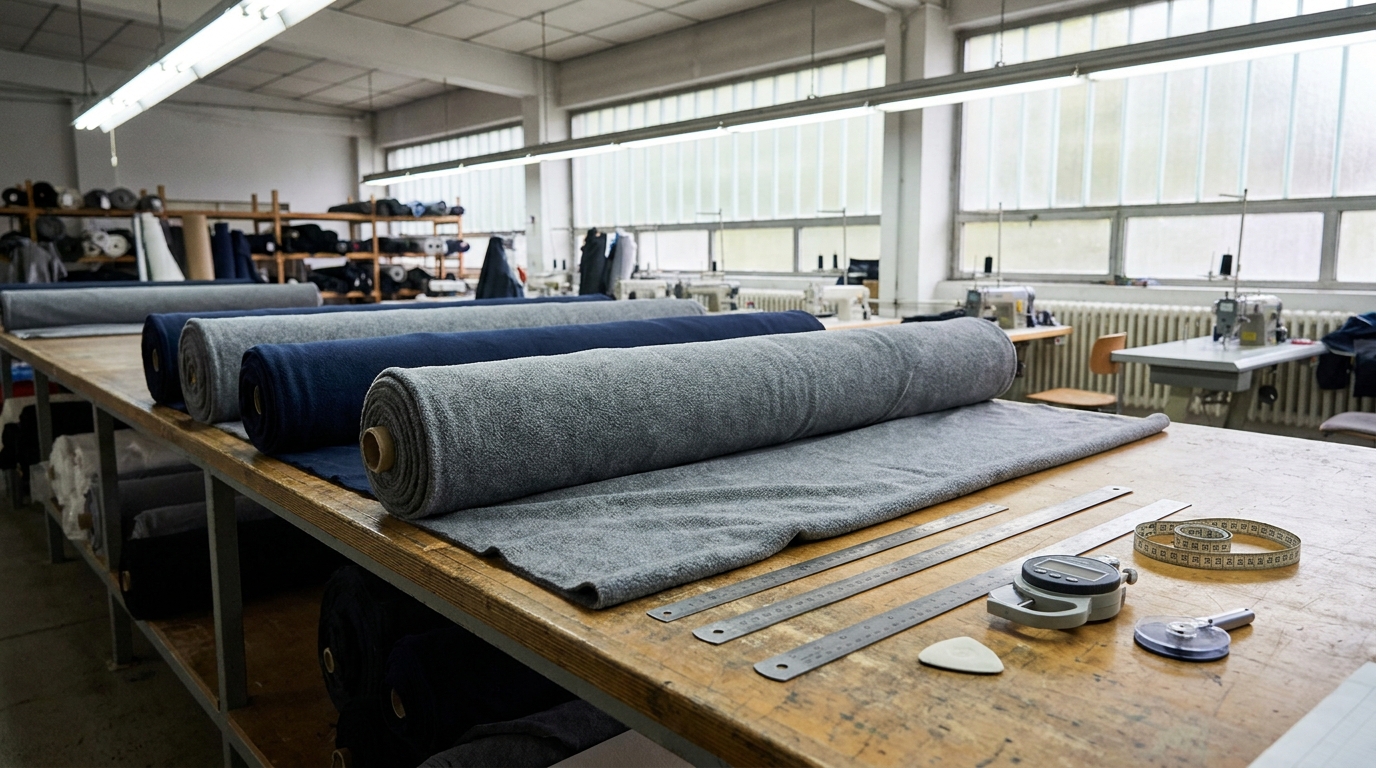
- GSM verification: We cut a 10 cm × 10 cm sample from the relaxed fabric and weigh it, following industry-standard testing protocols. GSM must be within ±5% of the specification.
- Visual inspection: We check for weaving defects, shade variation between rolls, and pile consistency.
Only after all three checks pass do we begin the marker layout and cutting process.
What to ask your factory: "Do you relax fleece fabric before cutting, and for how long?" If they say "we cut directly from the roll," your sizing consistency will suffer.
5 Cutting Defects That Kill Fleece Orders (And How We Prevent Them)
Fleece has specific cutting defects that do not occur in woven fabrics. If your factory does not know about these, they will not inspect for them, and you will discover them in customer complaints.
1. Pile Crush
When too many plies are stacked in a spread, or when the cutting blade is dull, the blade compresses the pile on the bottom layers. The result is a flat, shiny strip along the cut edge that does not recover after washing. The affected panels look different from the others — the edge has a visible "crush line" where the pile was flattened.
Prevention: Limit plies per spread based on GSM weight (see the table above). Change blades after every spread for heavyweight fleece. Use sharp, fresh blades exclusively.
2. Nap Burn
Laser cutting synthetic fleece at too high a power setting melts the pile fibers along the cut edge. The melted fibers create a hard, rough edge that feels like sandpaper. This is called nap burn, and it is irreversible.
Prevention: Test laser power settings on the actual fabric before production. Start low and increase incrementally. For polyester fleece, the optimal power setting varies by GSM and fiber denier — there is no universal setting.
3. Edge Fusion
Related to nap burn but distinct: edge fusion occurs when the laser heat causes adjacent fibers to melt together along the cut line. This creates a sealed edge that looks clean but feels stiff. In extreme cases, the fused edge cracks after washing.
Prevention: For synthetic fleece where a sealed edge is desired, use controlled laser power with proper ventilation. For cotton-blend fleece, switch to mechanical cutting entirely.
4. Shade Variation Across a Spread
When fabric is spread in multiple layers on the cutting table, the top layer and bottom layer may have slightly different pile compression due to the weight of the layers above. After cutting, the top-layer panels and bottom-layer panels can appear slightly different shades — even though they came from the same roll.
Prevention: Limit spread height. Use consistent spreading tension. After cutting, inspect panels from the top and bottom of the spread under D65 lighting (the industry standard for shade evaluation). If shade variation exceeds the acceptable tolerance (typically Grade 4 on the grey scale), separate the panels and do not mix them in the same garment.
5. Off-Grain Distortion from Spreading Tension
If the fabric is spread under too much tension, it stretches in the course direction. When the tension is released after cutting, the panels shrink back — but unevenly, because the tension was not uniform across the spread width. The result is panels that are slightly off-grain, causing the garment to twist after washing.
Prevention: Use controlled spreading machines with consistent tension settings. Never hand-pull fabric during spreading. Verify grain direction on every spread before cutting.
What to ask your factory: "What is your defect rate for fleece cutting, and how do you measure it?" At Fominte, our cutting defect rate is below 0.5%, measured by post-cutting inspection of every bundle.
What to Look For in a Fleece Cutting Room (Buyer Audit Checklist)
If you are evaluating a new fleece supplier, or auditing your current one, here is what to look for in the cutting room. These are specific, observable indicators that tell you whether the factory understands fleece cutting or is just guessing.
1. Grain direction markers on the cutting table Every marker layout should have grain arrows printed on it. The cutting supervisor should be able to show you how grain alignment is verified before cutting begins.
2. Pile direction arrows on pattern pieces Each pattern piece should have a pile direction indicator — an arrow showing which way the pile should run. If the pattern pieces have no pile indicators, the factory is not controlling pile matching.
3. Fabric relaxation area with timestamped batches There should be a dedicated area where unrolled fabric rests before cutting. Each batch should have a timestamp showing when it was unrolled. If fabric goes from the roll directly to the cutting table, the factory is skipping relaxation.
4. D65 lighting for shade matching The cutting area should have D65 daylight-balanced lighting for shade evaluation. Standard yellow factory lights distort color perception and make shade variation invisible.
5. Bundle labeling that tracks pile orientation After cutting, each bundle should be labeled with pile direction, lot number, and layer position (top/middle/bottom of spread). This information allows the sewing line to maintain pile consistency through assembly.
6. Blade change protocol Ask how often blades are changed. For heavyweight fleece, blades should be changed after every spread. If the factory uses the same blade until it breaks, they are producing pile crush defects on every spread after the first.
7. GSM testing equipment There should be a GSM punch and scale near the cutting area. Fabric should be tested before cutting, not after. If there is no testing equipment, the factory is not verifying that the fabric matches the specification.
These are not complex requirements. They are basic quality controls that any factory producing fleece garments at scale should have in place. If your factory is missing more than two of these, you have a systemic problem — not a one-time mistake.
If you want to see how our cutting room handles your specific fleece specs, send your tech pack to info@fominte.com. We will show you exactly how we plan your marker layout, control grain direction, and match pile across every panel — before we cut a single piece.
⚡ Common Mistakes to Avoid
Everything You Need to Know
Conclusion