.png?w=970&h=250)
Sequin, Bead & Tube Embroidery: Our Capabilities and What We Can Produce for Your Order
What It Really Means
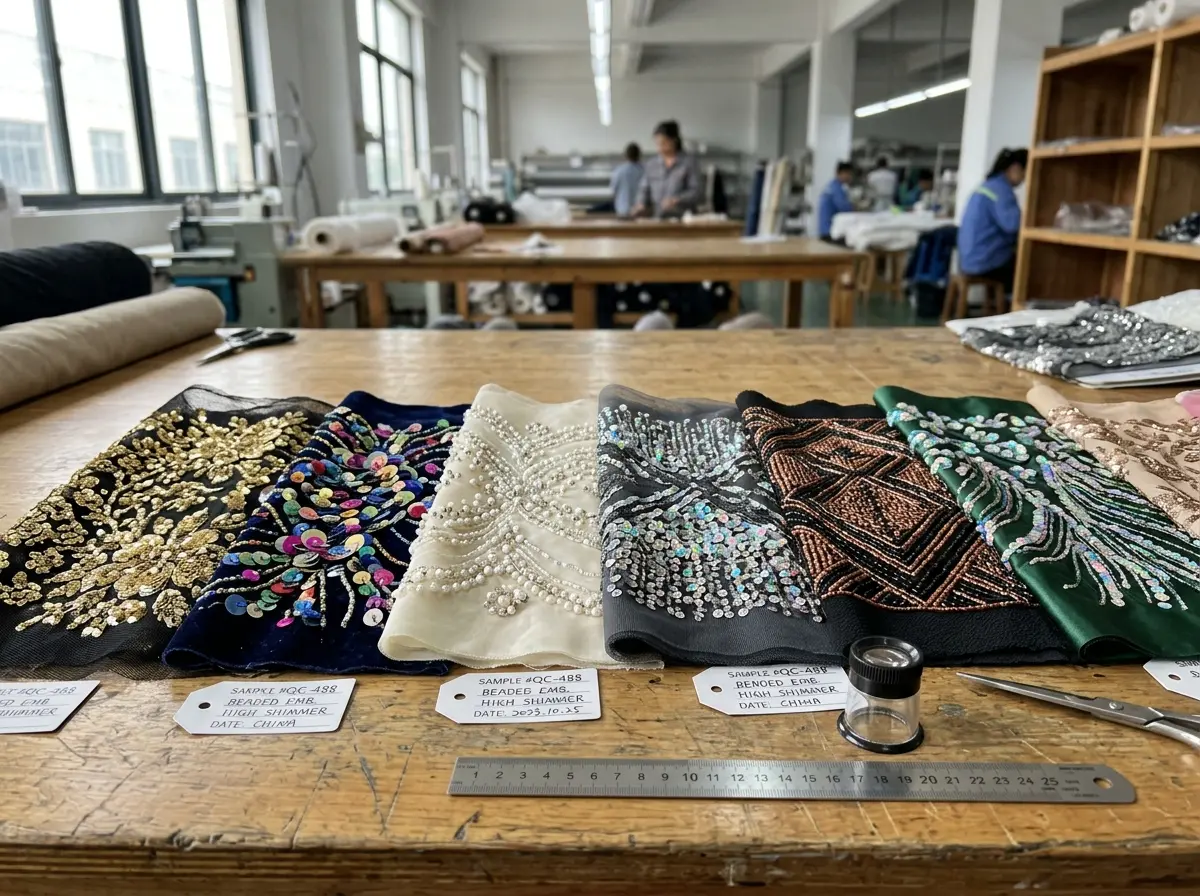
Sequin Embroidery — What We Can Produce
When a buyer sends us a design with sequin embroidery, the first question isn't "can you do it?" It's "what规格 do you need?" Sequin work isn't one thing. The size, shape, attachment method, and base fabric all change the outcome, and they all change the price.
Sequin Sizes and Shapes We Handle
Our production covers two main size categories:
- Flat sequins with side holes: up to 18mm. These are the large statement pieces you see on evening gowns and stage costumes. The side-hole design allows them to lie flat against the fabric, catching light across the full surface.
- Other sequin types (center-hole, cup sequins, specialty shapes): up to 8mm. This includes round paillettes, teardrop shapes, and custom-cut forms.
We can source and produce sequins in virtually any color. On a single fabric, we work with up to 10 different sequin colors in one design. That's enough for most gradient effects, multi-tone patterns, and complex motifs. If your design calls for more than 10 colors, we'll walk you through the trade-offs. Usually it comes down to production time and thread management complexity, not a hard technical limit.
Sequin Placement Techniques
How you place the sequins matters as much as the sequins themselves.
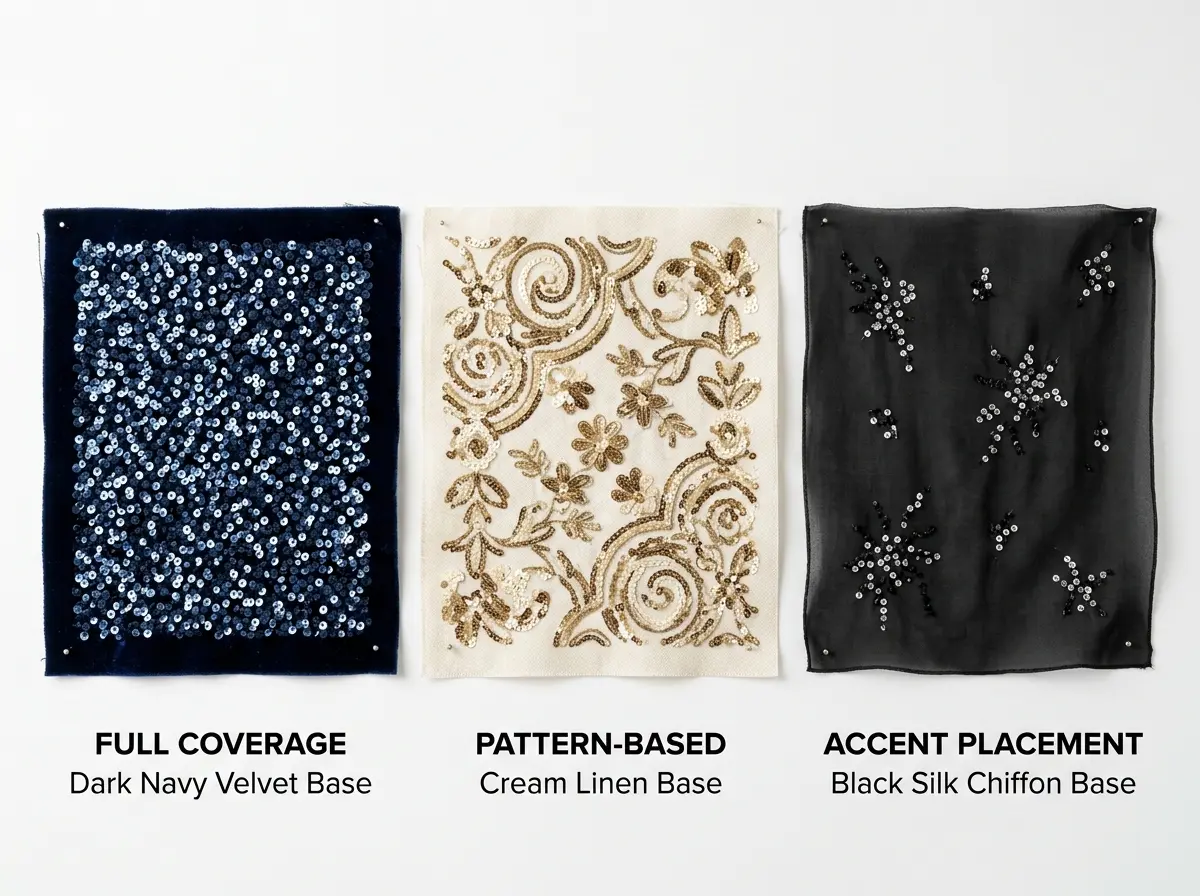
Full-coverage embroidery covers the entire fabric surface with sequins. This is common for stage costumes, dance wear, and high-impact evening wear. The result is heavy, dramatic, and catches light from every angle. The trade-off: higher material cost and longer production time.
Pattern-based placement uses sequins to form specific motifs: flowers, geometric designs, borders. This is more common for bridal overlays, formal dress panels, and decorative home textiles. It requires precise digitizing to ensure each sequin lands exactly where the design calls for it.
Scattered or accent placement adds sequins as highlights within a larger embroidery design. Think of a floral embroidery where the flower centers are sequins but the petals are thread work. This approach keeps costs down while adding visual interest.
The choice between these depends on your product and your market. A bridal brand ordering 5,000 yards of overlay fabric has different needs than a costume house ordering 500 yards of full-coverage stage fabric. We help you match the technique to the end use.
Bead and Tube Embroidery — Our Production Range
Bead and tube embroidery adds something sequins can't: physical depth. Sequins lie flat. Beads and tubes rise off the fabric surface. That three-dimensional quality is why luxury bridal, couture evening wear, and high-end decorative textiles rely on beaded work.
Bead Types and Specifications
We work with several bead and tube types:
- Tube beads (bugle beads): up to 8mm in length. These cylindrical beads create clean linear effects and are often used for borders, geometric patterns, and Art Deco-inspired designs.
- Seed beads: various sizes depending on the design requirement. These small round beads fill areas and create texture.
- Crystal beads and rhinestones: used as accent points within larger bead embroidery designs.
For tube embroidery specifically, the production process demands careful calibration. As our chief embroiderer explains: "The viscosity of the adhesive and the inner diameter of the tube have to match perfectly. Too much adhesive and the tubes push outward. Too little and they won't stand upright." This kind of parameter tuning is what separates consistent, production-ready bead embroidery from samples that look good on the first piece but fall apart at scale.
We've seen buyers come to us after trying other factories where bead samples looked great but bulk production had inconsistent tube alignment. The problem is usually the same: the factory didn't calibrate adhesive viscosity for the specific tube batch. Every batch of tubes has slightly different inner diameters. If you don't adjust the adhesive, you get inconsistency. We test every tube batch before production and adjust accordingly.
Tube Embroidery for Dimensional Effects
Tube embroidery creates a raised texture that works well for:
- Bridal bodices and overlays: tubes catch light differently than flat sequins, adding subtle dimension to white and ivory fabrics
- Evening wear panels: linear tube patterns create clean, architectural effects
- Cultural and ceremonial garments: heavily beaded and tubed fabrics for Middle Eastern and South Asian markets
The key technical consideration with tube embroidery is base fabric selection. Tubes add weight and stress to the fabric. We typically recommend mesh or net bases for heavily beaded designs, as these fabrics handle the additional weight better than lightweight woven materials. For a detailed comparison of base fabric options, see our guide on mesh vs. crochet vs. chemical lace base fabrics. If your design calls for a specific base fabric, we'll test the combination during sampling to confirm the tubes hold properly through washing and wear.
Combining Techniques — Sequin + Bead + Tube in One Design
This is where our production capability stands out. Most factories handle sequin work or bead work separately. Doing both on the same fabric, at production scale, is a different level of complexity.
Multi-Technique Production on a Single Fabric
Our 27 embroidery machines, each with 62 heads and 6 needles, are configured to handle multi-technique production. A single fabric can run through sequin attachment, bead placement, and tube embroidery without leaving our facility. No subcontracting, no coordination between workshops, no quality inconsistency from handoffs.
The practical advantage for buyers: when sequin and bead embroidery happen under one roof, we control the registration (alignment between different embellishment layers) throughout the process. If a sequin pattern and a bead pattern need to line up perfectly (and in high-end work, they do), that alignment is maintained from the first yard to the last.
On a single fabric, we manage up to 10 different embellishment colors across all techniques combined. So a design with 4 sequin colors, 3 bead colors, and 3 tube colors is within our standard production capability.
Quality Control for Combined Embroidery
Multi-technique embroidery has more potential failure points than single-technique work. A sequin can sit slightly off-angle. A bead can spin during attachment. A tube can tilt instead of standing upright.
Our quality control process for combined embroidery includes:
- First-piece inspection: we produce 3-5 sample pieces before starting production. You approve these before we run the full order.
- In-line monitoring: our floor team checks registration and attachment quality throughout the production run.
- Needle inspection: every piece passes through our needle detection system to catch any broken needle fragments.
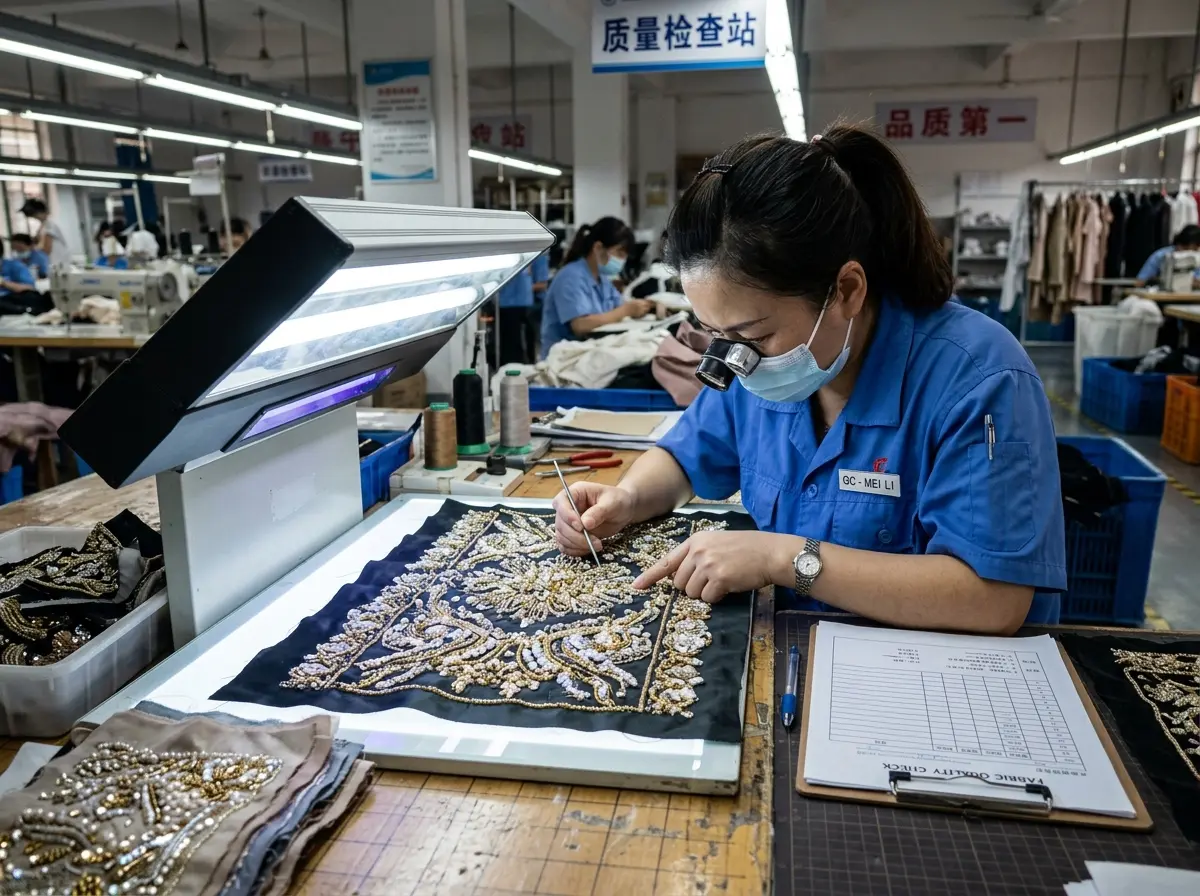
- Final inspection under dual lighting (D65 + TL84): this catches color inconsistencies that single-source lighting would miss, following AATCC evaluation standards.
Our defect rate across all embroidery types stays below 2%. For combined-technique work, we maintain the same standard. A bead falling off a $50 evening gown is just as problematic as a sequin falling off a $5 stage costume.
What Buyers Should Know Before Ordering
Once you know what a factory can produce, the next question is how to structure your order.
MOQ, Lead Time, and Customization
Minimum order quantity: 100 yards for standard embroidery fabrics. This covers the setup time for digitizing, thread changes, and machine calibration. For orders below 100 yards, the per-yard cost increases significantly because those fixed setup costs get spread across fewer yards.
Lead time: 20-40 days from order confirmation to shipment, depending on complexity. Here's how that breaks down:
| Phase | Duration |
|---|---|
| Digitizing and pattern programming | 2-3 days |
| Raw material sourcing | 3-5 days |
| Production setup | 1-2 days |
| Actual embroidery production | 5-15 days |
| Quality inspection | 1-2 days |
| Finishing and packing | 2-3 days |
Heavily beaded or multi-technique fabrics push toward the longer end of that range. Simple sequin patterns on standard base fabrics push toward the shorter end.
Sampling: 7-15 days. First samples carry a charge, but that cost gets deducted from your production order if it exceeds 1,000 yards. Returning clients get 3 rounds of sample modifications free of charge.
Customization: We customize sequin sizes, bead types, tube specifications, color combinations, base fabric selection, and pattern design. The more custom your requirements, the longer the initial setup — but once the parameters are locked, production runs consistently.
Choosing the Right Embroidery for Your Product
Not every product needs every technique. Based on what we see from our clients:
Evening wear and gowns → Sequin embroidery. Full-coverage or large-pattern sequins deliver the high-impact sparkle that sells on the rack. Flat sequins up to 18mm work well for statement pieces.
Bridal and formal wear → Bead and tube combination. The dimensional quality of beads and tubes adds elegance without overwhelming the design. White and ivory beadwork on mesh bases is our most-requested bridal combination.
Stage costumes and performance wear → Full-coverage sequin + bead. Maximum visual impact, durability for repeated wear, and the weight that says "this is a real costume, not a cheap copy."
Cultural and ceremonial garments → Heavy bead and tube embroidery. Middle Eastern and South Asian markets often require dense, all-over beadwork. We've been producing for these markets for years.
Home décor (cushion covers, curtains, table runners) → Accent sequin or tube embroidery. Decorative textiles benefit from subtle embellishment rather than full coverage.
Fashion accessories (bags, belts, headpieces) → Precision bead embroidery. Small areas require tight control, which our digitizing team handles well.
The right choice depends on your market, your price point, and your brand positioning. If you're not sure which technique fits, send us your design and your target price range. We'll recommend the approach that gives you the best balance of visual impact and cost efficiency.
One thing we tell every buyer: the cheapest option is rarely the best option. A full-coverage sequin fabric costs more per yard than an accent sequin design, but if your end customer expects full coverage, cutting corners on embellishment density will cost you returns and reputation. We help you find the right level of embellishment for your market, not the minimum level that technically qualifies as "sequin embroidery."
Why Fominte for Sequin, Bead & Tube Embroidery
We've been doing this since 1990. That's 35+ years of embroidery production, starting in Shenzhen and now operating from our facility in Xuzhou with a team of 100-200 production staff and a 10-person design team dedicated to digitizing, pattern optimization, and technical support.
Our monthly production capacity reaches 300,000 meters across all embroidery types, including water-soluble embroidery production at scale. We hold OEKO-TEX Standard 100, Higg Index, and Amfori certifications. We export primarily to the Middle East, Europe, and Southeast Asia.
Numbers only tell part of the story. What matters to buyers who work with us is consistency. Knowing that the 10,000th yard of beaded mesh looks the same as the first yard. That comes from standardized processes, experienced operators, and a QC system that catches problems before they leave the factory.
Our 10-person design team handles digitizing, pattern optimization, and technical support for every order. When a buyer sends a complex multi-technique design, our team reviews the digitizing file before production starts. About 15% of incoming files get sent back for revision. That's not a delay. It's a safeguard. Fixing a digitizing problem before production costs a day. Catching it after production costs the whole batch. For a closer look at our production process, read how we make embroidery fabric from start to finish.
As our founder Shawn puts it: "Quality isn't a cost. It's an investment." We'd rather spend extra time on sampling and first-piece approval than deal with rejections after shipment.
When to Use & Avoid
Evening wear and gowns
✅ Use When
- full-coverage sequin embroidery
- large-pattern sequin placement
- statement pieces up to 18mm
⚠️ Avoid When
- delicate chiffon-only designs
- heavy beading on lightweight fabrics
Bridal and formal wear
✅ Use When
- bead and tube combination on mesh bases
- white and ivory beadwork
- dimensional overlay panels
⚠️ Avoid When
- full-coverage heavy beadwork
- rigid non-flexible bases
Stage costumes and performance wear
✅ Use When
- full-coverage sequin plus bead
- maximum visual impact
- durability for repeated wear
⚠️ Avoid When
- everyday casual wear
- low-cost promotional items
Cultural and ceremonial garments
✅ Use When
- heavy bead and tube embroidery
- dense all-over beadwork
- Middle Eastern and South Asian market designs
⚠️ Avoid When
- minimalist Western fashion
- technical sportswear
⚡ Common Mistakes to Avoid
Everything You Need to Know
Conclusion