.png?w=970&h=250)
Sherpa, Teddy & Fluffy Fleece: A B2B Buyer's Guide to Choosing the Right Pile Fabric
What It Really Means
Sherpa, teddy, and fluffy fleece look similar in product photos. They're not. Their pile construction, backing structure, and GSM ranges differ in ways that change how they behave in production — cutting efficiency, shedding rates, seam performance all shift depending on which one you're working with. Here's what to know before specifying one in a tech pack.
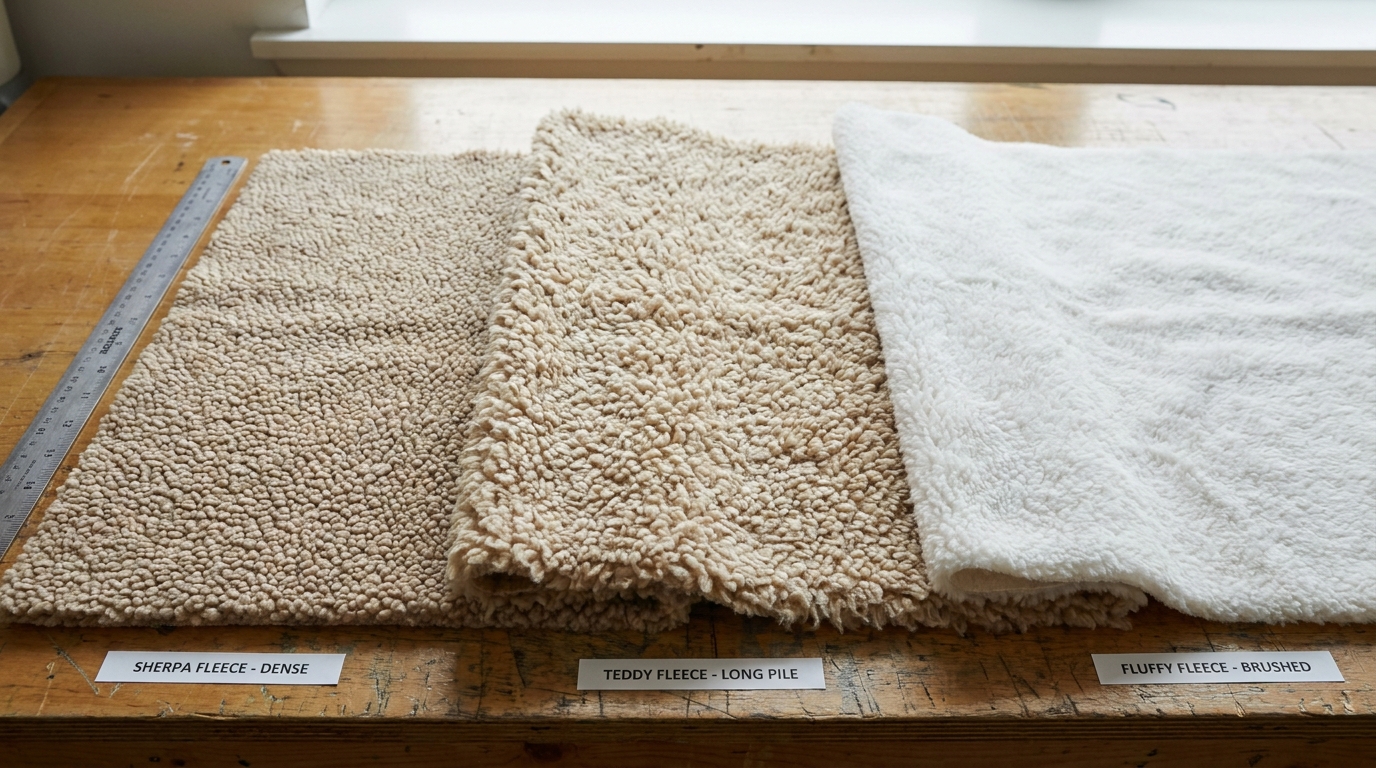
What Are Sherpa, Teddy, and Fluffy Fleece? (Technical Definitions)
Most content online describes these fabrics by how they feel. That's fine for consumers. Procurement managers need specs — fiber composition, pile structure, backing construction, and GSM range.
Sherpa Fleece
Sherpa mimics sheepskin wool — smooth knit face, textured pile side. What sets it apart technically is the fleece-backed construction: pile fibers are bonded to a dense backing, which anchors them securely.
- Fiber: Typically 100% polyester. Some mills offer polyester-cotton blends (80/20 or 70/30) for improved hand feel, though these are less common in bulk production.
- GSM range: 250–400. For outerwear linings, 300–380 GSM is the sweet spot.
- Pile height: 3–8mm. Shorter than teddy, denser than fluffy fleece.
- Backing: Fleece-backed (fibers bonded to a knit base). This is what gives sherpa its clean reverse side and low shedding behavior.
- Width: 150–180 cm, depending on the mill.
Teddy Fleece
Teddy has a longer, fluffier pile — looks like a teddy bear's fur, hence the name. The difference from sherpa comes down to backing: teddy uses a honeycomb or open-weave construction instead of a bonded fleece back.
- Fiber: 100% polyester, or polyester-cotton blends (common in EU markets where cotton content is preferred).
- GSM range: 200–350. Lighter than sherpa at the low end, but the long pile can push the upper range.
- Pile height: 8–15mm. Significantly longer than sherpa, which creates the characteristic fluffy appearance.
- Backing: Honeycomb (open weave). The fibers are tufted into an open mesh rather than bonded to a solid base. This makes teddy more breathable but also more prone to shedding at cut edges.
- Width: 150–200 cm.
Fluffy Fleece (High-Pile Fleece)
Fluffy fleece is the lightweight option. It's a brushed, single-sided fleece — breathability and layering over raw warmth.
- Fiber: 100% polyester. Often used in activewear contexts where moisture-wicking matters.
- GSM range: 150–280. The lightest of the three.
- Pile height: 2–5mm. Short, brushed nap rather than long tufted fibers.
- Backing: Smooth knit on the reverse (single-sided brushing). No open weave, no bonded backing — just a clean, lightweight knit.
- Width: 150–180 cm.
Side-by-Side Specs Comparison
This table is designed to be screenshot-ready. If you're evaluating a supplier's fleece offering or writing a tech pack, this gives you the specs to request.
| Specification | Sherpa | Teddy | Fluffy Fleece |
|---|---|---|---|
| GSM Range | 250–400 | 200–350 | 150–280 |
| Pile Height | Short-medium (3–8mm) | Medium-long (8–15mm) | Short (2–5mm) |
| Backing Construction | Fleece-backed (bonded fibers) | Honeycomb (open weave) | Smooth knit (single-sided brush) |
| Thermal Insulation | High | Medium-High | Medium |
| Breathability | Low-Medium | Medium-High | High |
| Shedding Risk at Cut Edge | Low | High | Medium |
| Typical Fiber | 100% polyester | 100% polyester or poly-cotton | 100% polyester |
| Best For | Outerwear linings, cold-weather jackets | Loungewear, fashion pieces, home textiles | Activewear linings, lightweight layers |
| OEKO-TEX Eligible | Yes | Yes | Yes |
| Common Recycled Option | GRS-certified rPET available | GRS-certified rPET available | GRS-certified rPET available |
A note on sourcing: when a supplier quotes "sherpa," always confirm whether they mean fleece-backed sherpa or just a high-pile fleece with a brushed back. The terms get used interchangeably in some markets, and the production behavior is very different. (If you're also comparing heavyweight and lightweight polar fleece, we have a detailed GSM and performance comparison.)
Manufacturing Differences: What Happens on the Factory Floor
Consumer guides skip this part. It's the part that matters most if you're buying at scale. How sherpa, teddy, and fluffy fleece behave in cutting, sewing, and QC depends entirely on their construction.
Cutting Behavior
Teddy sheds. The honeycomb backing doesn't anchor the pile fibers as firmly as sherpa's bonded fleece back. When you cut teddy fabric, loose fibers escape from the exposed edge. In a production run of 5,000 pieces, that translates to visible lint on garments, extra cleaning time, and potential fiber contamination on adjacent workstations.
How we manage it: rotary cutting instead of die cutting (less fiber agitation), pile-direction alignment (cutting with the grain reduces pull), and edge sealing for high-shed fabrics. Some factories use compressed air to blow loose fibers off cut pieces before sewing — we do this for teddy orders above 2,000 pieces.
Sherpa is the opposite. The fleece-backed construction holds fibers tightly. Cut edges stay clean, shedding is minimal, and you can die-cut without worrying about fiber loss. This is one reason sherpa is the default choice for outerwear linings — it behaves predictably in production.
Fluffy fleece falls in the middle. The brushed nap can shed slightly, but the smooth knit backing holds better than teddy's open weave. Standard cutting methods work fine for most fluffy fleece orders.
Sewing Requirements
Each fabric type needs different needle and stitch configurations:
- Sherpa: Standard overlock works. Needle size NM 90–100. Stitch length 2.5–3.0mm. The dense backing provides a stable sewing surface.
- Teddy: Requires stronger overlock and thicker needles (NM 100–110). Reduce stitch length to 2.0–2.5mm — longer stitches on teddy's open backing can cause yarn slippage. Presser foot pressure needs adjustment; too much pressure compresses the pile and creates visible marks.
- Fluffy fleece: Standard setup works for most orders. Watch for pile compression under the presser foot on lighter GSMs (below 200). Walking foot attachment helps on very light constructions.
A common mistake we see from new suppliers: using the same needle and stitch settings for all three fabrics. The result is seam puckering on teddy (from too-long stitches) and pile damage on fluffy fleece (from too much presser foot pressure).
Quality Control Checkpoints
For all three fleece types, we run these inspections:
- Pile integrity after washing — 3 wash cycles at 30°C, then inspect for pile flattening, matting, or excessive shedding. Teddy is the most sensitive here.
- Seam strength — Pull test at 15N/cm minimum. Sherpa's bonded backing gives it the strongest seams. Teddy's open backing requires careful overlock to hit the same strength.
- Pilling resistance — Martindale test (ISO 12945-2). We test at 2,000 cycles minimum. Sherpa typically scores Grade 3–4, teddy Grade 2–3, fluffy fleece Grade 3–4.
- Color fastness — ISO 105 series (washing, rubbing, light). Our target: Grade 4 minimum across all tests. Dark colors on teddy can be challenging because the long pile traps dye particles.
- Shrinkage — ISO 6330. Target: less than 3% after 3 washes. All three fabrics perform similarly here when properly heat-set.
Our overall defect rate across fleece production is under 2%. For teddy specifically, the most common defect is edge shedding during cutting — which is why we invest extra time in pile alignment before the cut. (Want to see how the full production line works? Here's a walk-through of our fleece production process.)

Which Fabric for Which Product? (Application Mapping)
Choosing the right fleece isn't about which one feels nicest. It's about matching the fabric to the product.
Outerwear and Jackets → Sherpa
Sherpa is the standard for cold-weather outerwear linings. The fleece-backed construction provides:
- High thermal insulation without excessive bulk
- Clean reverse side that doesn't shed on the wearer's base layers
- Strong seam performance for garments that face repeated stress (zippers, cuffs, waistbands)
- Stable surface for embroidery or heat-transfer logos
When a buyer sends us a tech pack for a lined jacket, sherpa is our default recommendation unless they specifically request something else. (For a deeper look at all the fleece types we produce, see our complete fleece product range guide.)
Loungewear and Home Textiles → Teddy
Teddy's long pile and soft hand feel make it the go-to for products where tactile appeal drives the purchase:
- Loungewear sets, robes, and housecoats
- Throw blankets and cushion covers
- Fashion-forward outerwear where the teddy aesthetic is the selling point
The trade-off: teddy's open backing means more shedding in production and potentially during the garment's lifespan. For loungewear, this is usually acceptable. For products that will be washed frequently (children's pajamas, for example), sherpa or fluffy fleece may be more practical.
Activewear and Lightweight Layers → Fluffy Fleece
Fluffy fleece is lighter, more breathable, and dries faster. It works well for:
- Lightweight mid-layers for hiking and outdoor activities
- Running jackets and cycling vests
- Performance linings where moisture management matters
At 150–280 GSM, fluffy fleece adds warmth without the weight penalty. It's the only one of the three that works well next-to-skin in active contexts.
Children's Products → All Three, With Caveats
Any of these fabrics can be used for children's products, but the compliance requirements are stricter:
- OEKO-TEX Standard 100 is non-negotiable for children's items (Class I for products for babies, Class II for products with direct skin contact)
- Flammability testing varies by market: US (16 CFR 1610), EU (EN 14878 for children's nightwear)
- Fluffing test — some markets require evidence that pile fibers don't separate easily, which is especially relevant for teddy
If you're producing children's fleece products for export, always confirm the testing standards with your supplier before committing to a fabric type.
Sourcing Checklist for B2B Buyers
When evaluating a fleece supplier or writing a tech pack that includes sherpa, teddy, or fluffy fleece, here's what to specify and verify:
Fabric specifications to request:
- Exact GSM (not a range — get the supplier's standard tolerance, typically ±5%)
- Fiber composition (100% polyester, or blend ratio if poly-cotton)
- Backing construction (fleece-backed, honeycomb, or brushed single-side)
- Pile height in millimeters
- Fabric width
Testing standards to require:
- Pilling resistance: ISO 12945-2 (Martindale method), minimum Grade 3
- Color fastness to washing: ISO 105-C06, minimum Grade 4
- Color fastness to rubbing: ISO 105-X12, minimum Grade 4 (dry), Grade 3 (wet)
- Dimensional stability: ISO 6330, maximum 3% shrinkage
- Seam strength: ISO 13935-2, minimum 15N/cm
Certifications to verify:
- OEKO-TEX Standard 100 (chemical safety baseline)
- GRS (Global Recycled Standard) — if specifying recycled polyester content (see our guide to recycled fleece and GRS certification)
- REACH compliance — for EU-bound products
Sample evaluation steps:
- Cut a 10cm square and shake it over a dark surface. Count the loose fibers. Teddy will shed more than sherpa — that's normal. But excessive shedding (more than 15–20 loose fibers) indicates poor fiber anchoring.
- Wash the sample 3 times at 30°C. Check for pile matting, color bleeding, and shrinkage.
- Pull the seam at 15N/cm. If the stitch yarn slips or the backing distorts, the construction isn't adequate for the intended use.
- Hold the fabric against a light source. If you can see through the backing (common with low-GSM teddy), the fabric may not have enough structure for tailored garments.
FAQ
Is sherpa warmer than teddy fleece?
Sherpa generally provides higher thermal insulation due to its denser, fleece-backed construction (250–400 GSM). Teddy fleece (200–350 GSM) has a longer pile but its open honeycomb backing allows more airflow, making it slightly less warm but more breathable. For outerwear linings, sherpa is the standard choice. For loungewear where you want warmth without overheating, teddy works well.
Does teddy fleece shed more than sherpa?
Yes. Teddy fleece's open honeycomb backing means fibers are less anchored at cut edges, leading to higher shedding during cutting and sewing. Sherpa's fleece-backed construction holds fibers more securely. In production, teddy requires edge-sealing or rotary cutting to minimize fiber loss. If shedding is a concern for your end product, sherpa is the safer choice.
Can I use sherpa fleece for activewear?
Not ideal. Sherpa's low breathability and higher GSM make it better suited for outerwear linings and cold-weather jackets. For activewear, fluffy fleece (150–280 GSM) is the better choice — it's lighter, more breathable, and dries faster. If you need a fleece for a hiking mid-layer or running vest, fluffy fleece gives you warmth without the moisture-trapping properties of sherpa.
What certifications should I look for when sourcing fleece fabrics?
OEKO-TEX Standard 100 is the baseline for chemical safety, especially for children's products. If using recycled polyester, request GRS (Global Recycled Standard) certification to verify the recycled content chain. For EU markets, also check compliance with REACH regulations. For children's nightwear, flammability testing to EN 14878 (EU) or 16 CFR 1610 (US) is required.
At Fominte, we produce all three fleece types in-house. If you're deciding between sherpa, teddy, and fluffy fleece for your next collection, send us your tech pack at info@fominte.com. We'll recommend the right fabric for your product's performance requirements and provide samples with full test data.
When to Use & Avoid
Outerwear & Jackets
✅ Use When
- Best for cold-weather linings, clean reverse side, strong seams, stable for embroidery
Loungewear & Home Textiles
✅ Use When
- Acceptable but less tactile appeal
Activewear
✅ Use When
- Not suitable: low breathability, high GSM
Children's Products
✅ Use When
- All three possible with OEKO-TEX Standard 100 and flammability testing
Comparison
| Specification | Sherpa | Teddy | Fluffy Fleece |
| GSM Range | 250-400 | 200-350 | 150-280 |
| Pile Height | 3-8mm (short-medium) | 8-15mm (medium-long) | 2-5mm (short) |
| Backing | Fleece-backed (bonded) | Honeycomb (open weave) | Smooth knit (single-sided brush) |
| Thermal Insulation | High | Medium-High | Medium |
| Breathability | Low-Medium | Medium-High | High |
| Shedding Risk (Cut Edge) | Low | High | Medium |
| Best For | Outerwear linings, jackets | Loungewear, fashion, home textiles | Activewear, lightweight layers |
⚡ Common Mistakes to Avoid
Everything You Need to Know
Conclusion