.png?w=970&h=250)
Inside Fominte's Fleece Production Line: From Fabric Roll to Finished Garment
What It Really Means
How a Fleece Order Moves Through Our Factory
A fleece garment order at Fominte passes through six stages: fabric inspection, cutting, sewing, pressing, quality control, and packing. Each stage has checkpoints. The full cycle takes 20 to 40 days depending on order size and complexity, and every garment goes through at least eight quality inspections before it reaches the shipping carton.
I walk buyers through this process regularly, and the most common reaction is surprise at how many steps sit between a roll of fleece fabric and a finished jacket. If you haven't yet reviewed the fleece types we produce, that's worth reading first. Most guides online cover the textile side, how fleece fabric is knitted and brushed, but stop there. What happens after the fabric arrives at a garment factory involves a different set of challenges.
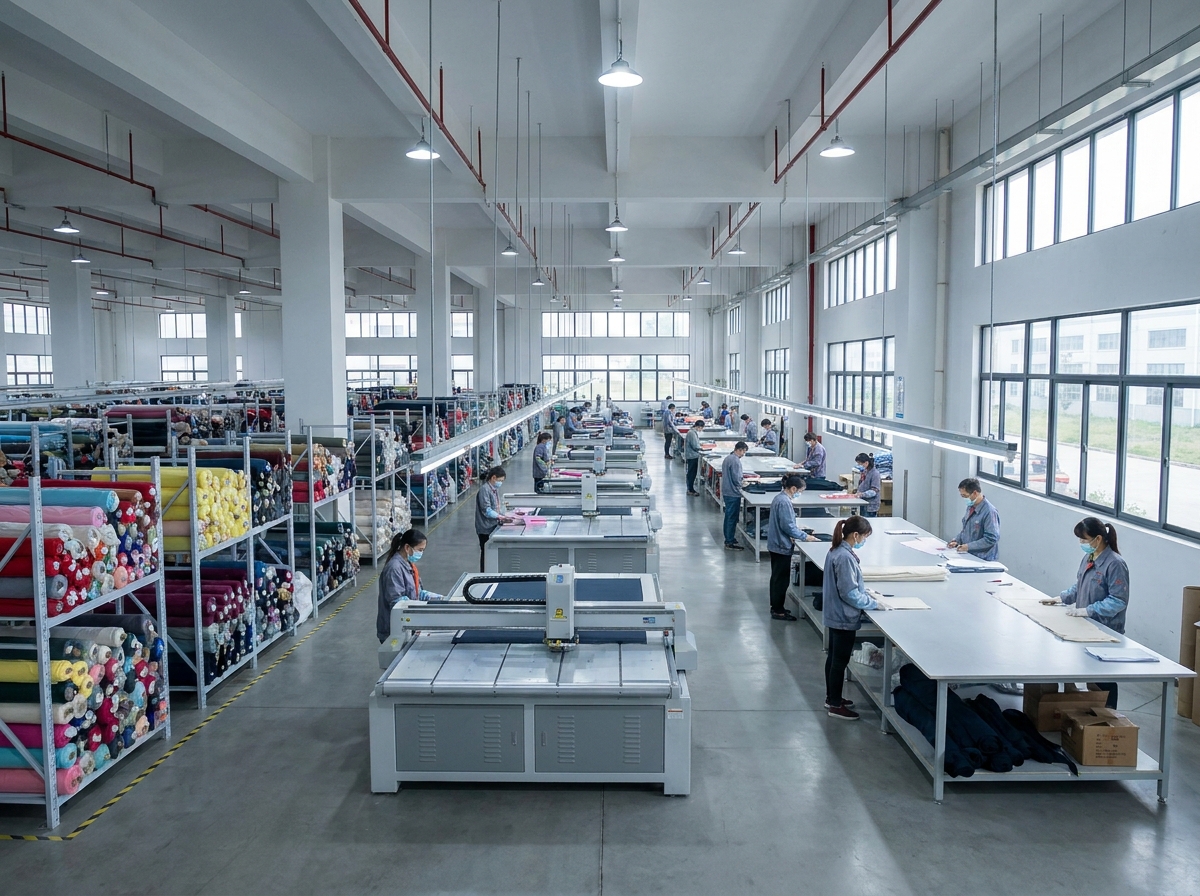
Stage 1 — Fabric Inspection and Relaxation
Every roll of fleece fabric that enters our facility gets inspected before it touches a cutting table. It's the first quality gate. Skip it, and defects multiply through an entire production run.
Our incoming inspection checks four things:
- Width consistency: Each roll is measured at multiple points. We accept ±1 cm variation. Anything beyond that gets flagged because width inconsistency causes cutting layout problems downstream.
- Fabric defects: We unroll and inspect under D65 lighting (daylight-balanced fluorescent). The standard is ≤2 defects per 50 yards. Defects include needle holes, uneven brushing, oil stains, and shade variation within the roll.
- Color matching: Every roll is compared against the approved lab dip under D65 and TL84 dual light sources. Fleece is particularly sensitive to shade variation between dye lots. A problem that's invisible in a small swatch becomes obvious when 500 jackets are hanging side by side in a retail store.
- GSM verification: We weigh a sample from each roll on a precision scale. The tolerance is ±5% of the specified GSM. A 300 GSM fleece that comes in at 280 GSM will feel noticeably thinner than the approved sample, and buyers will notice.
After inspection, the fabric goes through a relaxation period. Fleece fabric that's been tightly wound on rolls carries tension from the knitting and finishing processes. If you cut it immediately, the pieces will shrink slightly after the first wash — sometimes enough to throw off the fit by a full size. We relax the fabric for 24 to 48 hours, laid flat and open, before cutting begins. This step alone prevents the majority of post-wash shrinkage complaints.
Stage 2 — Cutting: Where Fleece Gets Its Shape
Cutting fleece is not the same as cutting a standard jersey or woven fabric. The pile surface, the soft brushed side that makes fleece feel like fleece, introduces variables that don't exist with smooth fabrics.
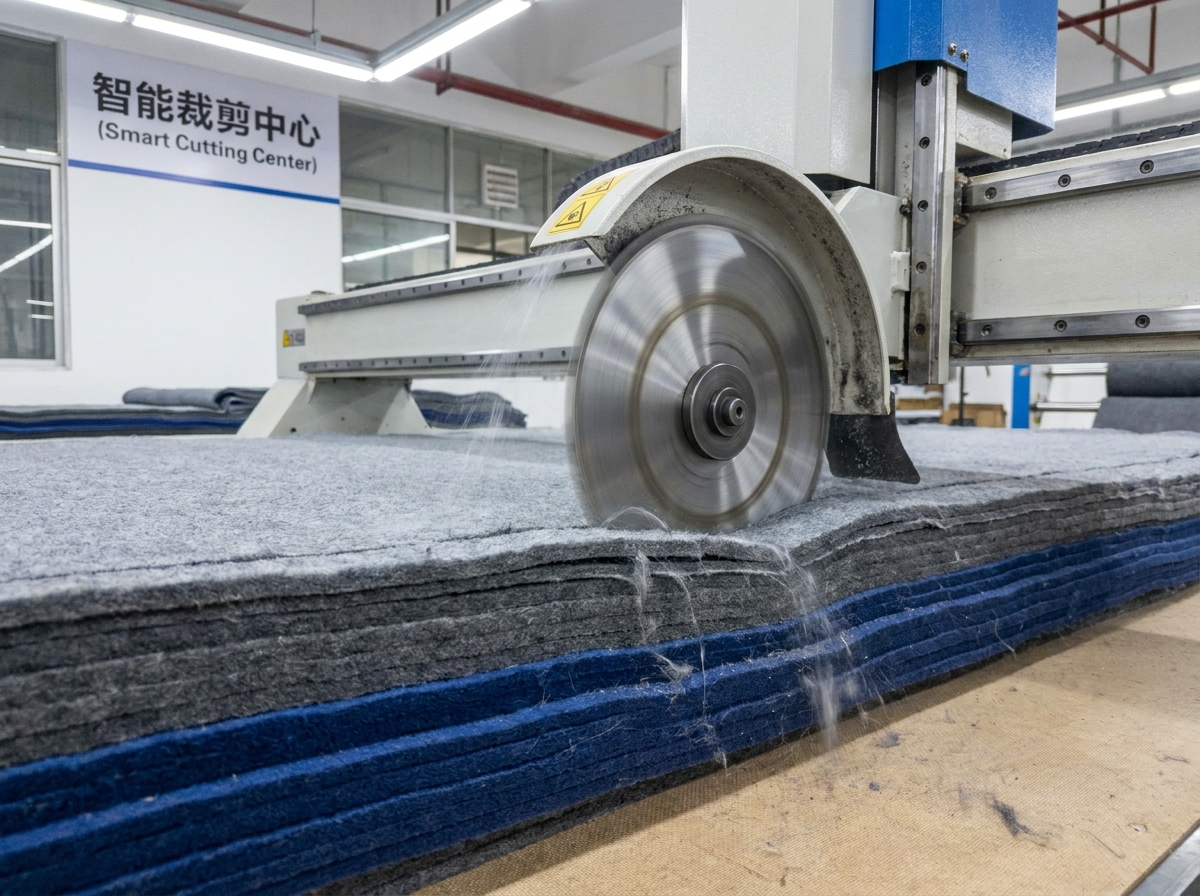
Our cutting room uses computerized spreading machines and straight-knife cutting equipment. For large orders, we use automated cutting systems that follow digital marker layouts for maximum fabric utilization.
-
Marker creation: Our pattern team creates a digital marker — the layout of all pattern pieces on the fabric width. Marker efficiency (how much fabric is actually used vs. wasted) typically runs 82-88% for fleece garments, compared to 88-92% for smooth-surface fabrics. The difference comes from the grain direction constraint, which I'll explain in the next section.
-
Spreading: Fabric is laid out in layers on the cutting table. The number of layers depends on GSM — a 200 GSM microfleece can be stacked 40-60 layers deep, while a 400 GSM polar fleece might only allow 20-30 layers. More layers mean more pieces cut at once, which directly affects throughput.
-
Cutting: Straight-knife or automated cutting follows the marker. The blade has to be sharp — dull blades compress the pile instead of cutting through it, leaving ragged edges that show in the finished garment.
-
Bundling: Cut pieces are sorted by size, bundled, and tagged with lot numbers for traceability. Each bundle goes to the sewing floor with a ticket that identifies the fabric lot, cutting date, and size.
Stage 3 — Sewing and Assembly
The sewing floor is where cut pieces become garments. Our production line is organized by product type: jackets in one area, hoodies in another, vests in a third. This matters because fleece sewing needs different machine settings and techniques than other fabrics.
Thread and needle selection comes first. Fleece is thicker than standard knit fabrics. We use size 11 or 14 needles depending on GSM, and polyester-core thread for strength and stretch compatibility. The wrong needle size causes skipped stitches or fabric puckering, problems that don't show up until the garment is washed and the stitches start to fail.
Most fleece garments use overlock (serged) seams for structural joins and coverstitch for hems and visible topstitching. The overlock seam provides stretch and strength for a fabric that will be worn in active conditions. Coverstitch gives a clean finish on cuffs, hems, and necklines.
Presser foot pressure is one of those settings that separates a good factory from an average one. Too much pressure compresses the pile and leaves visible marks. Too little causes fabric feeding problems and uneven seam lengths. We adjust presser foot pressure for each GSM. It's not a set-it-and-forget-it setting.
We run 100-200 workers on the floor depending on order volume. Each team is specialized: cutting operators don't sew, sewers don't do QC. This division of labor means each person develops deep skill in their function rather than being a generalist doing everything at average quality.
Stage 4 — Pressing and Finishing
After sewing, garments go through pressing and finishing. This step removes wrinkles and sewing distortions, and sets the final shape of the garment.
We use industrial steam pressing stations, not household irons. The temperature, pressure, and steam duration are calibrated for polyester fleece. Too much heat melts the polyester fibers (polyester has a lower melting point than cotton), creating shiny spots that can't be fixed. Too little heat leaves the garment looking unfinished.
For fleece garments with linings, like sherpa-lined jackets, pressing also helps bond the lining to the shell at collar, cuffs, and hem, preventing the lining from shifting during wear.
Finishing includes thread trimming, button attachment if applicable, and any final handwork that machines can't do, like securing loose thread ends inside the garment where they won't be visible.
Stage 5 — Quality Control: The 8-Point Check
Quality control isn't a single step at the end. It runs throughout production, but the formal inspection happens after pressing and finishing.
-
Measurement verification: Every size in the production run gets measured against the approved spec sheet. We check at least 5 points per garment — chest, body length, sleeve length, shoulder width, and hem opening. Tolerance is typically ±1 cm for most measurements.
-
Stitch quality: We inspect seam strength, stitch density, and consistency. Weak or skipped stitches are pulled and resewn. Stitch density is checked against the approved sample — too few stitches per inch means a weak seam, too many means unnecessary needle holes in the fabric.
-
Surface inspection: Under D65 lighting, we check for fabric defects, stains, needle holes, and pile damage. Fleece pile that's been compressed by a sewing machine foot or damaged by a needle shows up clearly under proper lighting.
-
Color consistency: All garments in the lot are compared against each other and the approved standard. Dye lot variation that passed incoming inspection can still show up when garments from different rolls are sewn together.
-
Needle detection: Every garment passes through a needle detection machine. This detects broken needle fragments that may have been left in the fabric during sewing. For a product worn against skin, there's no acceptable alternative to 100% detection. We don't sample. We check every piece.
-
Labeling and trim check: Care labels, size labels, hang tags, and any attached trims (zippers, drawstrings, snaps) are verified against the spec. Wrong label placement or missing labels are caught here.
-
Packing check: Garments are folded, poly-bagged, and packed according to the buyer's packing instructions. We verify packing ratio (how many of each size per carton), carton markings, and shipping labels.
-
Final random inspection: After packing, we pull a random sample from the finished cartons for a final AQL (Acceptable Quality Level) inspection. The standard is AQL 2.5 for major defects and AQL 4.0 for minor defects, following the ISO 2859-1 sampling procedure.
Our consistently maintained defect rate is below 2%. That number comes from tracking every defect found at every inspection point and working backward to fix the root cause — not from reclassifying defects to make the numbers look better.
Stage 6 — Packing and Shipping Preparation
The final stage. Garments are folded to the buyer's specifications (flat fold, hanger fold, or rolled), placed in poly bags, and packed into export cartons. We follow the buyer's packing instructions exactly — size ratio per carton, carton dimensions, marking requirements, and any special instructions for retail-ready packaging.
Cartons are weighed and measured, and the packing list is generated with lot numbers for full traceability. If the buyer has arranged a pre-shipment inspection (PSI) with a third-party inspector, this is when it happens. The inspector pulls samples from packed cartons and verifies against the spec sheet and approved sample.
For export orders, we coordinate with the buyer's freight forwarder for container loading. Our standard export port is Shanghai.
The Cutting Room: Why Fleece Cutting Is Different
I mentioned grain direction and pile matching in the cutting section, but these deserve more detail. They're the most common source of quality complaints in fleece garments, and the most overlooked by factories that don't specialize in fleece.
Grain Direction: Why Every Piece Must Face the Same Way
Fleece has a directional pile — the brushed fibers lean in one direction, like petting a cat from head to tail vs. tail to head. When you run your hand across a fleece fabric in one direction, it feels smooth. In the other direction, it feels rougher. This is the grain direction, and it's not optional to control.
If a garment is cut with some pieces oriented one way and others the opposite way, the finished product will look wrong. One sleeve will appear darker than the other. The front panel will have a different sheen than the back panel. Under retail lighting, these differences are obvious.
Our cutting markers account for this. All pieces in a single garment are cut with the same grain orientation. This constraint reduces marker efficiency because you can't flip pieces to nest them more tightly. That's why fleece marker efficiency runs lower than smooth-surface fabrics. But the alternative, a garment with mismatched panels, is unsellable.
Pile Matching: The Detail That Separates Good from Great
Beyond grain direction, the pile height and density need to match at seam joins. When the front panel meets the side panel at a seam, the pile should transition smoothly. If one panel has slightly taller pile than the adjacent panel, the seam looks uneven — like two different fabrics were used.
We control this by cutting adjacent pieces from the same section of the fabric roll. Pieces that will be sewn together come from the same area, so the pile characteristics match as closely as possible. This is more labor-intensive than cutting wherever the marker falls. But it's the difference between a garment that looks made and one that looks right.
Stacking and Cutting: How GSM Affects Throughput
The number of fabric layers you can stack on the cutting table determines how many garments you can cut in a single pass. Thicker fleece means fewer layers, which means more cutting passes, which means longer production time.
For a 10,000-piece order in 300 GSM polar fleece, cutting takes approximately 3-4 days with our current equipment. The same order in 200 GSM microfleece would take 2-3 days because we can stack more layers. This difference compounds across a large production run and is one reason why heavier fleece garments have slightly longer lead times.
How We Control Quality at Every Step
I've described the 8-point final inspection, but quality control starts much earlier.
Incoming fabric inspection is the first gate. Every roll is checked for width, defects, color, and GSM. Rolls that fail are rejected before they reach the cutting room. We reject approximately 3-5% of incoming fabric rolls, mostly for color variation between dye lots.
Pre-production sample approval happens before cutting begins. We produce 3-5 garments from the actual production fabric, not lab dips or development samples, and send them to the buyer for approval. Production doesn't proceed until the buyer signs off. This catches problems that lab dips can't reveal, like how the fabric handles in bulk cutting, or how the GSM feels in a finished garment versus a swatch.
In-line sewing inspection runs continuously. Our QC team walks the sewing floor checking stitch quality, measurements, and assembly accuracy during production, not after. Catching a problem at garment #50 is far cheaper than catching it at garment #5,000.
Needle detection runs on 100% of finished garments. This is standard for any garment worn against skin, but not every factory invests in the equipment or the time. We do.
The sub-2% defect rate isn't an aspiration. It's our operating reality. We track defects by type and by production stage to identify patterns. If defect rates on a particular order trend above 1.5%, we stop and investigate before they reach 2%. The most common sources are sewing-related (skipped stitches, uneven seam allowances) and fabric-related (minor surface flaws that passed incoming inspection but became visible after cutting exposed a different section of the roll). We apply the same root-cause approach across all product lines, including our embroidery defect prevention system.
The Team Behind the Production Line
Our production floor runs with 100-200 workers depending on current order volume. During peak season, typically August through November for fleece, we're at the higher end. During slower months, we maintain a core team and bring in additional workers as orders require.
The cutting team has 8-12 operators who handle fabric inspection, spreading, cutting, and bundling. These are some of the most skilled workers on the floor. A bad cut wastes fabric and can't be resewn.
The sewing teams are the largest group, organized by product type. Each sewing line has a line leader who manages workflow and quality for that line.
The QC team handles incoming inspection, in-line inspection, final inspection, and needle detection. They report independently from the production teams. That structure prevents production pressure from overriding quality standards.
The packing team handles folding, poly-bagging, carton packing, and shipping preparation.
New workers go through a structured training period before they touch production orders. Sewing operators train on sample garments first. QC inspectors are trained on inspection standards for each product type. Fleece has different defect profiles than woven garments, and the inspection criteria need to reflect that.
What This Means for Your Order
I've walked you through the floor. Now let me translate that into what shows up at your warehouse door.
The 8-point inspection system and sub-2% defect rate mean your order arrives looking like the approved sample. Not close to the sample. Like the sample. That's not a marketing line, it's the result of catching problems at garment #50 instead of garment #5,000.
The 20-40 day production cycle is based on real production data. We've run enough fleece orders to know that a 5,000-piece polar fleece jacket order takes roughly 25-30 days, and a 10,000-piece order takes 30-38 days. Those numbers include the relaxation period that most factories skip.
Whether your order is 1,000 pieces or 10,000 pieces, the same production system and quality standards apply. We scale by adding shifts and workers. We don't cut corners on QC when the order gets big.
Every garment can be traced back to its fabric lot, cutting date, sewing line, and inspection records. If a quality issue surfaces after delivery, we can identify the root cause within hours, not days.
The best test of any factory is a sample order. Send us your tech pack and we'll produce pre-production samples from our production floor, using the same equipment and operators that will run your bulk order. What you see in the sample is what you'll get in 10,000 pieces. If you want to understand our full sampling workflow, see our sampling process and timeline.
FAQ
How long does it take to produce a fleece garment order?
Standard lead time is 20-40 days depending on order size and complexity. This includes fabric inspection (1-2 days), relaxation (1-2 days), cutting (2-4 days for a typical order), sewing (5-15 days depending on quantity and complexity), pressing and finishing (1-2 days), QC (1-2 days), and packing (1-2 days). Rush orders can be accommodated with prior arrangement. Contact us with your timeline.
What's your defect rate for fleece production?
Our consistently maintained defect rate is below 2%. This is achieved through 8 inspection checkpoints throughout the production process, including 100% needle detection on finished garments. We track defects by type and stage to identify and fix root causes, not just catch defective output.
Can you handle orders of 10,000+ pieces?
Yes. Our production floor supports 100-200 workers depending on order volume, and we regularly handle large orders. We scale by adding production lines and shifts, maintaining the same quality standards regardless of order size. For a detailed look at how we manage large orders, see our 10,000-piece jacket case study.
Do you provide production updates during the order?
Yes. We provide milestone updates at key stages: fabric confirmation and incoming inspection results, cutting completion, sewing progress (typically at 30%, 60%, and 100%), and pre-shipment inspection results. For orders with third-party inspection, we coordinate the PSI schedule and provide full access to inspection records.
What certifications does your factory hold?
Our facility holds OEKO-TEX Standard 100 certification for products, Amfori BSCI social compliance certification, and Higg Index sustainability assessment. These certifications are audited annually and cover our entire production facility, not just specific product lines.
Step-by-Step Guide
Fabric Inspection and Relaxation
Cutting
Sewing and Assembly
Pressing and Finishing
Quality Control
Packing and Shipping
When to Use & Avoid
Standard fleece jacket order (5000 pcs)
✅ Use When
- 25-30 day lead time, 2-3% fabric rejection rate, sub-2% defect rate
⚠️ Avoid When
- Skipping fabric relaxation or cutting corners on in-line QC
Large fleece order (10000 plus pcs)
✅ Use When
- 30-38 day lead time, scalable with added shifts, same QC standards
⚠️ Avoid When
- Assuming same timeline as small orders without accounting for cutting throughput
Heavyweight fleece (350-400 GSM)
✅ Use When
- Fewer cutting layers (20-30), longer cutting time, adjusted needle and presser foot settings
⚠️ Avoid When
- Using same cutting and sewing settings as lightweight fleece
Childrens fleece products
✅ Use When
- Additional compliance checks (CPSIA, EN 14682), specific finishing processes
⚠️ Avoid When
- Starting production before confirming destination market compliance requirements
Comparison
| Production Stage | Time (Standard Order) | Key Quality Checkpoint | Common Failure Mode |
| Fabric Inspection | 1-2 days | Width, defects, color, GSM (plus or minus 5%) | Color variation between dye lots (3-5% rejection rate) |
| Relaxation | 1-2 days (24-48 hours flat lay) | Tension release before cutting | Skipping causes post-wash shrinkage |
| Cutting | 2-4 days | Grain direction, pile matching, marker efficiency (82-88%) | Dull blades compress pile, wrong grain orientation |
| Sewing | 5-15 days | Needle size, thread type, presser foot pressure, seam strength | Skipped stitches, puckering from wrong needle |
| Pressing and Finishing | 1-2 days | Temperature calibration for polyester, lining bonding | Heat damage (melted fibers, shiny spots) |
| Quality Control | 1-2 days | 8-point inspection, 100% needle detection, AQL 2.5 major defects | Surface flaws revealed after cutting |
| Packing | 1-2 days | Size ratio, carton markings, lot traceability | Wrong packing ratio or missing labels |
⚡ Common Mistakes to Avoid
Everything You Need to Know
Conclusion