.png?w=970&h=250)
Embroidery Quality Standards Explained: What Your Test Report Actually Tells You
What It Really Means
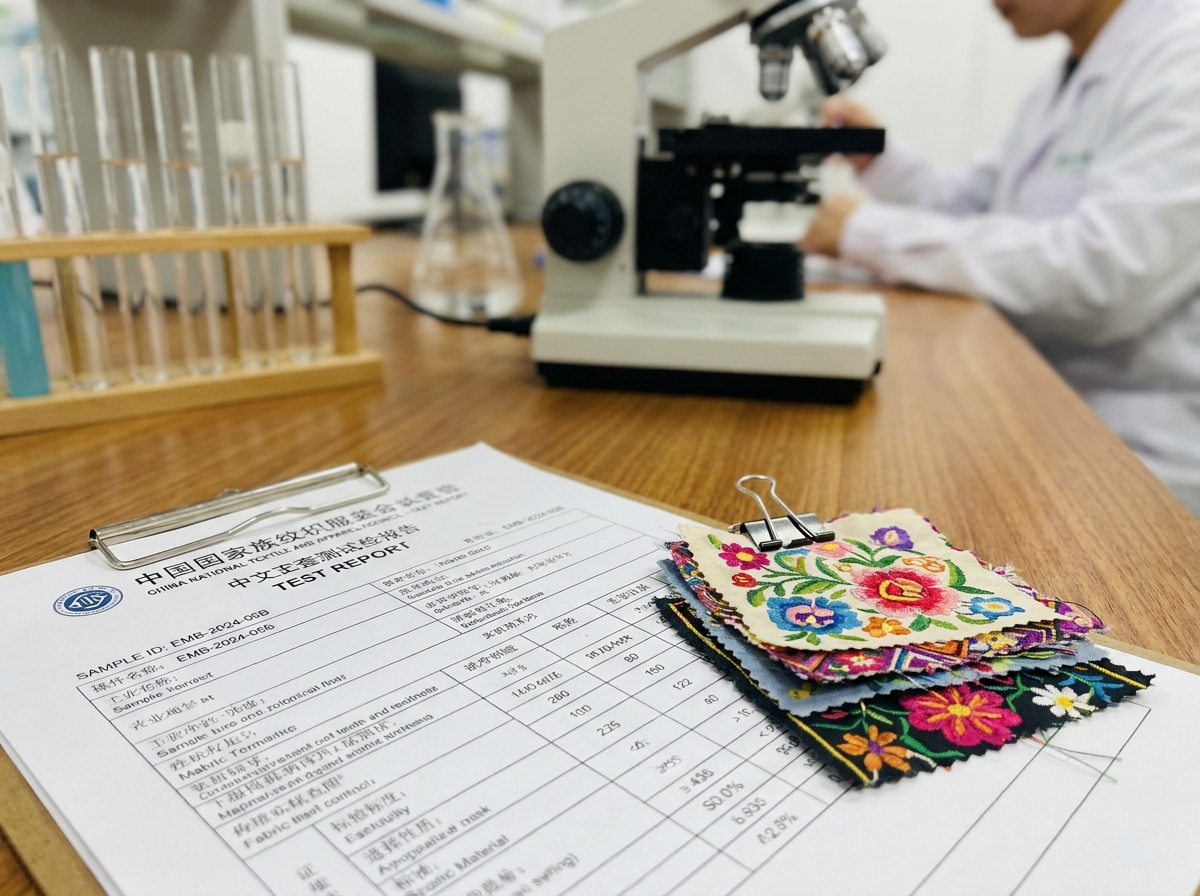
The 5 Quality Tests That Actually Matter for Embroidery Fabric
When a supplier tells you "our fabric passes quality testing," what does that actually mean? I review test reports every week, and I can tell you: most buyers don't know how to read them. They see a stamp that says "PASS" and move on. That's a mistake.
There are five tests that determine whether your embroidery fabric will hold up in the real world — on the shelf, in the wash, and in your customer's hands. If you're placing orders of 10,000 yards or more, these are the numbers you should be asking for.
Color Fastness — Will the Colors Hold?
Color fastness measures how well the embroidery thread and base fabric resist fading or bleeding when exposed to washing, rubbing, light, and perspiration. It's rated on a scale of 1 to 5, where 1 means severe fading and 5 means no visible change.
For most export markets, you want a minimum grade of 3. For the EU and US markets, grade 4 or above is what serious brands expect. At Fominte, our embroidery fabric tests at grade 4. We source thread from suppliers who meet these standards and test every production batch, not just the first one.
Here's what most buyers don't realize: the embroidery thread and the base fabric can test differently. A base fabric might pass at grade 4, but the embroidery thread could test at grade 3 if it's a cheaper polyester or if the dyeing process wasn't controlled. When you get a test report, check that both the thread and the fabric are tested separately, or that the test specifically covers the embroidered area.
The relevant standards here are ISO 105-B02 (light fastness), ISO 105-C06 (washing fastness), and ISO 105-X12 (rubbing fastness). If your test report doesn't reference these specific standards, the results aren't comparable to anything meaningful.
Shrinkage — Will the Fabric Change Size After Washing?
Shrinkage testing measures how much the fabric contracts after washing. For embroidery fabric, this matters more than for plain fabric because the stitching creates localized tension. Areas with dense embroidery may shrink differently than surrounding areas, which can cause puckering or distortion.
The standard test method is AATCC 135 (US) or ISO 6330 (international). Results are reported as a percentage — for example, "2.1% warp, 1.8% weft" means the fabric shrank 2.1% in the length direction and 1.8% in the width direction.
For most applications, shrinkage under 3% is acceptable. For precision garments — anything with pattern matching, stripe alignment, or where fit is critical — you want under 2%. Our fabric consistently tests under 3%, and we control this through fabric selection, pre-shrinking treatments, and stabilizer choices during production.
One thing to watch for: some suppliers test shrinkage on the base fabric alone, before embroidery. That's not the number you care about. The embroidery process changes the fabric's behavior. Make sure your test report covers the finished embroidered fabric, not just the raw material.
Tensile Strength — Will the Embroidery Hold Under Stress?
Tensile strength testing measures how much force the fabric can withstand before tearing. For embroidered fabric, this is about more than just the base material — the embroidery stitching creates perforations in the fabric that can become stress points.
The standard methods are ASTM D5034 (grab test) and ISO 13934 (strip test). Results are reported in pounds or newtons of force.
This test matters most for applications where the fabric will be under regular stress: activewear, swimwear, workwear, upholstery, and children's clothing. A garment that passes tensile testing on the base fabric might still fail at the embroidery edges if the stitch density is too high or the pattern creates weak points.
At our factory, we account for this during the design phase. Our team reviews patterns for potential stress concentration before production starts. It's one of the reasons we send back about 15% of digitizing files for revision — not because the design won't look good, but because the stitch pattern could create structural problems.
Pilling Resistance — Will the Surface Stay Clean?
Pilling is those small balls of fiber that form on fabric surfaces after friction. It's measured using the Martindale test (ISO 12945-2), where fabric is rubbed against a standard surface and rated on a scale of 1 to 5. Grade 3-4 is standard for most apparel; grade 4-5 is expected for premium products.
Embroidery can actually make pilling worse in the surrounding fabric. The embroidery edges create friction points where fibers get abraded during wear and washing. Dense embroidery patterns on knit fabrics are particularly prone to this.
The solution isn't to avoid embroidery — it's to choose the right base fabric and thread quality. Higher-quality thread sheds fewer fibers. Tightly woven base fabrics resist pilling better than loose knits. And proper stabilizer use during production prevents the fabric from shifting and creating additional friction points.
Formaldehyde and Restricted Substances — Is It Safe?
This is the test that determines whether your product can legally enter certain markets. Formaldehyde is used in some fabric finishing processes, and excessive levels can cause skin irritation. Other restricted substances include heavy metals (lead, cadmium), azo dyes, and certain phthalates.
The key standard here is OEKO-TEX Standard 100, which sets limits based on product class:
- Class I (baby products): 16 mg/kg formaldehyde limit
- Class II (direct skin contact): 75 mg/kg
- Class III (no direct skin contact): 300 mg/kg
For EU market access, you also need to comply with REACH regulation, which has its own list of restricted substances. The US market has fewer formal restrictions, but major US retailers increasingly require OEKO-TEX or equivalent certification as a condition of doing business.
We hold OEKO-TEX Standard 100 certification, and every production batch is tested to ensure compliance. This isn't just about passing a test once — it's about maintaining that standard across every meter of fabric we produce. Some suppliers get certified with their best materials and then use cheaper alternatives in production. That's why batch-level testing matters.
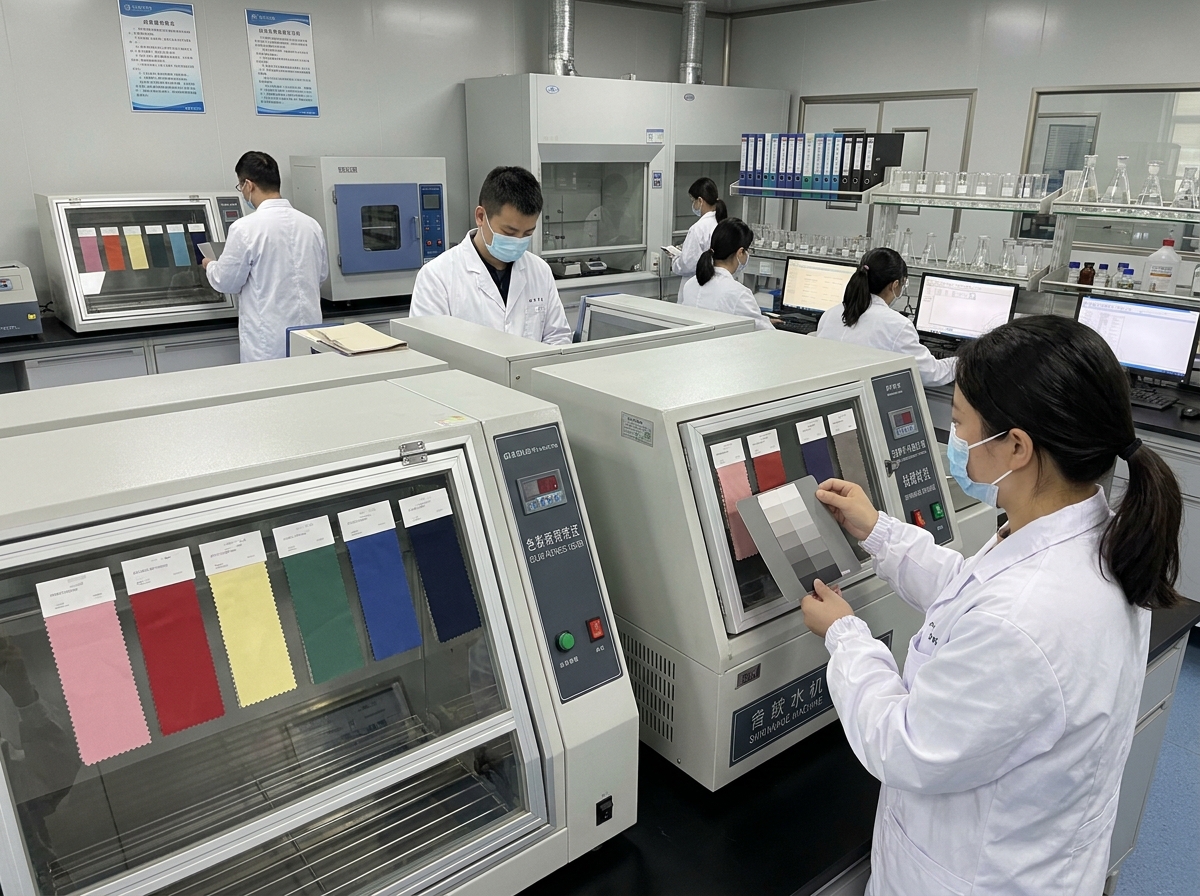
What Certifications Actually Guarantee (and What They Don't)
I hear this a lot: "We need a supplier with OEKO-TEX." That's a good starting point. But understanding what these certifications actually test — and what they don't — will help you make better sourcing decisions.
OEKO-TEX Standard 100 — What It Tests
OEKO-TEX Standard 100 is probably the most recognized textile safety certification globally. It tests for harmful substances in the finished product: formaldehyde, heavy metals, pesticides, chlorinated phenols, phthalates, organotin compounds, azo dyes, and allergenic dyes.
What it tells you: the product is safe for human contact at the certified product class level.
What it does NOT tell you: whether the fabric will hold its color after 50 washes, whether the embroidery will survive industrial laundering, or whether the production quality is consistent from batch to batch. It's a safety certification, not a quality or durability certification.
A product can be OEKO-TEX certified and still have poor color fastness, high shrinkage, or inconsistent quality. The certification checks for chemical safety, not physical performance.
GOTS — Organic Textile Certification
The Global Organic Textile Standard goes further than OEKO-TEX. It requires that at least 70% of the fibers come from certified organic agriculture, and it covers the entire production chain — from harvesting to manufacturing to labeling.
GOTS also includes social criteria: fair labor practices, no child labor, safe working conditions. For brands with sustainability commitments or customers who care about supply chain ethics, GOTS is becoming a baseline requirement.
The limitation: GOTS-certified embroidery fabric is more expensive and has a smaller supplier pool. Not every factory can meet the organic fiber requirements, and the certification process is more rigorous. For most mainstream embroidery applications, OEKO-TEX is sufficient. GOTS is for brands that specifically need organic credentials.
ISO 9001 — Quality Management System
ISO 9001 certifies that a factory has a documented quality management system — processes for handling complaints, corrective actions, internal audits, and continuous improvement. It certifies the system, not the individual product.
What it means in practice: ISO-certified factories tend to have lower defect rates because they have structured processes for catching and fixing problems. But it's not a guarantee. A factory can have ISO 9001 certification and still produce inconsistent quality if the system isn't actually followed on the production floor.
When evaluating a supplier, ISO 9001 is a positive signal, but don't stop there. Ask for specific quality data: defect rates, inspection procedures, batch testing protocols.
Other Relevant Standards
Higg Index measures a factory's environmental and social performance. It's a self-assessment tool that's increasingly required by major brands like H&M, Nike, and PVH. We hold Higg Index certification.
Amfori BSCI (Business Social Compliance Initiative) focuses on social compliance — labor rights, working conditions, fair wages. It's particularly important for buyers selling into the European market. We're Amfori certified.
For a more comprehensive overview of testing parameters and what they mean for your orders, see our guide to Fominte's quality inspection system, which covers our 6-checkpoint QC process from raw material to packing.
How Testing Varies by Embroidery Type
Different embroidery types have different quality risks. The type you're ordering determines which tests matter most.
Water-Soluble Embroidery
Water-soluble embroidery uses a dissolvable stabilizer as the base. After stitching, the stabilizer is washed away, leaving only the embroidery thread. Two things to watch:
Stabilizer removal completeness. If the stabilizer doesn't fully dissolve, it leaves a residue that affects the fabric's feel, drape, and safety. For baby products or direct-skin-contact applications, chemical residue testing is critical.
Thread integrity after washing. The dissolution process involves water and sometimes heat. The embroidery thread needs to maintain its color, strength, and shape through this process. Color fastness testing matters more here because the thread goes through additional wet processing.
For more on water-soluble embroidery specifications and what we can produce, see our water-soluble embroidery capability guide.
Sequin and Bead Embroidery
Sequin and bead embroidery has different testing priorities:
Attachment strength. Sequins, beads, and tubes need to stay attached through wear, washing, and handling. Pull testing measures the force required to detach individual embellishments. For children's products, this is a safety requirement — loose small parts are a choking hazard.
Sharp edge safety. Some sequins and beads have edges that could scratch or irritate skin. For baby and children's products, additional safety testing is required.
Weight consistency. Bead and tube embroidery adds weight to the fabric. If the weight varies significantly across a production run, it can cause problems in garment construction and fit.
For details on our sequin and bead embroidery capabilities, see our sequin, bead, and tube embroidery guide.
Mesh and Crochet Embroidery
Mesh and crochet embroidery are the most common types for wholesale production. What to look for:
Dimensional stability. Mesh fabrics are inherently less stable than woven fabrics. The embroidery stitching can cause the mesh to pucker or distort if the tension isn't properly controlled. Shrinkage testing on mesh embroidery should account for this.
Edge integrity. Cut edges of mesh embroidery can fray or curl. Testing should include edge durability through washing and wear cycles.
For a detailed comparison of mesh, crochet, and chemical lace — including cost, MOQ, and quality trade-offs — see our wholesale guide to choosing the right lace type.
How to Read a Test Report — A Buyer's Checklist
You've asked your supplier for test reports. They've sent you a PDF. Now what? Here's what to look for.
The 6 Things to Check First
1. Which test standard is referenced? A test result without a standard reference is meaningless. "Color fastness: 4" tells you nothing unless you know whether it was tested to ISO 105-C06 (washing), ISO 105-X12 (rubbing), or something else entirely. Different standards test different things.
2. Is the testing lab accredited? Look for CNAS (China National Accreditation Service), A2LA (American Association for Laboratory Accreditation), or equivalent. A test report from a non-accredited lab may not be accepted by your customers or regulatory bodies.
3. Does the sample description match your order? Check that the test report describes the same fabric type, embroidery technique, and color as what you're ordering. Some suppliers test their best product and ship something different.
4. When was the test conducted? Test reports older than 12 months may not reflect current production. Raw materials, suppliers, and processes change. If your report is more than a year old, request a fresh test.
5. Do the results meet your market requirements? EU markets have stricter requirements than some other regions. If you're selling into the EU, your fabric needs to meet REACH and OEKO-TEX Class II at minimum. US market requirements vary by retailer — major chains like Walmart and Target have their own compliance programs.
6. What are the actual values, not just pass/fail? A report that says "PASS" without showing the actual test value is less useful than one that shows "Color fastness: Grade 4 (standard: Grade 3 minimum)." The actual value tells you how much margin you have above the minimum.
Red Flags in Test Reports
Watch out for these warning signs:
- No testing standard referenced. The results can't be compared to anything.
- Results without units or grade scale. "Good" or "Excellent" is not a test result.
- Report from a non-accredited lab. May not be accepted by regulators or customers.
- Only "PASS" without actual values. You can't assess margin or consistency.
- Sample description doesn't match your order. The test may not apply to what you're buying.
- Report date is more than 12 months old. Production conditions may have changed.
FAQ
What certifications do I need to import embroidered fabric into the EU?
For the EU market, OEKO-TEX Standard 100 (Class II for direct skin contact products) is the baseline. REACH compliance is mandatory — it restricts over 1,000 substances in textile products. Major EU retailers may also require GOTS certification for organic claims, or Amfori BSCI for social compliance. If you're selling children's products, additional safety testing is required under the EU Toy Safety Directive.
What is the difference between OEKO-TEX and GOTS certification?
OEKO-TEX Standard 100 tests for harmful substances in the finished product. It's a safety certification that applies to any textile, regardless of fiber source. GOTS (Global Organic Textile Standard) is broader — it requires organic fiber content (70% minimum), covers environmental and social criteria across the entire supply chain, and includes chemical testing similar to OEKO-TEX. Think of OEKO-TEX as "safe to use" and GOTS as "sustainably and ethically produced."
How often should embroidery fabric be tested?
For initial orders, full testing against all relevant standards is essential. For repeat orders, batch-level testing for key parameters (color fastness, shrinkage, formaldehyde) should be done with every production run. Full re-testing (including tensile strength, pilling, and restricted substances) is recommended annually or when there's a change in raw materials, suppliers, or production processes.
What is a safe color fastness grade for export orders?
Grade 4 (on the 1-5 scale) is the standard for EU and US export markets. Grade 3 is acceptable for some applications but may not meet the requirements of major retailers in developed markets. For products that will be frequently washed — children's clothing, bedding, activewear — grade 4-5 is recommended. At Fominte, we consistently achieve grade 4 across our embroidery fabric range.
How Fominte Builds Quality Into Every Meter
Quality testing isn't something we do after production. It's built into every stage of how we work.
Our 6-point inspection system runs from raw material intake through final packing. Every roll of incoming fabric is checked for width consistency, weaving defects, color variation, and weight. About 15% of digitizing files are sent back for revision before production starts. First-article approval requires 3-5 samples signed off by the client.
During production, we monitor thread breakage rates, tension calibration, and pattern alignment. Before shipping, every meter goes through needle detection and D65+TL84 dual-light color verification.
The numbers: defect rate under 2%, shrinkage under 3%, color fastness grade 4. Across our monthly production of 300,000 meters, these are consistent results, not targets we sometimes hit.
We hold OEKO-TEX Standard 100, Higg Index, and Amfori certifications. But more importantly, we test every production batch, not just the samples we sent for initial certification. You can see our full range of embroidery capabilities in our product range overview.
If you're evaluating suppliers and want to see our test reports, send your requirements to info@fominte.com. We'll share our latest certifications and discuss what testing parameters matter for your specific market.
Step-by-Step Guide
Check the test standard referenced
Verify lab accreditation
Match sample to your order
Request batch-level testing
When to Use & Avoid
EU market export
✅ Use When
- OEKO-TEX Class II + REACH compliance + batch-level testing required
⚠️ Avoid When
- Markets with no formal compliance requirements
Children's products
✅ Use When
- OEKO-TEX Class I (strictest limits) + attachment strength testing for embellishments + small parts safety
⚠️ Avoid When
- Adult products without embellishments
Premium retail brands
✅ Use When
- GOTS for organic claims + OEKO-TEX for safety + color fastness grade 4-5 + pilling grade 4-5
⚠️ Avoid When
- Budget bulk orders where certification is not required
Water-soluble embroidery
✅ Use When
- Chemical residue testing + color fastness after dissolution + thread integrity testing
⚠️ Avoid When
- Standard mesh embroidery without dissolution step
Comparison
| Certification | What It Tests | What It Does NOT Test | Best For |
| OEKO-TEX Standard 100 | Harmful substances (formaldehyde, heavy metals, azo dyes, pH) | Durability, color fastness, shrinkage, stitching quality | All export markets, baseline safety |
| GOTS | Organic fiber content + chemical safety + environmental + social criteria | Specific durability test parameters | Brands with organic/sustainability commitments |
| ISO 9001 | Quality management system and process consistency | Individual product quality or safety | Evaluating factory reliability |
| Higg Index | Environmental and social performance (self-assessment) | Product-level testing | Sustainability reporting to major brands |
| Amfori BSCI | Social compliance (labor rights, working conditions) | Product safety or quality | EU market social compliance |
⚡ Common Mistakes to Avoid
Everything You Need to Know
Conclusion