.png?w=970&h=250)
How Is Embroidery Fabric Made? Step-by-Step Factory Process
What It Really Means
Embroidery fabric production follows a six-stage process: pattern digitizing, material preparation, machine setup, production run, quality inspection, and finishing. For a standard order of 5,000 yards, the entire cycle takes 20-30 days from order confirmation to shipment. Here's exactly what happens at each stage, based on how we run production on our Tajima multi-head machines.
I've been operating Tajima embroidery machines for over 30 years. In that time, I've watched countless buyers place orders without understanding what happens inside the factory between "confirmed" and "shipped." That gap in visibility leads to unrealistic timeline expectations, poor planning, and frustration on both sides. So I'm going to walk you through the real process, step by step, with actual timeframes from our production floor.
What Happens After You Place an Embroidery Order
When your order comes in, it doesn't go straight to the machine. There's a structured pipeline that every order passes through, and skipping or rushing any stage creates problems downstream.
Here's the complete timeline for a standard 5,000-yard order:
| Stage | Duration | Key Activity |
|---|---|---|
| 1. Pattern Digitizing | Days 1-3 | Convert design to machine-readable stitch program |
| 2. Material Preparation | Days 3-7 | Source fabric, thread, backing; run pre-treatment |
| 3. Machine Setup | Days 7-9 | Calibrate Tajima heads, tension, needle selection |
| 4. Production Run | Days 9-19 | Actual embroidery across multi-head machines |
| 5. Quality Inspection | Days 19-21 | Check every batch for defects, run needle detection |
| 6. Finishing & Packaging | Days 21-25 | Wash, press, cut, fold, pack, and label |
Total: 20-25 working days for standard orders. Custom colors or complex designs can push this to 30 days. Peak season (January-February, May-June, September-October) adds another 7-10 days due to raw material lead times and production queue congestion.
Understanding this timeline helps you plan backwards from your delivery date and know exactly where your order is at any point.
Stage 1: Pattern Digitizing (Days 1-3)
This is where your design file becomes a machine-readable stitch program. It's the most underestimated stage in the entire process, and it's where I've seen the most expensive mistakes happen.
What the digitizer actually does
Your design arrives as an AI, PSD, or PDF file. A digitizer (we call them "制版师" in Chinese) translates that visual design into a set of instructions that tells the embroidery machine:
- Stitch sequence: Which areas to embroider first, second, third
- Stitch type: Satin stitch for outlines, fill stitch for large areas, running stitch for details
- Stitch density: How many stitches per square inch (typically 4-7 for standard work)
- Color changes: When to switch thread colors
- Underlay stitches: Hidden foundation stitches that stabilize the design
A typical fashion embroidery design has 15,000-30,000 stitches. A complex sequin design can exceed 80,000 stitches.
Why stitch count matters for your timeline
Production time = total stitches ÷ machine speed (stitches per minute).
Our Tajima machines run at 800-1,000 stitches per minute for standard work. For a 25,000-stitch design on a 12-head machine, that's about 25 minutes per head. But that's just the raw stitching time. Add thread trimming (about 120 stitches per trim), color changes, and machine stops for quality checks, and the real time is 30-40% longer.
What can go wrong here
Bad digitizing is the number one cause of production defects. Wrong stitch sequence → puckering. Too much density → the design feels stiff and cardboard-like. Missing underlay → stitches pull through on lightweight fabrics.
I always tell clients: "The digitizing file is the blueprint. If the blueprint is wrong, no amount of skilled machine operation can fix it." We reject about 15% of incoming digitizing files and send them back for revision before production.
Stage 2: Fabric & Thread Preparation (Days 3-7)
While the digitizer is working, the production team is preparing materials. This stage runs in parallel with Stage 1 to save time.
Fabric sourcing and inspection
For standard orders using our stock fabrics (cotton, cotton-poly blends, mesh), we pull from inventory and inspect each roll. For custom fabrics, we order from our verified textile suppliers, which adds 3-5 days.
Every roll gets checked for:
- Width consistency: Must be within ±1cm across the full roll
- Weave defects: We reject rolls with more than 2 visible defects per 50 yards
- Color matching: Compared against the approved swatch under standardized D65 lighting
- Weight (GSM): Must match the specified tolerance (±5%)
Pre-shrinking treatment
All base fabrics go through pre-shrinking before embroidery. This is non-negotiable in our factory. The fabric runs through a controlled wash cycle and is dried under tension to lock in dimensions.
Why this matters: embroidery stitches themselves take up space on the fabric. If the base fabric shrinks after stitching, the stitches pucker and the entire pattern distorts. Pre-shrinking adds 1-2 days to production, but it prevents the most common quality complaint we hear from buyers who sourced elsewhere.
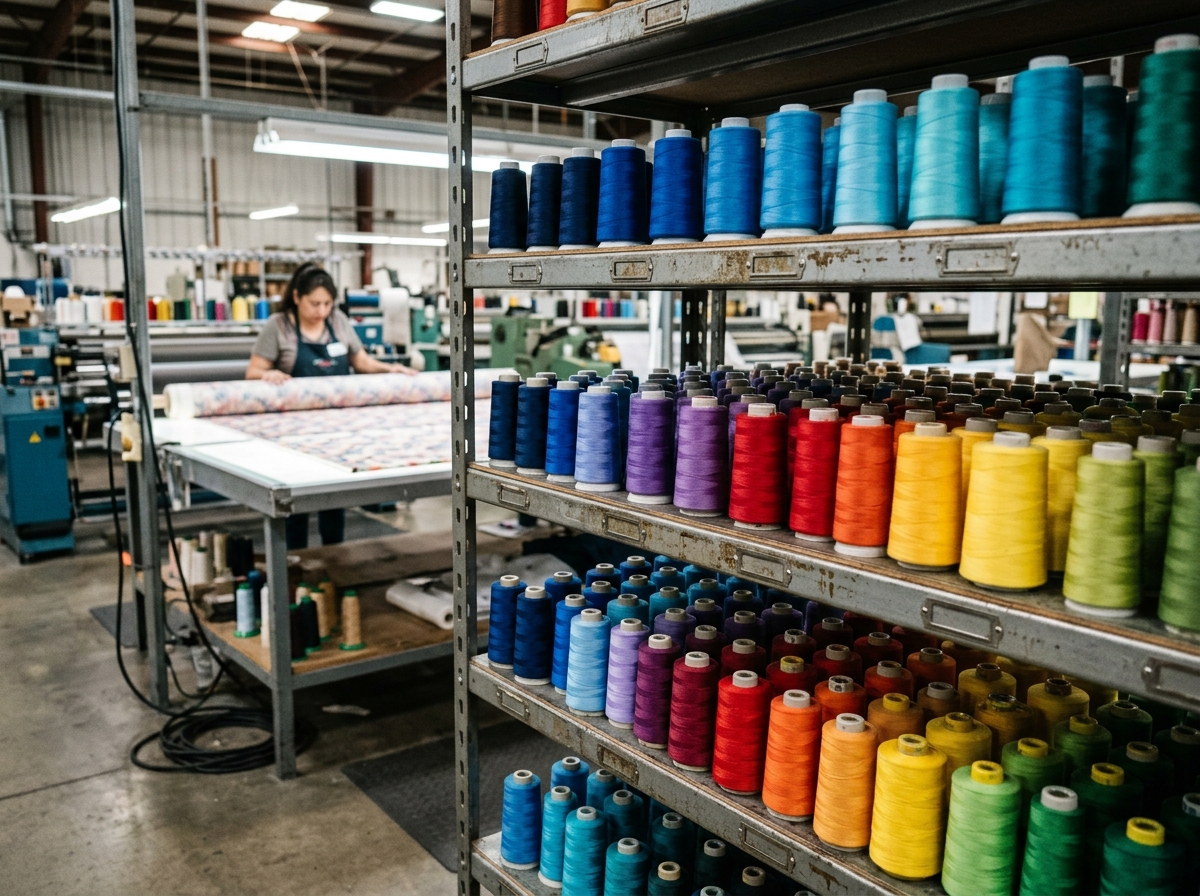
Thread and backing material
We stock over 200 standard thread colors from Madeira and our own verified suppliers. For custom colors, we dye-match against Pantone codes, which adds 2-3 days.
Backing material (stabilizer) is selected based on the fabric type and design complexity:
- Cutaway backing: For knit fabrics and designs with high stitch density
- Tear-away backing: For woven fabrics and lighter designs
- Water-soluble backing: For lace and open-work embroidery
Stage 3: Machine Setup & Test Runs (Days 7-9)
This is where the technical preparation meets the physical equipment. Every order gets a dedicated setup session before production begins.
Needle selection
We use three standard needle sizes depending on fabric weight:
- DB-7 (size 11): For lightweight fabrics like chiffon, georgette, and fine cotton
- DB-9 (size 14): For medium-weight fabrics like standard cotton, polyester blends
- DB-11 (size 16): For heavy fabrics like canvas, denim, and thick knits
Wrong needle selection causes problems. Too fine on heavy fabric → needle breaks. Too heavy on fine fabric → visible holes and fabric damage.
Tension calibration
Thread tension is the machine setting that matters most. Too tight, and the thread breaks constantly. Too loose, and loops appear on the fabric surface. Each thread color can behave slightly differently depending on the dye, so we calibrate tension for each color individually.
On our Tajima machines, we test tension using a standardized test pattern: a 2-inch satin stitch square. The bobbin thread should be visible about 1/3 on the back. If it's pulling through to the front, tension is too loose. If the top thread isn't showing on the back at all, tension is too tight.
Test run and first-piece approval
Before running the full order, we produce 3-5 test pieces on the actual production fabric. These are inspected for:
- Stitch registration (alignment between colors)
- Puckering or distortion
- Color accuracy against the approved sample
- Backing adhesion
The test pieces are photographed and sent to the client for approval. This step takes 1-2 days but prevents costly rework later.
Stage 4: Production Run (Days 9-19)
This is the core of the process, where the actual embroidery happens across our multi-head Tajima machines.
How multi-head production works
Our factory runs Tajima machines with 12-15 heads per machine. Each head embroiders the same design simultaneously on a separate section of fabric. So a 12-head machine produces 12 identical pieces per cycle.
For a 5,000-yard order with a design that takes 30 minutes per piece, the math works out like this:
- 12 heads × 2 pieces per hour = 24 pieces per hour
- 5,000 yards ÷ (average 0.5 yards per piece) = 10,000 pieces
- 10,000 pieces ÷ 24 per hour = ~417 machine hours
- Running 2 machines × 16 hours per day = 32 machine hours per day
- 417 ÷ 32 = ~13 production days
This is why we allocate 10 days for the production run stage on a standard order.
What operators monitor during production
The machine does the stitching, but the operator's role is critical. During a production run, operators watch for:
- Thread breaks: The machine auto-stops, but the operator must re-thread and restart. Average thread break rate on well-calibrated machines is 1-3 per 10,000 stitches.
- Fabric shifting: If the hooping isn't tight enough, fabric moves during stitching, causing misalignment.
- Color registration: Checking that multi-color designs line up correctly.
- Bobbin thread supply: Bobbins need replacing every 15-20 minutes depending on design density.
A skilled operator manages 2-3 machines simultaneously. Less experienced operators handle one machine at a time.
Common production issues and fixes
Issue: Excessive thread breaks Cause: Poor thread quality, incorrect tension, or damaged needle Fix: Replace thread cone, recalibrate tension, change needle
Issue: Design shifting on fabric Cause: Loose hooping, unstable fabric, or missing backing Fix: Re-hoop with tighter tension, add backing, or switch to cutaway stabilizer
Issue: Inconsistent stitch density across batch Cause: Machine timing drift, worn needle plates Fix: Machine recalibration, replace needle plates
Stage 5: Quality Inspection (Days 19-21)
Every piece of embroidered fabric goes through quality inspection before it moves to finishing. This is the stage where we catch defects that would otherwise reach your customers.
What we check
Our QC team inspects every batch against these criteria:
- Stitch quality: No loose threads, no skipped stitches, no bird-nesting on the back
- Color accuracy: Compared against the approved sample under D65 standardized lighting
- Pattern alignment: Multi-color designs must register within 0.5mm
- Puckering: Fabric should lay flat without visible distortion around the embroidery
- Back appearance: Bobbin thread coverage should be clean and consistent
Needle detection
After visual inspection, every piece runs through a needle detection machine. This is standard practice in our factory, especially for orders going to markets with strict safety regulations (EU, US children's wear). The machine detects broken needle fragments that may have embedded in the fabric during production.
Any piece that triggers the needle detector is quarantined and inspected manually. If a needle fragment is found, we trace back to the specific machine and operator to prevent recurrence.
Defect rates and tolerances
Our standard defect rate target is under 2% for mesh embroidery, under 3% for chemical lace, and under 2.5% for crochet lace. These numbers are based on over 2 million yards of production data.
When we find defects, we don't just discard them. We categorize them:
- Repairable: Loose threads, minor misalignment → fixed by hand
- Replacement needed: Major defects → re-embroidered on fresh fabric
- Scrapped: Unfixable → discarded and counted against our defect rate
Stage 6: Finishing & Packaging (Days 21-25)
The final stage transforms raw embroidered fabric into shipment-ready product.
Washing and pressing
Depending on the fabric type, embroidered fabric may go through a final wash to remove marking lines, backing residue, or processing chemicals. Chemical lace specifically requires a water wash to dissolve the PVA base film, leaving only the embroidered pattern.
After washing, fabric is pressed flat using industrial steam presses. Temperature and pressure settings vary by fabric type:
- Cotton: 150-170°C, medium pressure
- Polyester blends: 130-150°C, low pressure
- Silk/chiffon: 110-130°C, minimal pressure
Cutting and inspection
Fabric is cut to the ordered width and length. Each cut piece is visually inspected one final time for any defects that may have been missed or introduced during washing.
Packaging
Standard packaging includes:
- Rolls wrapped in polyethylene film
- Inner cardboard tube for stability
- Moisture-absorbing packet for sea shipments
- Label with order number, color code, yardage, and lot number
For air shipments, we use vacuum-sealed packaging to reduce volume.
What Can Go Wrong (And How We Prevent It)
After 30 years of running embroidery machines, I've seen almost everything that can go wrong. Here are the most common issues and how we prevent them:
Problem: Thread color doesn't match the sample
Thread dye lots vary between production runs. A "red" from one dye lot can look noticeably different from another, especially under certain lighting.
How we handle it: We source thread from the same dye lot for the entire order. For repeat orders, we keep the dye lot number on record and request the same lot from the supplier. We also check colors under both D65 daylight and TL84 store lighting before approving.
Problem: Fabric puckers around the embroidery
Puckering is the most common complaint from buyers. The embroidery stitches compress the fabric, causing it to gather around the design.
We prevent this with proper digitizing (appropriate underlay stitches, correct stitch density) and pre-shrunk fabric. Hooping tension matters too: firm enough to hold the fabric stable, but not so tight that it stretches before the stitches go in.
Problem: Production runs behind schedule
Raw material delays, machine breakdowns, and quality issues requiring rework. These are the three usual suspects.
We maintain 2-week safety stock on our top 20 fabric types. Machines go through preventive maintenance every 500 operating hours. And we build 2 buffer days into every production schedule for unexpected rework.
Problem: Stitch count doesn't match the quoted estimate
This happens when the digitizer's estimate differs from what the machine actually produces, usually because density gets adjusted during test runs.
We quote based on the higher end of the estimated range. Actual count comes in lower → you pay less. Comes in higher → we absorb the difference on the first order.
Frequently Asked Questions
How long does standard embroidery production take?
For a standard order of 5,000 yards using stock fabrics and colors, plan for 20-25 working days from order confirmation to shipment. Custom fabrics, custom colors, or complex multi-color designs can extend this to 30 days. Peak season (January-February, May-June, September-October) adds 7-10 days.
What's the fastest turnaround possible?
For urgent orders using stock materials and existing digitizing files, we can compress the timeline to 12-15 days. This requires skipping the parallel processing of Stages 1-2 (using pre-digitized files and pre-approved fabrics) and running production on overtime. Expedited production carries a 15-20% surcharge.
How should I prepare my design files for production?
Send vector files (AI or EPS) at the actual production size. Include color callouts with Pantone codes. If you have specific stitch direction preferences or density requirements, note them in a separate document. The cleaner your input, the faster the digitizing stage goes.
Can I visit the factory during production?
Yes. We welcome factory visits and video calls during production. Many of our long-term clients schedule a mid-production video call to see their order in progress. This builds trust and lets you ask questions in real time about the process you're now reading about.
What if I need to change the design after production starts?
Changes after digitizing is complete (Stage 1) incur re-digitizing fees. Changes after test pieces are approved (Stage 3) may require starting over with new fabric if the change affects layout or stitch density. The further along in the process, the more costly the change. Lock in your design at the tech pack stage.
The Bottom Line
The embroidery production process isn't mysterious once you understand the six stages. Each stage has a specific purpose, a specific timeframe, and specific quality checkpoints. The buyers who have the best experience with us are the ones who understand this process and plan accordingly.
If you're evaluating a new embroidery supplier or planning your next collection's timeline, knowing these stages helps you ask the right questions and set realistic expectations. The 20-30 day timeline isn't arbitrary. It's the result of 30 years of refining a process that balances speed with quality.
Need a production schedule for your specific order? Send us your tech pack and we'll provide a detailed day-by-day timeline within 24 hours.
Step-by-Step Guide
Pattern Digitizing
Fabric & Thread Preparation
Machine Setup & Test Runs
Production Run
Quality Inspection
Finishing & Packaging
⚡ Common Mistakes to Avoid
Everything You Need to Know
Conclusion