.png?w=970&h=250)
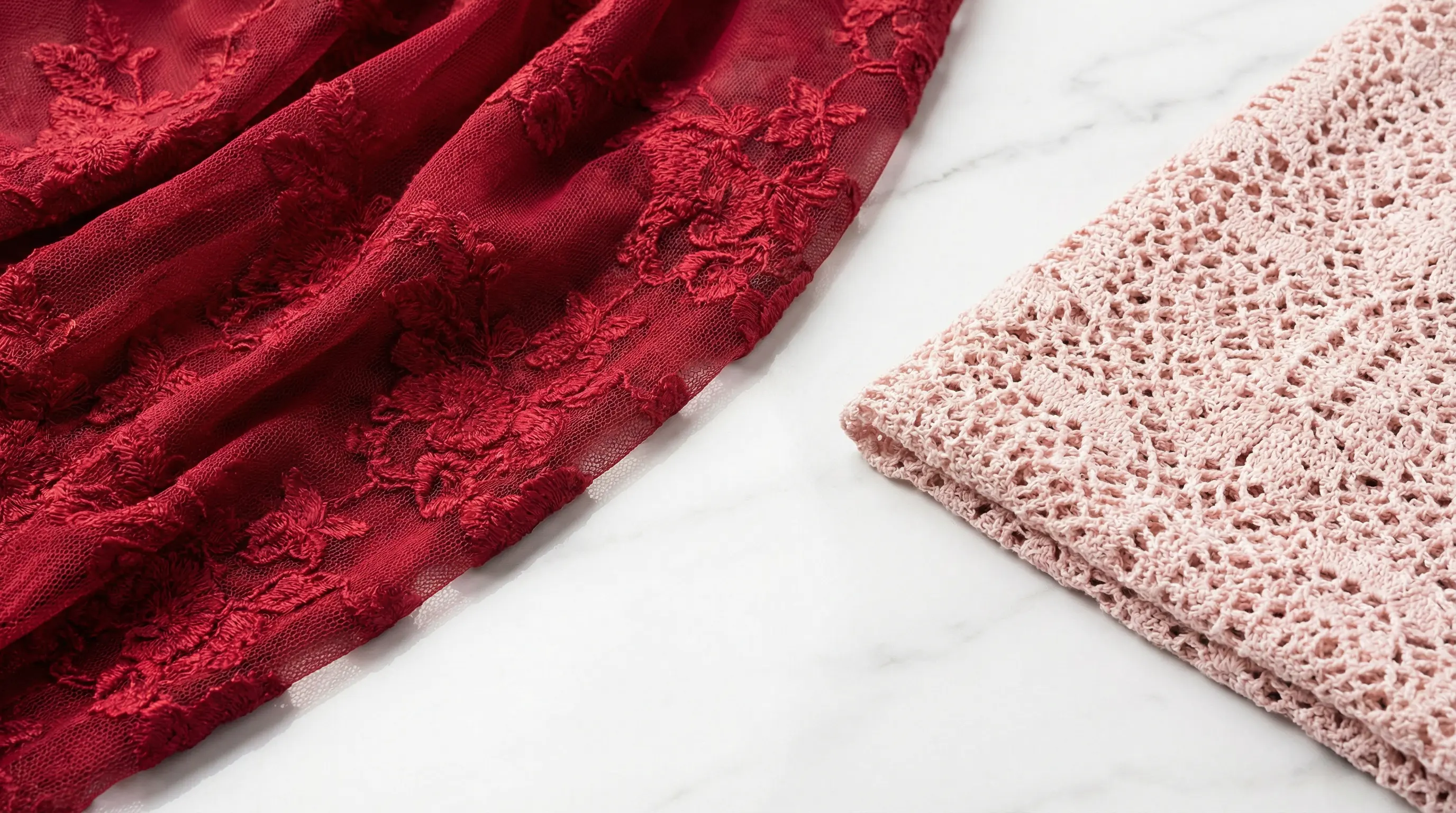
January 15th, last year. I was sitting in my office looking at two inquiry emails that came in within hours of each other. Both asked about red and pink lace fabric for Valentine's Day collections. Both were legitimate retailers. The difference in their situations? Night and day.
The first email came from a boutique owner in Manchester, UK. She'd already locked in her Valentine's fabric order back in early December. Deep crimson mesh embroidery and blush pink crochet lace. She was writing to ask if we could rush a small add-on order because her initial collection had sold out faster than expected. Her tone was calm, almost apologetic for the last-minute request.
The second email came from a retailer in Philadelphia. It started with: "Do you have any red lace in stock? We need it shipped ASAP for Valentine's." The urgency was obvious. This wasn't planning. This was panic.
What happened next? The UK client restocked smoothly and her Valentine's week became her highest-revenue seven days of Q1. The Philadelphia retailer? We did our best to help, but the choices available in mid-January were a fraction of what they would have been two months earlier. Limited colorways. Limited patterns. No leverage on pricing or terms.
I shared both stories with Eric, our head of sales. His response: "This happens every single year. And every year, I wish more buyers understood what the data actually shows."
So let me share that data with you. If you're reading this in January thinking about your Valentine's orders, you're not early. You're actually late.
The Faire Reality: January Is the Peak, Not the Start
According to Faire's 2025 global wholesale search data, Valentine's Day buying behavior looks like this:
- October: 3,614 searches (demand quietly begins)
- November: Still building slowly
- December: 25,567 searches (a 7x
jump in one month)
- January: 48,411 searches (the absolute peak)
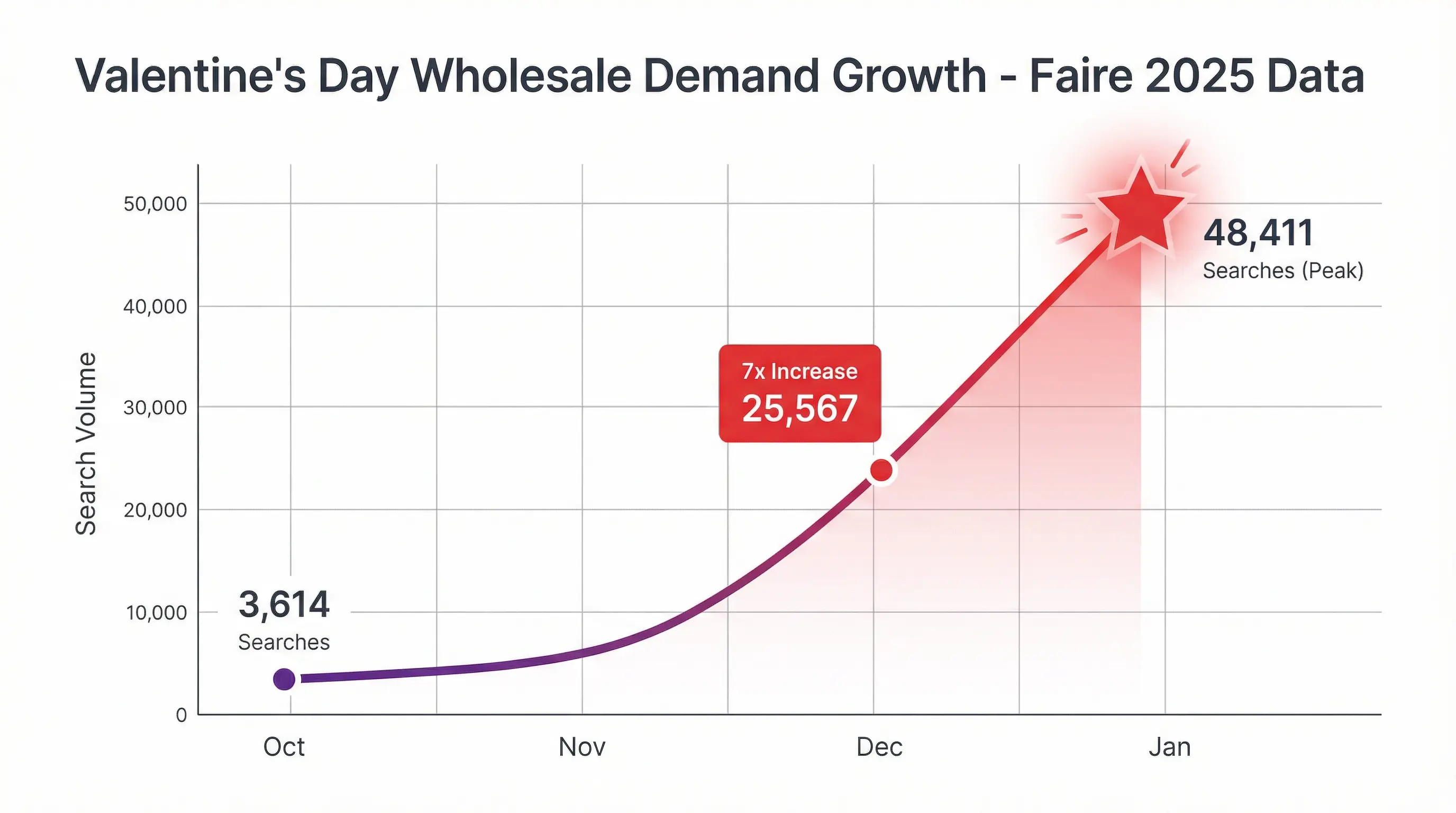
Stop for a second. January isn't when smart retailers start thinking about Valentine's Day. January is when the market is already at maximum competition. By the time January hits, more than 85% of all Valentine's demand is concentrated in a three-month window from December through February.
Peak month doesn't mean "best time to buy." It means "most competitive time to buy."
When search volume peaks, it tells you one thing: everyone else is buying too. Suppliers are stretched. Lead times compress. Selection narrows. And if you're asking for custom colorways or specific pattern variations? You're probably too late.
Eric tells me that buyers often misunderstand what "peak season" means. They think it means "when you should buy." It actually means "when everyone who didn't plan ahead is now scrambling."
The buyers who win Valentine's season? They committed in the acceleration period (November through early January), not at the peak.
What Shawn Taught Me About Wholesale Leverage
Shawn Wang, our founder, spent years as a QC inspector before starting Fominte back in 1990. He's seen every kind of buyer behavior you can imagine. He has a phrase he uses constantly when training our sales team:
"The first to commit gets the first pick."
It sounds almost too simple. But think about what that means.
When a fabric supplier is looking at their production calendar in November, they're making decisions about which colorways to produce, which patterns to prioritize, and how much capacity to allocate to each. If you come in during that window with a clear order, you're not just getting priority. You're literally influencing what gets made.
But if you show up in January asking for "red lace fabric," you're not picking from the full palette anymore. You're picking from what's left after everyone else has already made their selections.
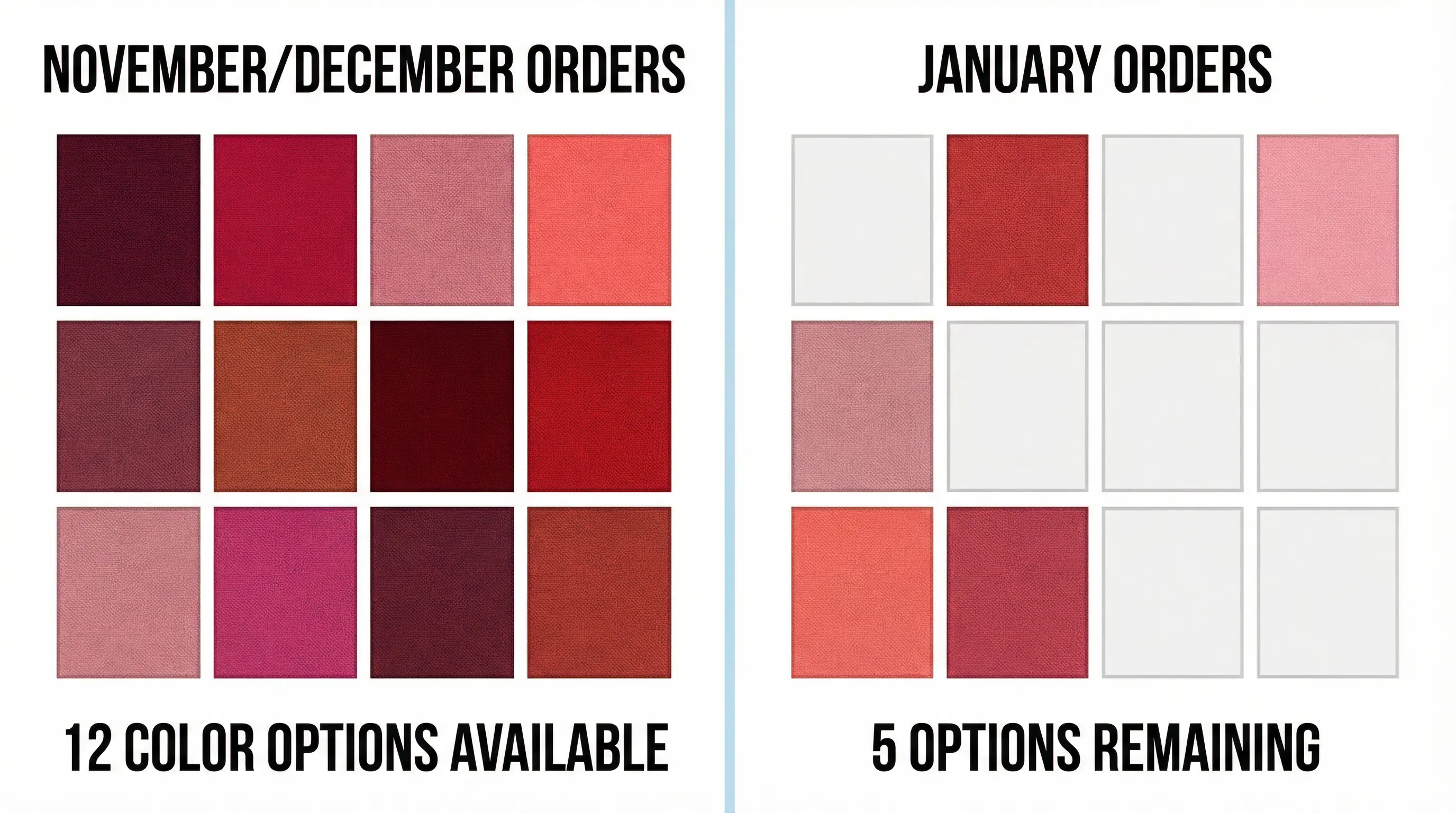
I watched this play out in our sample room last December. A designer from a New York bridal brand came in asking to see our Valentine's collection. We showed her twelve different red and pink variations. From deep burgundy mesh to soft rose crochet. She selected three, locked in her order before Christmas, and left.
Two weeks later, in early January, another buyer asked to see "all your Valentine's options." I pulled out the remaining samples. Five variations instead of twelve. The buyer asked, "Is this everything?" I had to explain: "This is everything that's still available for quick delivery."
That's the difference. November and December buyers choose from abundance. January buyers choose from inventory.
Shawn always says: "Timing in wholesale isn't about being first. It's about being early enough that you still have choices."
The Buyers I See in January
Eric and I have started noticing patterns in the Valentine's inquiries we get in January. They fall into a few categories.
The Strategic Restockers: These are the retailers who ordered their core Valentine's collection back in November or December. They're coming back in January because their early sales projections were conservative and now they're seeing stronger demand than expected. These buyers get the best experience. We know them. We have their previous order details. We can often pull from our ready-to-ship inventory or fast-track a small batch. They usually get their restock within 7–10 days and finish Valentine's season with minimal leftover inventory.
The Calculated Late Movers: These retailers know they're coming in during peak season, but it's a deliberate choice. Maybe they're testing a new product category. Maybe they're a new business launching their first Valentine's line. They're honest about the timeline and realistic about what's possible. We work hard for these buyers. If they're transparent and flexible, we can usually find solutions. They might not get their first-choice colorway, but they'll get something that works. Mixed outcomes. They get product, but often compromise on specifics. They pay a premium for rushed production or air shipping. And they learn a lesson about lead times for next year.
The Crisis Buyers: These are the emails that start with "URGENT" or "ASAP needed." There's often a story. A supplier fell through. A forecast was wildly wrong. Or they simply didn't plan. They want custom specs, low minimums, and immediate shipping. We try to help everyone. But physics exists. Fabric production has timelines. Embroidery machines run at a certain speed. Shipping from China takes time. We can sometimes pull off miracles with our ready-to-ship inventory, but the selection is extremely limited. More often, these buyers end up settling for whatever is immediately available, or they miss their selling window entirely.
A Case Study: Manchester vs. Philadelphia
The Manchester boutique owner (let's call her Sarah) told me later what her December decision process looked like. She'd been tracking her 2025 sales data and noticed that romantic occasion wear was trending 30% higher than the previous year. So in early December, she made a calculated bet: order aggressively for Valentine's.
She didn't just order red. She ordered three shades. Deep crimson mesh embroidery for statement dresses. Classic red crochet lace for blouses. Soft blush pink for layering pieces. She committed to order minimums that made her slightly nervous.
By mid-January, her gamble had paid off. The crimson mesh dresses sold out in the first week. She contacted us for a restock, we had inventory ready, and she received it within eight days. Her Valentine's week revenue was 43% higher than the previous year.
The Philadelphia retailer (I'll call them Store B to protect privacy) had a different story. They'd been conservative with their December inventory, waiting to see "real demand signals" before committing to seasonal product. When those signals came in early January, they scrambled.
We did everything we could. We offered three red lace options from our ready-to-ship inventory. They took what was available, paid for expedited shipping, and got their product by January 28th. But their assortment was limited. They couldn't offer the variety that Sarah's boutique had. Their customers noticed.
Store B still had a decent Valentine's week. But when I followed up afterward, the manager told me: "Next year, we're ordering in November. Lesson learned."
What "January" Really Means for Valentine's Buying
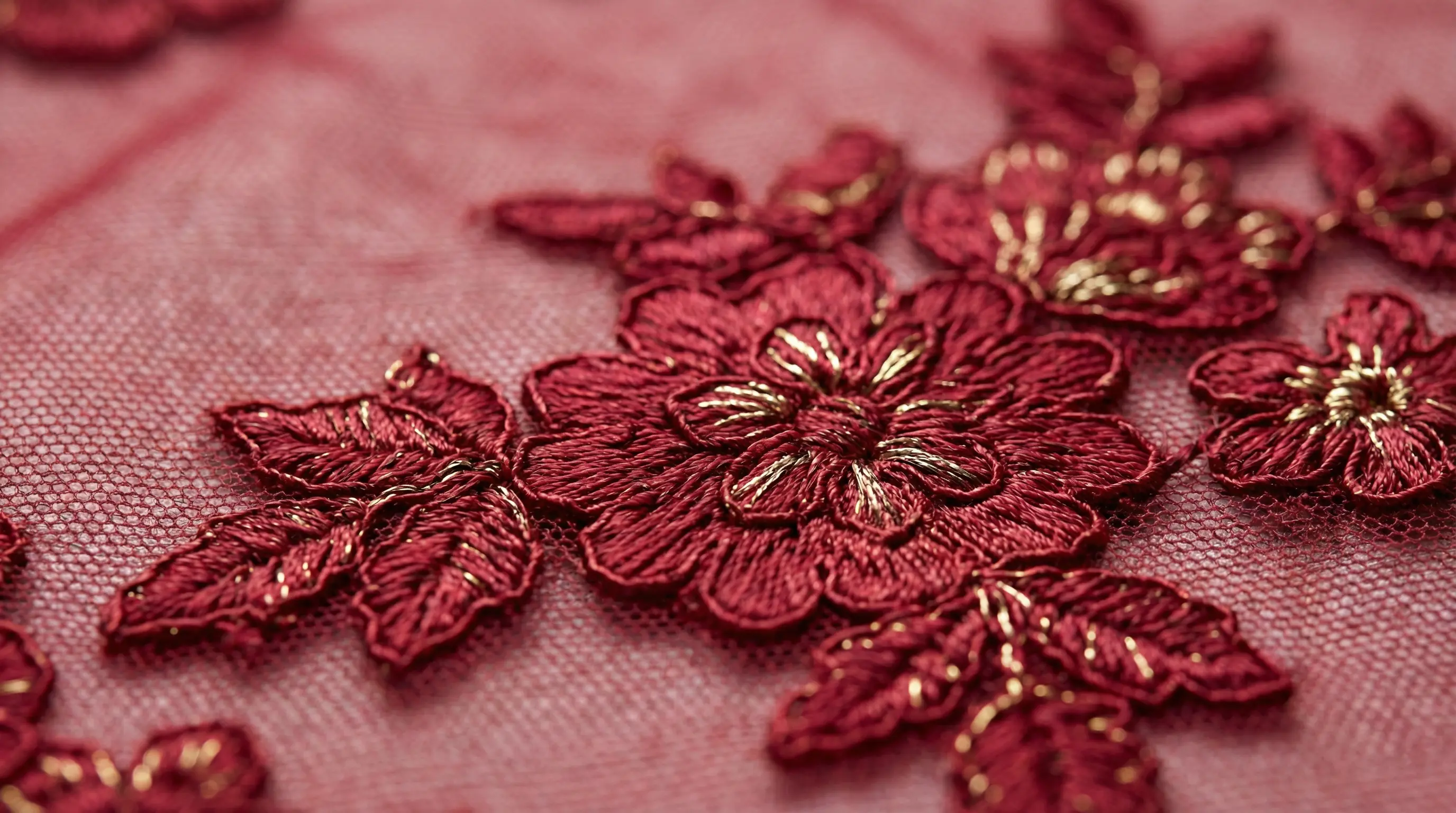
If you're reading this right now, in late January 2026, the reality is this:
You're not in the planning phase. You're in the execution phase.
The retailers who are going to have abundant, differentiated Valentine's collections have already locked in their orders. The fabric being produced right now? It's going to them.
Does that mean it's hopeless if you haven't ordered yet? No. But it means you need to adjust your expectations and your strategy.
What's still possible in late January:
Ready-to-ship inventory: If we (or any supplier) have stock on hand, you can still get it quickly. But selection is limited to what exists, not what could be made.
Small batch rush orders: If you're flexible on specs and willing to pay for expedited production and shipping, some suppliers can accommodate. But "flexible" is the key word.
Planning for next year: This is actually the best use of late January. Start building the supplier relationship now, learn the timelines, and set yourself up to avoid this situation next year.
Wholesale Timing Is Leverage
Watching Eric work with hundreds of wholesale buyers over the years, I've learned this:
In wholesale, timing isn't about being the earliest. It's about being early enough that you still have choices.
That window is different for every product and every season. But for Valentine's Day, the data is clear: the meaningful buying window starts in October, accelerates in November and December, and peaks (meaning becomes most competitive) in January.
The retailers who understand this don't think about Valentine's in January. They think about it in October. And they think about Easter in December. And they think about Christmas in May. (Yes, May. Faire data shows Christmas wholesale demand starting in May, but that's a conversation for another article.)
This isn't about being neurotic or over-planning. It's about understanding how supply chains work and using that knowledge as leverage.
Shawn says something that stuck with me: "The client who orders early isn't just getting their product faster. They're getting better product because they had real choices."
Why We Don't Just Stock Everything
People sometimes ask me why Fominte doesn't just keep massive ready-to-ship inventory of every possible Valentine's fabric variation. The logic seems sound. If January is peak demand, why not have everything ready?
There are reasons that doesn't work:
Fabric is perishable (not literally, but market-wise). What's "on trend" for Valentine's 2026 might look dated by 2027. Holding excessive inventory is a risk.
Customization matters. Our B2B clients don't want the same red lace as everyone else. They want their red. The specific shade that matches their brand aesthetic.
Capital efficiency. If we tie up capital in speculative inventory, we can't invest it in better equipment, faster sampling, or employee training.
What we do have is fast production capability and a ready-to-ship program for core, repeatable items. If you need classic red mesh embroidery and we have it in stock, you can get it in days. But if you want a custom shade of burgundy with a specific pattern density, that requires production time.
Even with our capabilities, we still need your early commitment to deliver what you actually want, not just what happens to be available.
The Valentine's Lesson for Every Other Season
Valentine's Day is just one data point. Faire's wholesale buying calendar shows the same pattern for every major retail season:
- Easter: Starts December, peaks March
- Spring/Summer: Starts January, peaks May
- Fall: Starts May, peaks August
- Halloween: Starts May, peaks September
- Christmas: Starts May, peaks November
Notice the pattern? Wholesale demand starts months before the retail selling moment.
If you wait until you "see demand signals" from your end customers, you're already late in the wholesale cycle. The suppliers who could give you the best selection and terms have already allocated their capacity to buyers who committed earlier.
Sarah, the Manchester boutique owner, understood this instinctively. When I talked to her in February, she mentioned she'd already started thinking about her Easter collection. It was early February. Easter was in April. She was already planning.
That's the shift. Retail is about responding to customer demand. Wholesale is about anticipating retail demand and committing before it's obvious.
What You Can Do
If you're reading this and thinking "I wish I'd read this in November," I hear you.
If you still need Valentine's fabric (late January 2026): Contact suppliers immediately and ask what's available in ready-to-ship inventory. Be specific about your absolute must-haves versus nice-to-haves. Be prepared to compromise on specs or pay premium for rush service. Build the relationship even if the timeline is tight. It'll pay off next year.
If Valentine's has passed or you're looking ahead: Download Faire's 2026 wholesale buying calendar (it's free and useful). Map out your retail selling calendar, then work backward 3–4 months for wholesale ordering. Identify a couple of core suppliers you want to build long-term relationships with. Commit to being a "November buyer" next year, not a "January buyer."
And if you're thinking about spring wedding season, Mother's Day, or summer collections? The buying window for those is right now. February is when smart retailers are locking in spring fabric orders.
Let's Talk
I don't write these articles to sell you something in this moment (though if you need red lace fabric right now, yes, drop us a line). I write them because Eric and I have these same conversations dozens of times every season, and we genuinely wish more buyers understood how the wholesale calendar actually works.
If this sounds like the kind of partnership you're looking for (a supplier who'll be straight with you about timing, selection, and what's actually possible), reach out to
info@fominte.com.
I'll make sure Eric's team gets back to you within 24 hours. Even if we can't solve your immediate problem, we can help you plan so you're not in this position next year.
Sarah, that Manchester boutique owner? She's now one of our long-term partners. She orders early, we deliver consistently, and she doesn't panic in January anymore.
You can be that buyer too. It starts with understanding that in wholesale, timing is leverage.
And January? January isn't early. It's the peak.
Stephen
Head of Brand & Strategy, Fominte
Related Reading:the full Faire wholesale buying calendar