.png?w=970&h=250)
How a Premium Fleece Sweatpants Manufacturer Prevents Knee Bagging & Waistband Rolling
What It Really Means
A reliable fleece sweatpants manufacturer stops knee bagging by knitting high-density fleece blends with molecular recovery, and prevents waistband rolling by anchoring the elastic with multi-needle stitching.
I review hundreds of sourcing inquiries at Fominte every month. Many buyers come to us after a disastrous production run with another supplier. They bring up the same recurring nightmare: a batch of fleece sweatpants that looked perfect in the sample phase but lost its shape after two wears. The knees bagged out, the waistbands twisted into tight ropes in the wash, and the ribbed cuffs didn't match the body color.
When you order 50,000 units for a retail chain, these are not minor defects. They ruin brand trust. As a fleece sweatpants factory focused on large-scale B2B production, we engineer solutions to prevent these specific structural failures before the fabric is even cut.
Preventing Knee Deformation ("Bagging Out") in Custom Fleece Sweatpants
The most common complaint about fleece bottoms is "bagging out" at the knees. This happens when a factory uses a low-density fleece that stretches under the mechanical stress of walking or sitting, but lacks the structural integrity to snap back.
Many buyers try to fix this by requesting thicker fabric. But thickness does not equal recovery. Heavy, cheap fleece will still bag out. Our approach focuses on density and blend. We often incorporate a precisely calculated percentage of spandex into the cotton-polyester matrix. More importantly, we control the GSM (Grams per Square Meter) consistency across every roll. A high-density knit structure gives the fabric memory.
If you are sourcing custom fleece sweatpants, ask your supplier about their fabric recovery testing. We conduct stretch-and-recovery tests on our fleece batches so the garment maintains its original silhouette after extended wear and multiple commercial wash cycles.
Secure Waistband Engineering: Stopping Twisting and Rolling
A twisted elastic waistband is an immediate giveaway of cheap manufacturing. It happens when the elastic band is simply fed through the casing without being anchored. After one wash, the elastic rolls over on itself. The sweatpants become uncomfortable and unsellable.
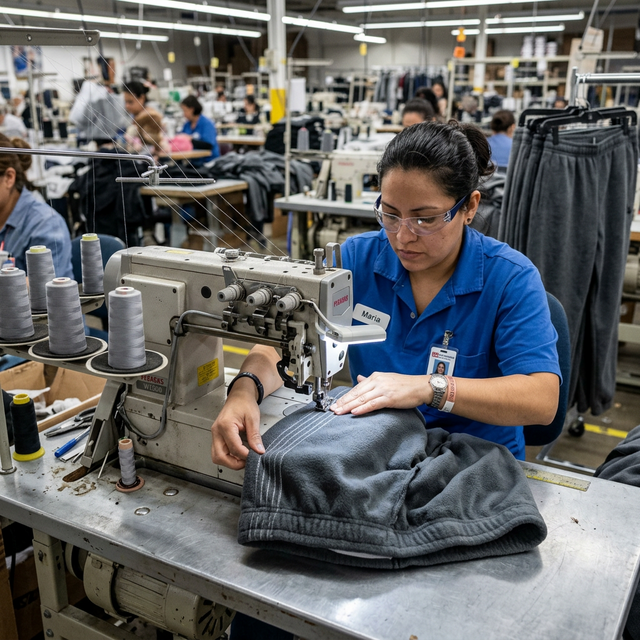
A professional fleece sweatpants OEM prevents this through multi-needle stitched engineering. We don't just insert the elastic; we secure it. Our standard protocol uses multi-needle chain stitch machines to sew directly through the casing and the elastic band simultaneously. This locks the elastic in place across its entire width.
The elastic itself also matters. We source high-tensile, heat-resistant elastic that survives high-temperature dyeing and commercial laundering. It adds a fractional cost to the unit, but it eliminates one of the biggest causes of retail returns.
Perfect Color and GSM Matching Between Body and Ribbed Cuffs
If you are a fleece sweatpants wholesale buyer, you've likely received shipments where the main fleece body and the ribbed ankle cuffs look like they belong to different garments. Because fleece (often a poly-cotton blend) and ribbing (often mostly cotton with heavy spandex) absorb dye differently, getting a perfect match requires advanced dye lot management.
As a dedicated fleece sweatpants supplier, we solve this at the formulation level. We don't dye the ribbing and the fleece in isolated silos. We conduct cross-material dye charting. Because the GSM of the 1x1 or 2x2 ribbing differs significantly from the main body, the tension and dye absorption rates vary. We adjust the dye formulas for each material composition so they converge visually under retail lighting.
We set strict AQL standards for color deviation between components. If the Delta E (color difference) exceeds our internal tolerance, the batch does not move to the cutting room.
Secure Your Next Bulk Production with Confidence
You can't build a scaling apparel business on weak structural foundations. You need a manufacturing partner who understands that the integrity of a waistband or the recovery of a knee joint is just as critical as the final price per unit.
We don't do pressure sales. If you need time to evaluate your options, take that time. But if you are ready to secure a supply chain that protects your brand's reputation, we are ready to build it for you.
Request a technical spec sheet and sample for our bulk fleece sweatpants production today. Let's start a conversation based on quality, capacity, and consistency.
⚡ Common Mistakes to Avoid
Everything You Need to Know
Conclusion