.png?w=970&h=250)
Organic cotton jersey knit fabric: certifications, batch consistency & cost realities for B2B buyers
What It Really Means
What makes organic cotton jersey different at the fiber level
Organic cotton jersey starts with cotton grown without synthetic pesticides, herbicides, or genetically modified seeds. At the fiber level, the staple length and hand feel are often comparable to conventional combed cotton of similar quality.
The real difference isn't in the fiber. It's in the audit trail.
Every kilogram of organic cotton that goes into GOTS-certified fabric — from the farm through ginning, spinning, knitting, dyeing, and finishing — needs to be traceable through a Transaction Certificate (TC). Each TC is issued by an approved certification body, linked to a specific production batch, and verifiable through the GOTS public database.
If that chain breaks anywhere — an uncertified dye house, an undeclared subcontractor, a batch that wasn't tested — the fabric cannot carry the GOTS label. The certification doesn't transfer. You can't apply retroactively. The batch loses its status, full stop.
Brands sourcing at scale need to understand this: GOTS certification is a documentation system, not just a supplier credential. It has to be intact from field to finishing. According to the GOTS official standard, every entity in the processing chain must be independently certified and audited annually — there are no exemptions for subcontractors at volume.
Understanding the cost premium (and where it goes)
A direct buyer comparison: for standard 180–200 GSM cotton jersey at volume (50,000+ yards), you're typically looking at a 20–30% premium for GOTS-certified organic vs. conventional combed cotton. Here's where that cost actually sits:
Certified Organic Cotton Fiber — +8 to 12%
Organic farming yields are lower (typically 20–25% below conventional), and the crop commands a premium from the farm. USDA data for 2025 puts the organic premium at approximately $0.55/lb over conventional. This flows through to the spinning mill.
Compliant Dyeing & Processing — +5 to 8%
GOTS 7.0 (March 2024) introduced stricter restrictions on chemical inputs: formaldehyde must be below 20 ppm in finished fabric, heavy metal limits are tighter, and azo dyes from certain amine groups are prohibited entirely. Compliant reactive dyes and auxiliaries cost more, and not all dye houses are certified. Finding certified capacity that also accepts your quantity — and your color program — takes time.
Certification Overhead — +3 to 6%
Certification bodies charge annual inspection fees. These costs are distributed across production volume, meaning a factory that runs 60% GOTS-certified production builds those costs into certified-batch pricing. Smaller or partial-volume GOTS producers pass a higher overhead per yard.
Lab testing per batch — variable
Most professional buyers require independent third-party testing of each production batch. For GOTS-certified fabric, this typically includes residual chemical testing (OEKO-TEX STANDARD 100 or equivalent) and physical performance: pilling, color fastness, dimensional stability. Budget $200–$400 per test run, and plan for two to three runs per colorway during initial supplier qualification.
These costs aren't unreasonable. They're what real compliance actually costs. The problem comes when a supplier offers "GOTS certified organic jersey" at conventional prices. That gap has to come from somewhere.
GOTS 7.0 in 2024: what changed and why it matters for wholesale buyers
The Global Organic Textile Standard released Version 7.0, effective March 2024. Most buyers haven't fully absorbed the implications.
Key changes relevant to wholesale sourcing:
Stricter chemical management: Version 7.0 expanded the restricted substances list and lowered permissible limits for a range of chemical classes used in wet processing. Suppliers who were compliant under Version 6.0 may need to reformulate or change chemical suppliers to maintain certification. It's worth asking your supplier when they were last recertified and which version their audit covered.
Supply chain traceability requirements: GOTS 7.0 now requires more granular documentation of subcontractors. If a factory subcontracts any processing step (embroidery, printing, supplementary finishing), that subcontractor must be declared and, in most cases, also GOTS-certified. This catches a significant number of nominally-certified producers who quietly outsource dyeing or finishing.
Wholesaler certification thresholds: If you're importing GOTS-certified goods and your annual GOTS-labeled turnover exceeds €20,000, you now need your own certification. Below that threshold, registration with a certification body is required. This is a compliance consideration for sourcing departments, not just for supplier evaluation.
Transaction Certificates are non-negotiable: Each shipment of GOTS-certified goods requires a TC issued for that specific shipment. The TC must reference the correct fabric batch, quantity, and facility. Suppliers who offer to "provide the certificate after production" or who ask you to "use our factory certificate" for your own product labeling are not operating within GOTS protocol.
Eric handles most of our inbound sourcing inquiries. His take on this: "The certificate is the easy part to fake. What you can't fake is the audit trail. If you can't trace the TC through the public GOTS database, the certificate is paper."
For brands sourcing 100% cotton jersey at scale, the sourcing discipline around batch documentation is similar — see our guide on 100% cotton jersey knit fabric wholesale sourcing for how we approach fabric consistency verification on conventional programs.
Batch consistency: the real problem with organic cotton at scale
This is where brands consistently get surprised, especially on their second or third order.
Organic cotton has higher natural fiber variability than conventional combed cotton. Conventional production uses tightly controlled inputs — seed varieties are standardized, fertilizer regimens are consistent, ginning specifications are narrow. Organic farming, particularly when sourced from smaller farms or mixed growing regions, produces cotton with more variation in staple length, micronaire (fiber fineness), and color tone.
That variation flows through to the finished fabric in ways that matter in production:
GSM tolerance control: Organic jersey is harder to hold to tight GSM specifications batch to batch. A 180 GSM order that comes in at 195 GSM across one fabric roll and 168 GSM across another (both within a ±10% tolerance that some suppliers consider acceptable) will cut differently, drape differently, and behave differently in finishing. For brands selling product by weight or with specific performance claims, this is a direct quality risk.
Color consistency: Lab Dip approval is standard practice in quality fabric sourcing. With organic cotton, the dyeability of fibers varies with natural variation in fiber maturity — immature fibers take dye less predictably. This means you may need more Lab Dip rounds to hit a consistent color match, and expect the approved shade to drift slightly across different production batches.
Shrinkage variation: Organic jersey often shows more pre-shrinkage variability. If your production specifications assume a standard 3–5% residual shrinkage after washing, you need to verify that number holds across batches, not just on the initial sample.
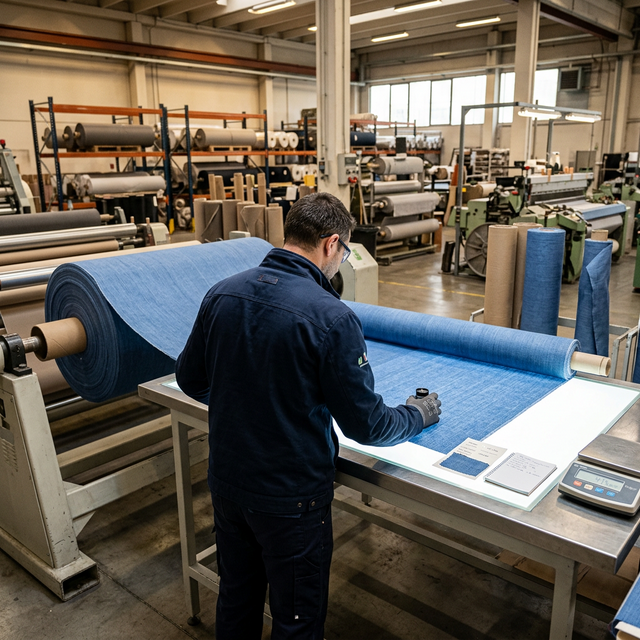
At Fominte, we manage this through tighter pre-production testing. Before dyeing any new organic cotton jersey batch, our floor team tests the greige fabric for GSM tolerance and dye uptake consistency. We reject greige that shows excessive variation before it goes into wet processing — which is cheaper than discovering the problem at inspection.
Shawn has a useful way of framing it: "Organic cotton requires more work to control, not less. The difference is that control has to happen at the fiber stage, not at the finishing stage."
How to evaluate an organic cotton jersey supplier: four questions that matter
Standard supplier qualification applies here. But for organic cotton specifically, four additional questions separate serious suppliers from those selling a label:
1. Can you provide Transaction Certificates for each production batch?
The TC should be searchable in the GOTS public database (you can verify at global-standard.org). If a supplier can't provide a TC or is vague about what a TC is, the GOTS claim isn't real. This applies to both the fabric manufacturer and any subcontracted processing facilities.
2. What is your GSM tolerance specification, and how is it verified?
Ask for the tolerance stated in their quality agreement — not what they "aim for," what they guarantee in writing. Then ask how it's measured and when. Good suppliers test GSM at multiple points per roll, not just at roll ends. A ±3% tolerance held throughout is significantly different from a ±10% tolerance checked once per batch.
3. What is your Lab Dip process, and how many rounds are included in standard pricing?
Two to three Lab Dip approval rounds is industry standard for conventional cotton. For organic cotton in reactive dyeing, budget for three to four. When a supplier includes "unlimited Lab Dips," ask what they actually charge for rounds beyond the third — that tells you whether the first three are genuinely adequate.
4. What is your monthly organic cotton jersey capacity, and how much is currently allocated to GOTS-certified production?
Suppliers who do small volumes of GOTS-certified fabric within a largely conventional facility often have two problems: their GOTS overhead per batch is higher (fewer certified batches to distribute costs across), and their dyeing schedules are less optimized for the chemical management discipline that certified production requires. A supplier running 70–80%+ of their production on GOTS-certified programs has built it into their process rather than treating it as a side option.
FAQ: questions from B2B procurement teams
Is organic cotton jersey worth the premium for mass-market brands?
It depends on what you're marketing. If your brand is making sustainability claims that include fiber sourcing, you need the certification chain to be intact or those claims are greenwashing liability. If you're using organic cotton as a differentiator for premium positioning, the 20–30% fiber cost premium is often recoverable in retail margin. If neither applies — you just want comfortable, responsibly produced fabric without the marketing angle — there are alternative certifications (OEKO-TEX STANDARD 100, Bluesign) that may fit your needs at lower compliance overhead.
How many rounds of Lab Dip approval are standard for organic cotton?
Plan for three to four rounds for a new colorway with a new supplier. For reorders within the same season on an approved shade, one to two rounds is typical if the supplier's dye chemistry and fiber lot haven't changed. Each Lab Dip round adds 5–10 business days. That time needs to be built into your production timeline before greige commits to a colorway. If you're also sourcing stretch cotton jersey in your line, this same timeline logic applies — see our piece on stretch cotton jersey fabric wholesale for more on Lab Dip management across blended programs.
What is the minimum order quantity for GOTS-certified organic jersey?
It varies by supplier. The more useful question is the minimum at which GOTS certification overhead is actually priced in. Smaller production runs (under 3,000–5,000 meters) on GOTS-certified programs typically carry higher per-yard certification costs — the audit overhead doesn't scale down proportionally. Volume above 15,000–20,000 meters per color per season starts to see pricing that genuinely reflects normalized certification costs. If you're sourcing below that range, ask specifically what percentage of the per-yard price is certification overhead versus production cost.
What this looks like in practice
We recently started working with a European activewear brand that was sourcing organic cotton jersey from two separate suppliers — one for their domestic market, one for export to the US. Both suppliers claimed GOTS certification. When the brand's compliance team ran TC verification on both, one supplier's TCs were unverifiable in the public database. The batch had passed internal quality inspection perfectly. The fabric performed well. But the certification trail was broken at the dye house.
They had to replace that supplier mid-season, absorb resampling costs, and delay a product launch by six weeks. The premium they thought they were paying for was never there.
The fabric itself doesn't look different. That's the point. Compliance verification is procurement work, not manufacturing work.
If your brand is building sustainable positioning that includes fiber sourcing claims, the documentation foundation matters as much as the material. A supplier who can show you an intact TC chain, who talks specifically about GSM tolerance management and Lab Dip rounds, and who can verify their certification bodies by name through the public database — that's a supplier who's actually running GOTS-certified production.
Working with Fominte on organic cotton jersey sourcing
Our organic cotton jersey production runs on GOTS-certified programs. Every batch carries a verifiable Transaction Certificate, and we test greige fabric for GSM consistency before committing to wet processing. Our standard tolerance for jersey fabric is ±3% GSM across the fabric roll.
For brands sourcing above 50,000 yards annually, we can provide our GOTS-certified batch consistency data, including our Lab Dip SOP and standard GSM tolerance verification procedure.
Email info@fominte.com with your annual volume forecast and compliance requirements. I'll make sure Eric's team gets back to you within 24 hours.
When to Use & Avoid
GOTS certification is essential
✅ Use When
- Brands making sustainability claims in marketing or labeling
⚠️ Avoid When
- Brands who want organic fiber for comfort only, without marketing claims
OEKO-TEX STANDARD 100 sufficient
✅ Use When
- Brands needing chemical safety verification without full supply-chain traceability
⚠️ Avoid When
- Brands requiring complete organic fiber documentation
Budget for 3-4 Lab Dip rounds
✅ Use When
- New supplier, new colorway, organic cotton reactive dyeing
⚠️ Avoid When
- Reorders with same supplier and approved shade from prior season
Audit supplier's GOTS TC carefully
✅ Use When
- All sourcing above 50,000 yards where GOTS compliance is a product claim
⚠️ Avoid When
- Smaller spot buys where certification overhead isn't commercially viable
⚡ Common Mistakes to Avoid
Everything You Need to Know
Conclusion